
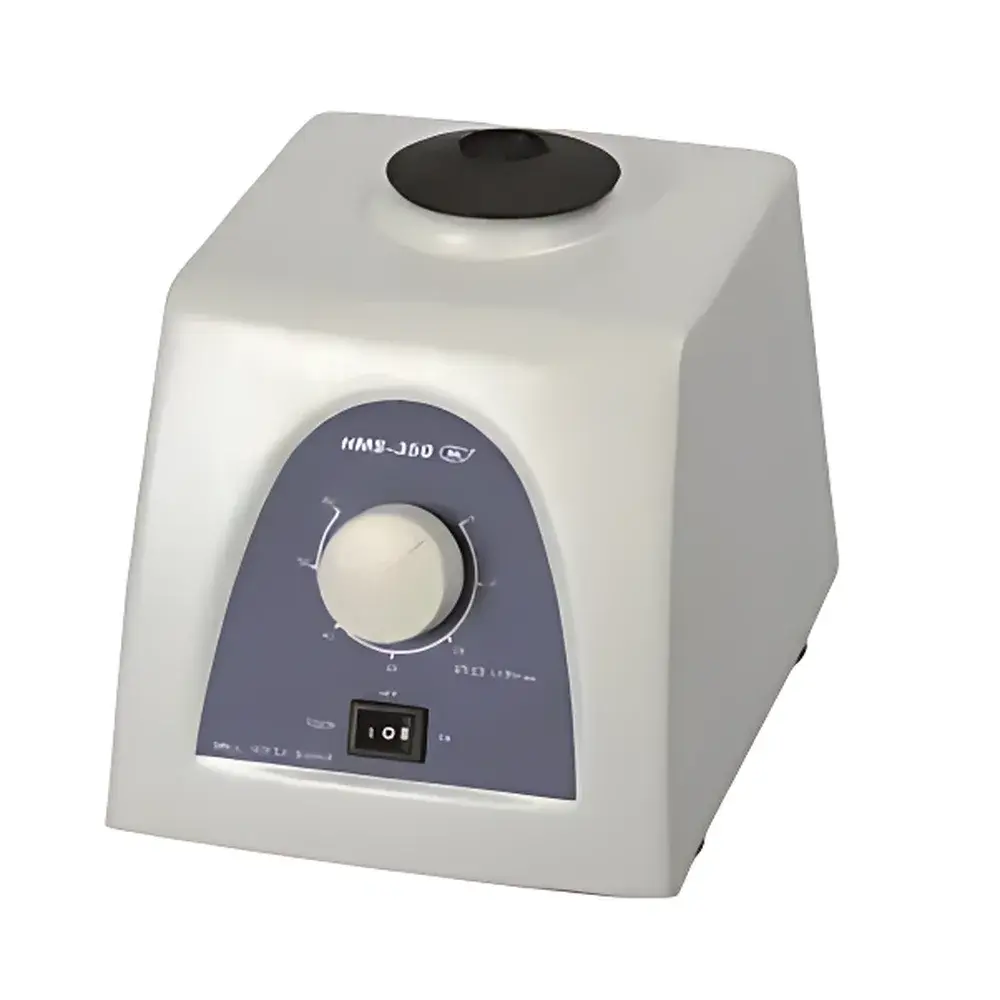
HengAo HMS-350 Compact Vortex Mixer
| Brand | HengAo |
|---|---|
| Model | HMS-350 |
| Type | Vortex Mixer |
| Speed Range | 0–3000 rpm |
| Motor Power | 15 W |
| Orbit Diameter | 4 mm |
| Platform Diameter Options | 25.4 mm (single-tube) or 88.9 mm (multi-tube) |
| Max Load Capacity | 1 kg |
| Housing Material | Powder-coated aluminum alloy |
| Contact Materials | Stainless steel (304) |
| Compliance | CE-marked for laboratory use |
| Power Supply | 100–240 VAC, 50/60 Hz |
Overview
The HengAo HMS-350 Compact Vortex Mixer is an entry-level, high-reliability vortex shaker engineered for consistent sample homogenization in life science and analytical laboratories. It operates on the principle of orbital shaking—generating a rapid circular motion with a fixed 4 mm orbit diameter—to induce vigorous vortexing in tubes and vials without requiring manual intervention. Unlike centrifugal or reciprocating shakers, the HMS-350 delivers controlled, repeatable mixing energy ideal for applications where gentle yet effective suspension, resuspension, or dissolution is required—particularly in low-volume liquid handling workflows such as reagent preparation, cell suspension, enzyme reaction initiation, and solid-phase extraction support. Its compact footprint (120 × 120 × 145 mm) and lightweight design (<2.5 kg) make it suitable for benchtop deployment in biosafety cabinets, cold rooms, and shared core facilities.
Key Features
- Brushless DC motor ensures maintenance-free operation, low electromagnetic interference, and long-term speed stability across the full 0–3000 rpm range—critical for reproducible mixing kinetics in QC and R&D environments.
- Interchangeable platform inserts: a 25.4 mm-diameter single-tube cup for precise 0.2–15 mL tube mixing, and an 88.9 mm multi-position platform accommodating up to six 15 mL conical tubes or twelve 1.5 mL microcentrifuge tubes simultaneously.
- Corrosion-resistant construction: powder-coated aluminum alloy housing provides mechanical rigidity and thermal dissipation, while all fluid-contact surfaces—including platform cups, clamps, and base components—are fabricated from AISI 304 stainless steel to withstand repeated exposure to organic solvents, acids, and alkaline buffers.
- No built-in timer; designed for manual activation via momentary contact switch—supporting flexible, operator-defined mixing durations aligned with SOP-driven protocols.
- Low-noise operation (<45 dB at 2000 rpm) and minimal vibration transmission to adjacent instrumentation, enabling stable placement on sensitive balances or optical tables.
Sample Compatibility & Compliance
The HMS-350 accommodates standard laboratory consumables including polypropylene and polycarbonate tubes (0.2–50 mL), glass vials (up to 20 mL), and PCR strip tubes. It is compatible with common biological matrices—aqueous buffers, cell lysates, protein solutions, and viscous reagents up to ~100 mPa·s viscosity. The device complies with IEC 61010-1:2010 for electrical safety in laboratory equipment and carries CE marking for conformity with EU health, safety, and environmental protection standards. While not certified under ISO/IEC 17025 or GLP-specific validation frameworks, its mechanical consistency supports internal method qualification per ASTM D5576 (Standard Practice for Evaluating Mixing Efficiency of Laboratory Shakers) and facilitates documentation of operational parameters for audit readiness.
Software & Data Management
The HMS-350 is a standalone analog instrument with no embedded firmware, connectivity ports, or software interface. This architecture eliminates cybersecurity risks, reduces validation burden, and ensures deterministic behavior across instrument lifecycles—making it suitable for regulated environments where traceability is maintained through procedural controls rather than electronic records. Users log operating conditions (e.g., speed setting, duration, tube type) manually in lab notebooks or LIMS-integrated electronic batch records. For labs implementing 21 CFR Part 11 compliance, the absence of digital data generation simplifies system boundary definition and avoids requirements for audit trails, electronic signatures, or access control configuration.
Applications
- Routine sample homogenization prior to centrifugation, filtration, or chromatographic injection.
- Resuspension of lyophilized reagents, bacterial pellets, and magnetic beads in immunoassay and nucleic acid purification workflows.
- Accelerating solvent-based extractions (e.g., phenol-chloroform DNA isolation) and adsorption/desorption steps in solid-phase extraction cartridges.
- Preparing uniform suspensions for particle size analysis (e.g., dynamic light scattering) and flow cytometry calibration standards.
- Supporting quality control testing in pharmaceutical manufacturing, including excipient blending verification and dissolution media conditioning per USP <711>.
FAQ
Does the HMS-350 support programmable timing or speed ramping?
No. It features a manual on/off rocker switch and analog speed dial—intentionally omitting digital controls to maximize reliability and minimize failure modes.
Can it be used with sealed tubes under pressure or vacuum?
Yes, provided tube caps are rated for vortex-induced shear stress; however, over-pressurized or evacuated vessels must be validated for mechanical integrity prior to use.
Is calibration required before use?
Speed calibration is recommended upon installation and annually thereafter using a non-contact tachometer traceable to NIST standards; no factory recalibration service is offered.
What maintenance is needed for long-term operation?
None beyond periodic wiping of the platform and housing with 70% ethanol; the brushless motor requires no lubrication or carbon brush replacement.
Is the HMS-350 suitable for GMP-regulated environments?
Yes—as a Class I, non-critical ancillary device, it may be included in equipment qualification (IQ/OQ) protocols when used within validated processes, provided usage parameters are documented and reviewed during internal audits.



