
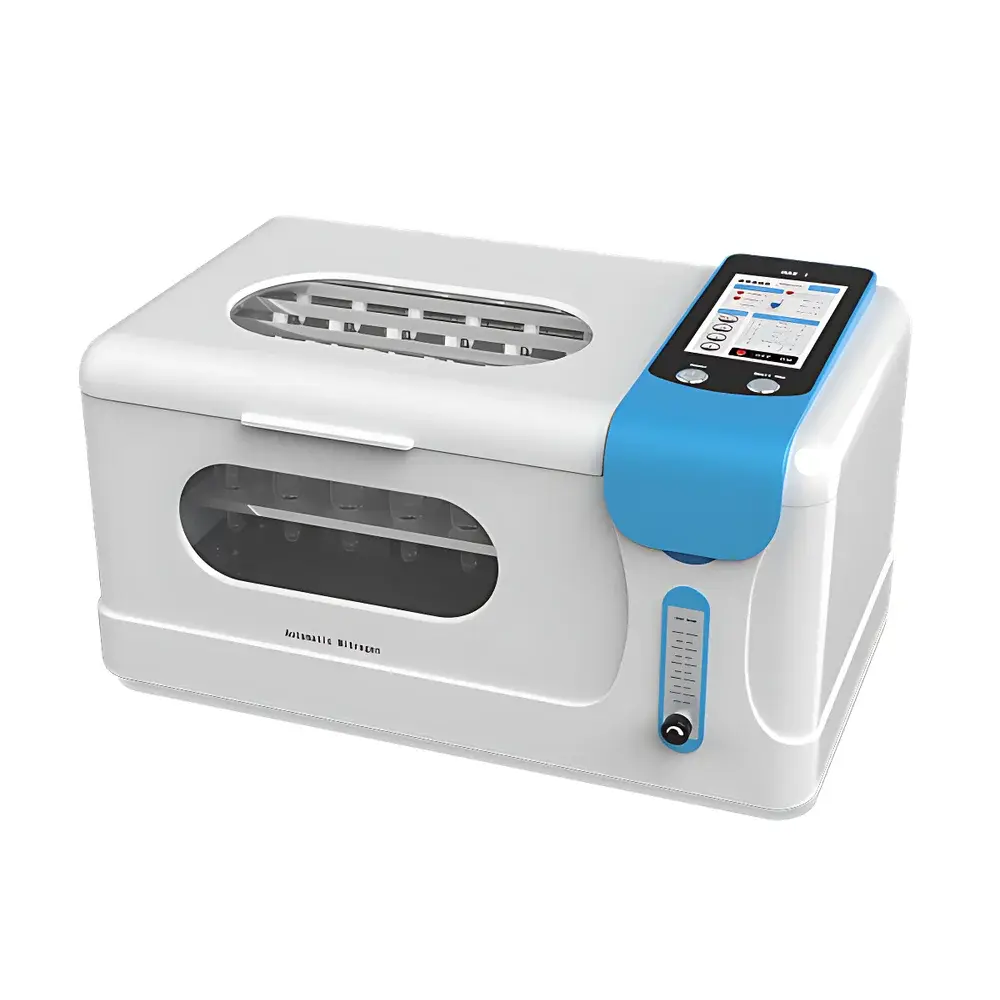
HengAo HAC-24A Automated Parallel Nitrogen Evaporator
| Brand | Tianjin HengAo |
|---|---|
| Origin | Tianjin, China |
| Manufacturer Type | Direct Manufacturer |
| Country of Origin | China |
| Model | HAC-24A |
| Heating Method | Water Bath |
| Temperature Range | Ambient +5°C to 99.9°C |
| Temperature Stability | ±0.1°C (typical), ±0.5°C (max) |
| Sample Capacity | 24 × 40 mL / 12 × 100 mL / 6 × 200 mL |
| Gas Flow Rate | 0–15 L/min |
| Heating Power | 800 W |
Overview
The HengAo HAC-24A Automated Parallel Nitrogen Evaporator is an engineered solution for high-throughput, reproducible solvent removal in analytical and preparative laboratories. It operates on the principle of inert gas-assisted evaporation—using precisely controlled nitrogen flow to accelerate solvent volatilization while minimizing sample oxidation, thermal degradation, or cross-contamination. Unlike manual or semi-automated nitrogen blow-down systems, the HAC-24A integrates closed-loop temperature regulation, programmable gas delivery, and optical fiber-based endpoint detection to enable unattended, protocol-driven concentration across up to 24 samples simultaneously. Designed for compliance-critical environments, its architecture supports traceable operation under GLP and ISO/IEC 17025 frameworks, with thermal uniformity validated across the water bath zone per ASTM E2251-22 guidelines for liquid bath temperature uniformity testing.
Key Features
- Automated endpoint detection via optical fiber sensor: Real-time monitoring of liquid meniscus recession enables precise termination of nitrogen flow upon solvent depletion—eliminating over-evaporation and improving analyte recovery consistency.
- Triple-configurable sample capacity: Switch between 24 positions for 40 mL tubes, 12 for 100 mL, or 6 for 200 mL vials without hardware modification—optimized for diverse throughput requirements in QC, environmental, and forensic labs.
- High-stability water bath heating: PID-controlled system maintains temperature within ±0.1°C (typical) across the full range (ambient +5°C to 99.9°C), with independent calibration ports for third-party verification.
- Adjustable nitrogen flow control: Digital mass-flow regulated output (0–15 L/min) ensures consistent gas velocity across all channels; flow profiles can be saved per method to support multi-analyte workflows.
- Modular gas distribution manifold: Stainless steel and PTFE-wetted components resist corrosion from organic solvents and acidic vapors; each channel features individual flow shut-off valves for maintenance isolation.
- Integrated safety interlocks: Overtemperature cutoff, low-water-level sensor, and gas pressure monitoring prevent operational hazards during extended unattended runs.
Sample Compatibility & Compliance
The HAC-24A accommodates standard conical-bottom and flat-bottom glass or polypropylene tubes (40 mL, 100 mL, 200 mL), compatible with common extraction formats used in EPA Method 525.3 (drinking water), ISO 18856 (environmental water), and USP residual solvent analysis. Its design conforms to IEC 61010-1:2010 for laboratory electrical equipment safety, and the water bath enclosure meets IP20 ingress protection requirements. While not certified for Class I Div 1 hazardous locations, it is routinely deployed in fume hoods compliant with ANSI Z9.5–2022 ventilation standards. Data integrity features—including user-accessible audit logs and timestamped method files—support alignment with FDA 21 CFR Part 11 expectations when paired with validated LIMS integration.
Software & Data Management
The instrument operates via embedded firmware with a tactile LCD interface supporting method creation, parameter recall, and real-time status visualization (bath temperature, gas flow, elapsed time). No proprietary PC software is required for basic operation; however, optional RS-232 or USB-to-serial connectivity allows integration into centralized lab automation platforms (e.g., Thermo Fisher SampleManager, LabVantage). All method parameters—including ramp profiles, dwell times, and endpoint thresholds—are stored in non-volatile memory with write-protection options. Audit trails record operator ID, start/stop timestamps, and critical alarm events (e.g., bath temperature deviation >0.5°C for >30 s), facilitating internal QA reviews and external inspection readiness.
Applications
- Environmental analysis: Concentration of pesticide residues, PAHs, and PCBs from large-volume water extracts prior to GC-MS or LC-MS/MS analysis.
- Pharmaceutical quality control: Residual solvent removal from API intermediates per ICH Q3C guidelines, with documented thermal history for batch release documentation.
- Food safety testing: Cleanup of acrylamide or mycotoxin extracts from complex matrices (e.g., coffee, cereals) where oxidation-sensitive analytes demand inert atmosphere handling.
- Forensic toxicology: Parallel processing of blood or urine samples for drug metabolite enrichment, meeting SWGTOX validation criteria for reproducibility (RSD <5% across n=6 replicates).
- Academic research: High-efficiency sample prep for metabolomics and lipidomics workflows requiring consistent evaporation kinetics across biological replicates.
FAQ
Is the HAC-24A suitable for use with chlorinated solvents such as chloroform or methylene chloride?
Yes—the gas manifold and tube holder are constructed from chemically resistant materials (316 stainless steel, PTFE, borosilicate glass-compatible polymers) and have been verified for compatibility with halogenated solvents under standard operating conditions.
Can the optical endpoint sensor be recalibrated by the end user?
No—sensor calibration is performed at the factory using NIST-traceable reference menisci; field verification is possible via the included calibration check kit (part no. HAC-CAL-KIT), but adjustment requires authorized service personnel.
Does the system support remote monitoring or alarm notification?
Not natively; however, dry-contact relay outputs (included) can interface with building management systems or PLCs to trigger audible/visual alerts or log events in external SCADA environments.
What maintenance intervals are recommended for sustained accuracy?
Water bath fluid should be replaced every 3 months or after 200 operational hours; nitrogen filter cartridges require replacement every 6 months or 1,000 L of gas flow—whichever occurs first.
Is validation documentation available for GMP-regulated laboratories?
Yes—IQ/OQ protocols, DQ templates, and a complete set of test certificates (temperature uniformity, flow linearity, endpoint repeatability) are provided with each unit upon request and installation qualification support is available through HengAo’s global service network.



