
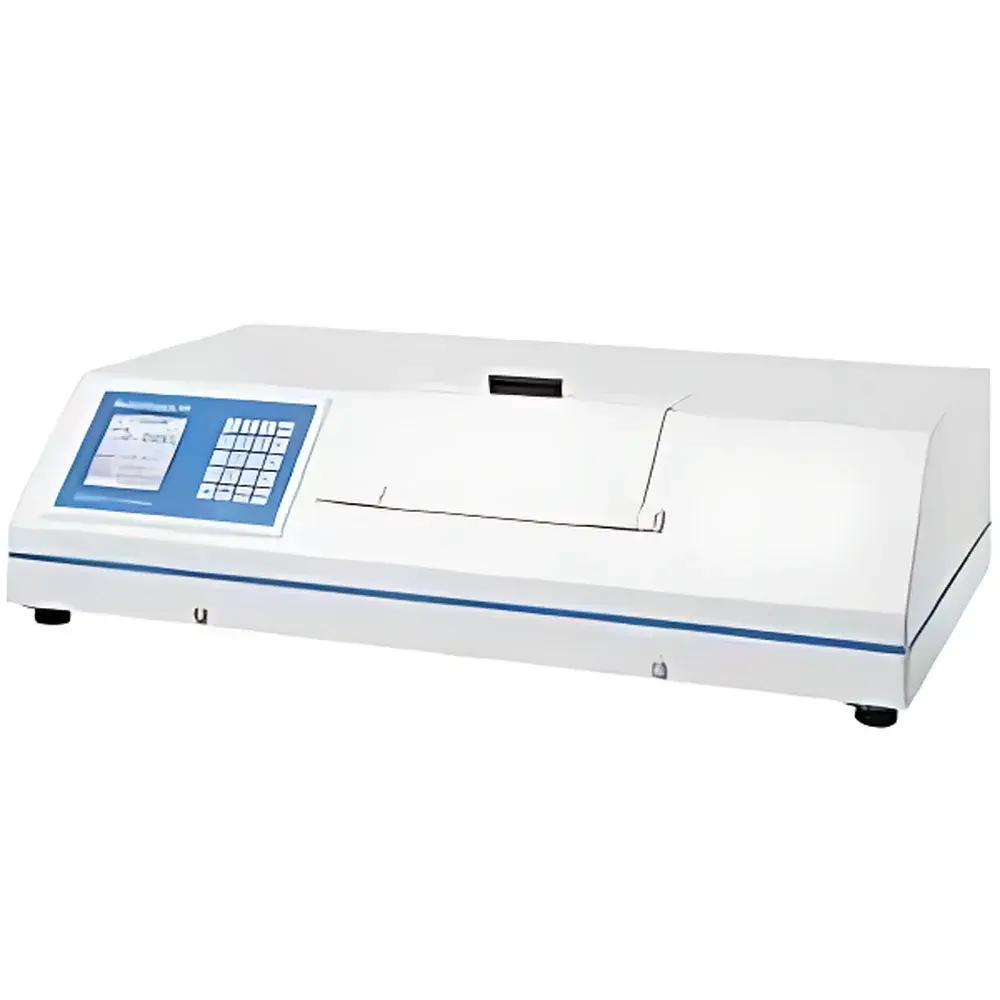
Schmidt+Haensch Polartronic H532 High-Precision Digital Polarimeter
| Brand | Schmidt+Haensch (S+H) |
|---|---|
| Country of Origin | Germany |
| Model | H532 |
| Measurement Range | ±360° / 259°Z |
| Resolution | 0.0001° / 0.01°Z |
| Accuracy | ±0.002° / ±0.01°Z |
| Repeatability | ±0.001° / ±0.01°Z |
| Sensitivity | OD 5 |
| Measurement Time | <4 s (full range, uniform performance) |
| Sample Cell Options | 10, 50, 100, 200 mm standard tubes + micro cells |
| Light Sources | Sodium lamp (589.3 nm), Mercury lamp (365 nm, 404.7 nm, 435.8 nm, 546.1 nm), or high-stability LED (lifetime >100,000 h) |
| Wavelength Options | Up to 5 discrete wavelengths from 365 nm to 589 nm |
| Compliance | ICUMSA, OIML R 102, Australian Standard K 157, USP <781>, Ph. Eur. 2.2.7, JP 2.05, FDA 21 CFR Part 11 (audit trail & electronic signature ready), GLP/GMP traceable operation |
Overview
The Schmidt+Haensch Polartronic H532 is a high-precision digital polarimeter engineered for metrological-grade optical activity measurement in regulated and research-intensive environments. It operates on the principle of automatic null-balance detection using a photoelastic modulator (PEM) and lock-in amplifier architecture—eliminating mechanical rotation of optical components and delivering direct digital readout of angular rotation. Unlike traditional half-shade or manual polarimeters, the H532 employs a solid-state, drift-compensated optical path with temperature-stabilized light sources and real-time polarization feedback control. This design ensures uniform accuracy across the full ±360° angular range—without interpolation, calibration offset, or range-dependent uncertainty—a capability unique to Schmidt+Haensch among commercial polarimeter manufacturers. The instrument is purpose-built for applications requiring traceable, repeatable, and auditable measurements under ISO/IEC 17025, GMP, and pharmacopeial frameworks.
Key Features
- True full-range precision: ±0.002° absolute accuracy maintained uniformly from –360° to +360°, verified per OIML R 102 Annex C protocols
- Multi-wavelength capability: Configurable with up to five discrete wavelengths (365 nm, 404.7 nm, 435.8 nm, 546.1 nm, 589.3 nm) via interchangeable spectral filters or integrated LED modules
- Dual-source flexibility: Factory-integrated sodium or mercury vapor lamps (narrow-band, NIST-traceable emission lines) or long-life LED (≥100,000 h, no warm-up time, zero spectral drift)
- Sub-millisecond response: Full-scale measurement completed in <4 seconds with <0.001° repeatability (n ≥ 10, 23 °C ±0.5 °C, stable ambient)
- Optical density tolerance: Capable of measuring samples up to OD 5 without signal saturation or dynamic range compression
- Rugged monolithic aluminum housing with EMI-shielded electronics, IP20-rated enclosure, and passive thermal management
- Built-in non-volatile memory: Stores ≥10,000 measurement records with timestamp, wavelength ID, cell length, operator code, and environmental metadata
Sample Compatibility & Compliance
The Polartronic H532 accommodates standard sample cells (10 mm, 50 mm, 100 mm, 200 mm path lengths) as well as micro-volume cells (down to 50 µL). Its optical train is optimized for aqueous, alcoholic, and organic solvent-based solutions—including viscous syrups, essential oils, and pharmaceutical suspensions—with minimal birefringence interference. All measurement protocols comply with internationally recognized standards: ICUMSA Method GS7–12 (sugar industry), OIML R 102 Class 0.002 (highest metrological class for polarimeters), Australian Standard AS K157, and pharmacopeial methods (USP , Ph. Eur. 2.2.7, JP 2.05). The system supports 21 CFR Part 11 compliance through optional software packages that provide electronic signatures, role-based access control, audit trails with immutable timestamps, and data integrity validation per ALCOA+ principles.
Software & Data Management
The instrument interfaces via USB 2.0 or Ethernet with PolarSoft™ v5.x—Schmidt+Haensch’s validated PC application for instrument control, method definition, and data export. PolarSoft enables automated ORD (optical rotatory dispersion) acquisition across multiple wavelengths, concentration series analysis with built-in specific rotation calculation (αD20), and batch reporting compliant with LIMS integration (ASTM E1482, ASTM E2500). Raw data are stored in vendor-neutral CSV and XML formats; metadata include temperature (via optional Peltier-controlled cell holder), atmospheric pressure, relative humidity, and operator ID. All firmware updates undergo IEC 62304-compliant verification and are digitally signed.
Applications
- Pharmaceutical QC: Identity confirmation and assay of chiral APIs (e.g., levodopa, ibuprofen, chloramphenicol), enantiomeric excess (ee) determination, and stability-indicating assays per ICH Q5C
- Food & Beverage: Sucrose concentration in cane/beet sugar solutions (ICUMSA), lactose quantification in dairy products, citric acid and tartaric acid profiling in wines and juices
- Chemical Synthesis: Monitoring asymmetric catalysis reactions, kinetic resolution studies, and polymer tacticity assessment via specific rotation trends
- Cosmetic Raw Materials: Purity verification of limonene, menthol, camphor, and other optically active terpenes per ISO 8556
- Clinical Research: Quantitative analysis of urinary glucose (using enzymatic amplification coupled to polarimetric endpoint detection) and D-/L-amino acid ratios in metabolic profiling
FAQ
Does the Polartronic H532 require periodic recalibration with quartz control plates?
No. The instrument’s self-referencing optical architecture and spectral-lamp-based wavelength definition eliminate the need for mechanical or empirical calibration—only annual verification against NIST-traceable sucrose standards is recommended per ISO/IEC 17025.
Can the H532 measure samples with high turbidity or particulate content?
Yes—up to OD 5 at 589 nm—but scattering effects must be assessed separately; for highly turbid matrices, use of matched reference cells and baseline subtraction protocols is advised.
Is temperature control integrated into the base model?
Temperature regulation is available via optional Peltier-controlled cell holders (±0.1 °C stability) or external recirculating baths; the base unit includes a high-accuracy RTD sensor for ambient temperature compensation.
How is data integrity ensured during power interruption or software crash?
All measurements are written to non-volatile flash memory prior to display; unsaved data buffers are retained across reboots, and file writes follow POSIX fsync semantics to prevent corruption.
What documentation is supplied for regulatory submissions?
Factory-issued IQ/OQ documentation, 21 CFR Part 11 readiness report, EU Declaration of Conformity (CE), and ISO 9001-certified manufacturing traceability records are provided with each unit.






