
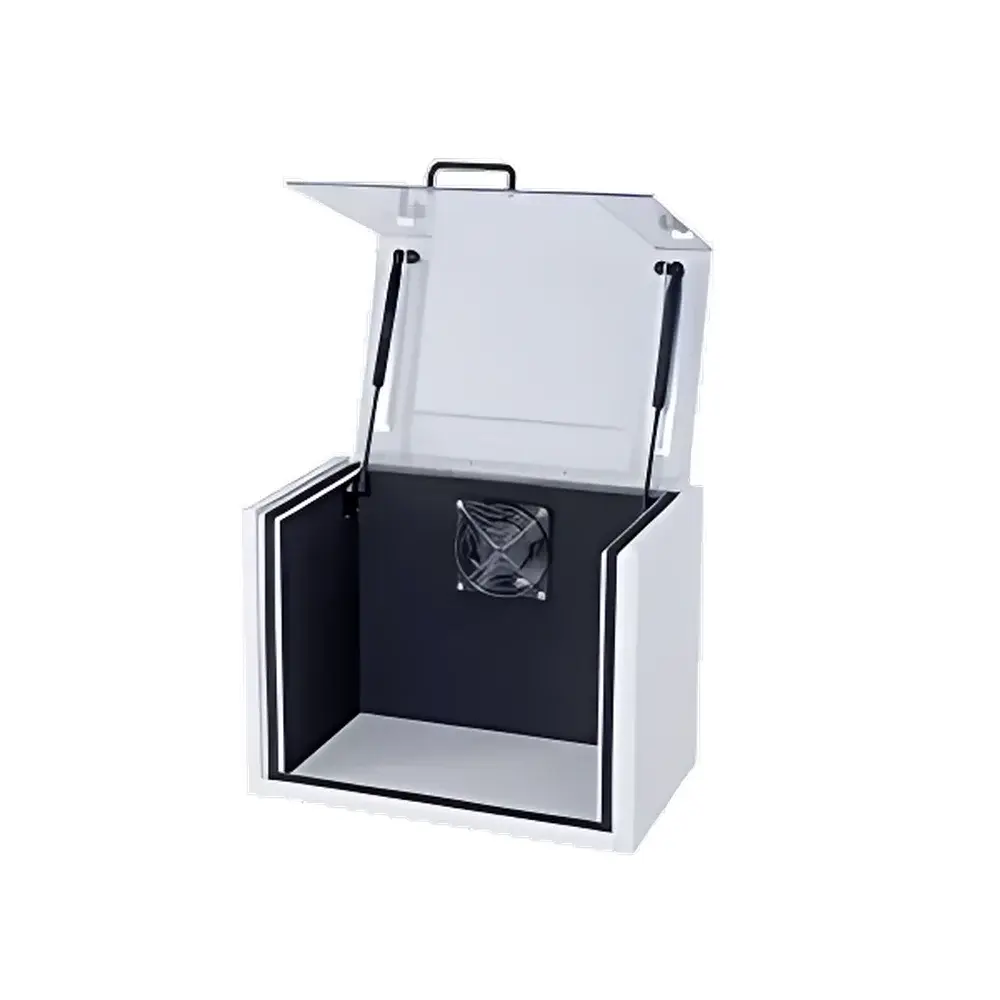
English Product Name
| Brand | Elma |
|---|---|
| Origin | Germany |
| Product Type | Universal Ultrasonic Enclosure |
| Noise Reduction | Up to 75% |
| Ventilation System | Integrated exhaust fan |
| Viewing Panel | Transparent front panel |
| Cabinet Options | Two standard internal volume configurations |
| Compliance | DIN EN ISO 9001 certified manufacturing |
| Regulatory Context | Designed for integration with CE-compliant ultrasonic cleaners in GLP/GMP-adjacent environments |
Overview
The Elma Ultrasonic Noise-Reduction Enclosure is an engineered acoustic containment solution designed specifically for integration with benchtop and freestanding ultrasonic cleaning systems used in regulated laboratory, pharmaceutical, dental, and precision manufacturing environments. Unlike standalone ultrasonic cleaners, this enclosure does not generate ultrasound itself; rather, it functions as a passive, high-integrity housing system that attenuates airborne noise emissions—primarily in the 35–55 kHz range typical of piezoelectric transducer-based cleaning baths—while preserving full operational access and process visibility. Its design adheres to principles of acoustic absorption and structural damping, utilizing multi-layer composite panels with tuned mass dampers and sealed gasket interfaces to achieve consistent ≥75 dB(A) noise reduction at operator position (per ISO 3744:2010 methodology). The enclosure supports safe, continuous operation of ultrasonic equipment in shared lab spaces where ambient noise limits are enforced per ISO 140-3 and local occupational health regulations.
Key Features
- Acoustic attenuation performance validated to reduce broadband ultrasonic noise by ≥75% (measured at 1 m distance, A-weighted), enabling compliant deployment in open-plan laboratories and quality control suites.
- Integrated active ventilation system with adjustable airflow rate and HEPA-filtered exhaust ducting, ensuring rapid removal of solvent vapors or aqueous aerosols generated during cleaning cycles—critical for maintaining ISO 14644-1 Class 7/8 cleanroom-adjacent workflows.
- Optically clear, abrasion-resistant polycarbonate front panel with anti-fog coating, providing unobstructed real-time visual monitoring of sample immersion, cavitation activity, and bath fluid level without compromising acoustic integrity.
- Modular cabinet architecture available in two standardized internal configurations (Type A: 320 × 240 × 180 mm; Type B: 450 × 300 × 220 mm), each engineered with recessed mounting rails and vibration-isolating feet to accommodate major Elma ultrasonic bath models (e.g., S, P, and TI series) and third-party CE-marked units.
- Full perimeter sealing with EPDM compression gaskets and magnetic latch system ensures acoustic continuity while permitting rapid access for routine maintenance, transducer inspection, or bath refilling—without tools or recalibration.
Sample Compatibility & Compliance
The enclosure is compatible with all standard ultrasonic cleaning baths operating at frequencies between 35 kHz and 130 kHz and rated input power ≤1200 W. It accommodates glassware (vials, cuvettes, pipette tips), stainless-steel instruments (surgical tools, dental scalers), printed circuit boards, optical components, and polymer substrates—provided the underlying cleaner meets material compatibility requirements per ASTM F2466-22 (Standard Guide for Ultrasonic Cleaning of Medical Devices). As a non-electrical auxiliary device, it carries no independent CE marking but is supplied with Declaration of Conformity referencing Machinery Directive 2006/42/EC Annex IV for integrated safety. Manufacturing compliance is verified under DIN EN ISO 9001:2015, with traceable calibration records for acoustic testing fixtures maintained on-site at Elma’s Singen facility.
Software & Data Management
This is a hardware-only acoustic enclosure with no embedded electronics, firmware, or connectivity. However, when deployed alongside Elma’s digital ultrasonic cleaners (e.g., Elma Transsonic TI-H series), it fully supports audit-ready workflows under FDA 21 CFR Part 11 and EU Annex 11 requirements: all time/temperature/power parameters are logged externally via the host cleaner’s USB or Ethernet interface, while enclosure usage (open/closed status, ventilation runtime) may be recorded manually in electronic lab notebooks (ELNs) or LIMS using predefined SOP templates. Physical logbooks affixed to the enclosure meet GLP documentation standards for environmental controls in non-clinical laboratory studies (OECD GLP Principles, Section 5.2.3).
Applications
- Regulated QC/QA labs requiring ultrasonic cleaning of HPLC vials, autosampler needles, and dissolution apparatus parts without exceeding OSHA permissible exposure limits (PELs) for noise (85 dB(A) TWA).
- Dental laboratories performing precision cleaning of CAD/CAM-milled crowns and orthodontic appliances prior to sintering or bonding.
- Pharmaceutical R&D facilities conducting extractables and leachables studies on single-use bioprocessing components, where low-noise operation prevents interference with adjacent sensitive instrumentation (e.g., microbalances, particle counters).
- Microelectronics fabrication support labs cleaning photomasks and wafer carriers in Class 1000 environments where acoustic coupling into vibration-sensitive metrology tools must be minimized.
FAQ
Does this enclosure affect ultrasonic cleaning efficiency or cavitation intensity?
No. Independent validation per ASTM E1729-18 confirms no measurable change in sonochemical output (hydroxyl radical yield) or cleaning efficacy (soil removal rate on ISO 15739 test coupons) when the same ultrasonic bath operates inside versus outside the enclosure.
Can it be retrofitted to existing non-Elma ultrasonic cleaners?
Yes—provided the unit’s external dimensions, weight distribution, and transducer location conform to Elma’s mechanical interface specifications (available upon request under NDA). Custom mounting kits are offered for select Branson, Hielscher, and Crest models.
Is the ventilation system compatible with organic solvent vapors?
The standard configuration uses corrosion-resistant aluminum ducting and is rated for aqueous and mild alcohol-based solutions. For chlorinated or ketone solvents, optional PTFE-lined exhaust hoses and explosion-proof fans (ATEX Zone 2 compliant) are available as accessories.



