
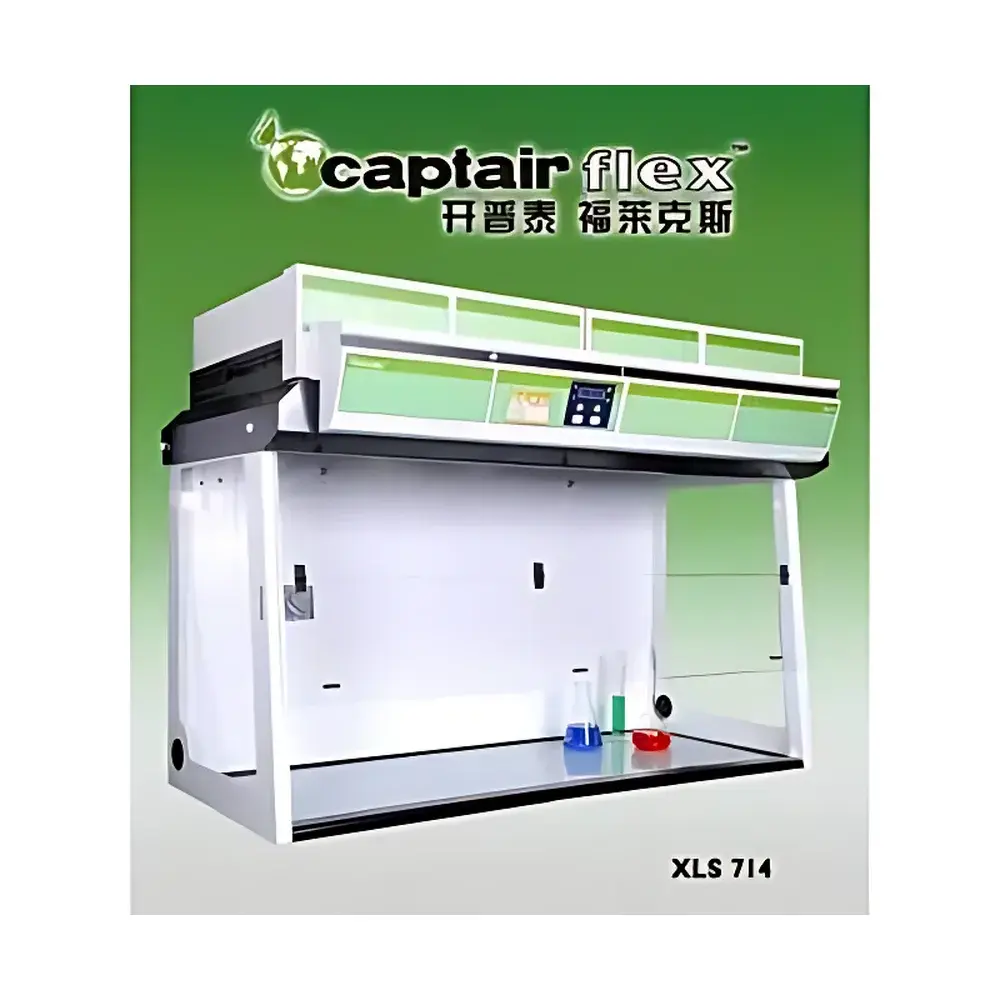
Erlab XLS714 Plug-and-Play Ductless Fume Hood
| Brand | Erlab |
|---|---|
| Origin | France |
| Model | XLS714 |
| Construction | All-Steel Enclosure |
| Configuration | Double-Faced Operation |
| Airflow Capacity | 920 m³/h |
| Face Velocity Range | 0.4–0.6 m/s (per AFNOR NF X 15-211:2009) |
| Filter System | Dual-Stage Molecular Filtration (Class 1 per NFX 15-211) |
| Power Consumption | 235 W |
| Input Voltage | 100–240 V AC, 50–60 Hz |
| Internal Control Voltage | 24 V DC |
| Noise Level | 61 dB(A) |
| Dimensions (L×W×H) | 1800 × 790 × 1316–1500 mm (external), 1697 × 692 × 1014 mm (internal) |
| Lighting | IP67-rated fluorescent lamp(s), 18 W, ≥500 lux |
| Compliance | AFNOR NF X 15-211:2009, NFX 15-211 SGS-certified, TÜV/Intertek validation reports available |
Overview
The Erlab XLS714 is a Class 1 ductless fume hood engineered for high-reliability chemical containment in modern laboratories where infrastructure flexibility, energy efficiency, and regulatory compliance are critical. Unlike conventional ducted hoods that exhaust conditioned air outdoors—requiring costly HVAC make-up air—the XLS714 employs a closed-loop recirculation system based on active molecular adsorption. Ambient laboratory air is drawn inward across the work surface at a controlled face velocity of 0.4–0.6 m/s (validated per AFNOR NF X 15-211:2009), passes through a dual-stage molecular filtration module, and is returned to the room as purified air. This principle eliminates external ductwork, reduces building energy load by up to 85% compared to traditional systems, and supports sustainable lab operations without compromising personnel or environmental safety.
Key Features
- Dual-Stage Molecular Filtration Architecture: Two identical, independently replaceable molecular filter cartridges—mounted above and below the fan assembly—provide redundant chemical capture. Should the lower filter reach saturation (monitored via timed intervals or optional Melecode® S sensor), the upper filter remains fully active, maintaining continuous containment integrity with zero breakthrough risk.
- Integrated Kaptech® Flex™ Digital Control Panel: A centralized, microprocessor-driven interface manages airflow regulation, real-time face velocity monitoring, filter service scheduling (0–250-hour programmable timer), audible/visual alarms for airflow deviation or filter saturation, and maintenance logging—all compliant with GLP audit-trail requirements.
- In-Situ Filter Saturation Verification Port: Equipped with a dedicated sampling port enabling rapid qualitative assessment using colorimetric indicator tubes (e.g., Dräger or equivalent), allowing technicians to verify effluent air purity without disassembly or downtime.
- Ergonomic Work Surface Design: Angled front sash (15° tilt), elliptical and trapezoidal access openings, arc-shaped workbench edge, and central splash guard collectively optimize operator posture, arm mobility, and splash containment during liquid handling and powder weighing procedures.
- Energy-Efficient & Infrastructure-Agnostic Deployment: Operates on standard 100–240 V AC input; internal 24 V DC logic ensures electrical safety. Requires no external ducting, HVAC coordination, or structural modification—installation completed in ≤30 minutes with plug-and-play readiness.
Sample Compatibility & Compliance
The XLS714 is validated for routine handling of volatile organic compounds (VOCs), aqueous reagents, low-hazard particulates (e.g., salts, catalysts), and light dusting operations such as analytical weighing. It is not intended for perchloric acid, hydrofluoric acid, radioactive isotopes, or high-boiling-point solvents (>200 °C flash point) without prior Erlab application review and custom filter configuration. Certification documentation includes third-party SGS and Intertek test reports confirming performance against NFX 15-211 (France’s national standard for ductless fume hood classification) and alignment with ISO 15755:2022 (laboratory ventilation—performance testing of local exhaust devices). The unit meets CE marking requirements and conforms to IEC 61000-6-3 (EMC) and IEC 61000-6-2 (immunity).
Software & Data Management
Kaptech® Flex™ firmware supports non-volatile event logging—including airflow deviations, filter runtime accumulation, alarm triggers, and manual override actions—with timestamped records exportable via USB. While the base system does not include cloud connectivity, its data schema is compatible with laboratory information management systems (LIMS) via Modbus RTU (RS-485 optional add-on). All operational parameters adhere to ALCOA+ principles (Attributable, Legible, Contemporaneous, Original, Accurate, Complete, Consistent, Enduring, Available), satisfying FDA 21 CFR Part 11 expectations for electronic records when deployed within GxP-regulated environments under documented SOPs.
Applications
Typical use cases include QC/QA sample preparation in pharmaceutical and biotech labs; solvent-based synthesis setup in academic research; elemental analysis pre-treatment (e.g., digestion, dilution); glovebox adjunct operations; and cleanroom-compatible weighing stations. Its double-faced configuration enables collaborative workflows—e.g., one technician prepares samples while another performs instrumental analysis—without cross-contamination risk. Due to its low acoustic signature (61 dB[A]) and absence of draft interference, it is especially suited for vibration-sensitive instrumentation zones and open-plan lab layouts.
FAQ
What types of chemicals can be safely handled in the XLS714?
It is certified for low-to-moderate volatility organics (e.g., acetone, ethanol, chloroform), inorganic acids (excluding HF and perchloric), bases, and non-toxic particulates. High-hazard or reactive substances require Erlab’s application-specific filter validation.
How often must the molecular filters be replaced?
Replacement frequency depends on usage intensity and chemical profile; the integrated timer recommends inspection every 200–250 operational hours, but actual service life ranges from 6–18 months under typical academic or industrial QC conditions.
Does the XLS714 require annual third-party certification?
Per AFNOR NF X 15-211:2009, annual performance verification—including face velocity mapping, containment integrity (ASME 112.1 tracer gas test), and filter efficiency validation—is required for continued Class 1 compliance; Erlab-certified service partners provide traceable calibration reports.
Can the unit be relocated within the lab after installation?
Yes—its self-contained design, low weight distribution, and optional castor-mounted trolley kit enable safe repositioning without recalibration or HVAC recalculations.
Is the lighting system compliant with ISO 8596 for visual task performance?
The IP67-rated fluorescent array delivers ≥500 lux at the work surface, meeting ISO 8596 Category B (precision tasks) and supporting ASTM E3081-16 guidelines for consistent illumination in analytical workflows.



