
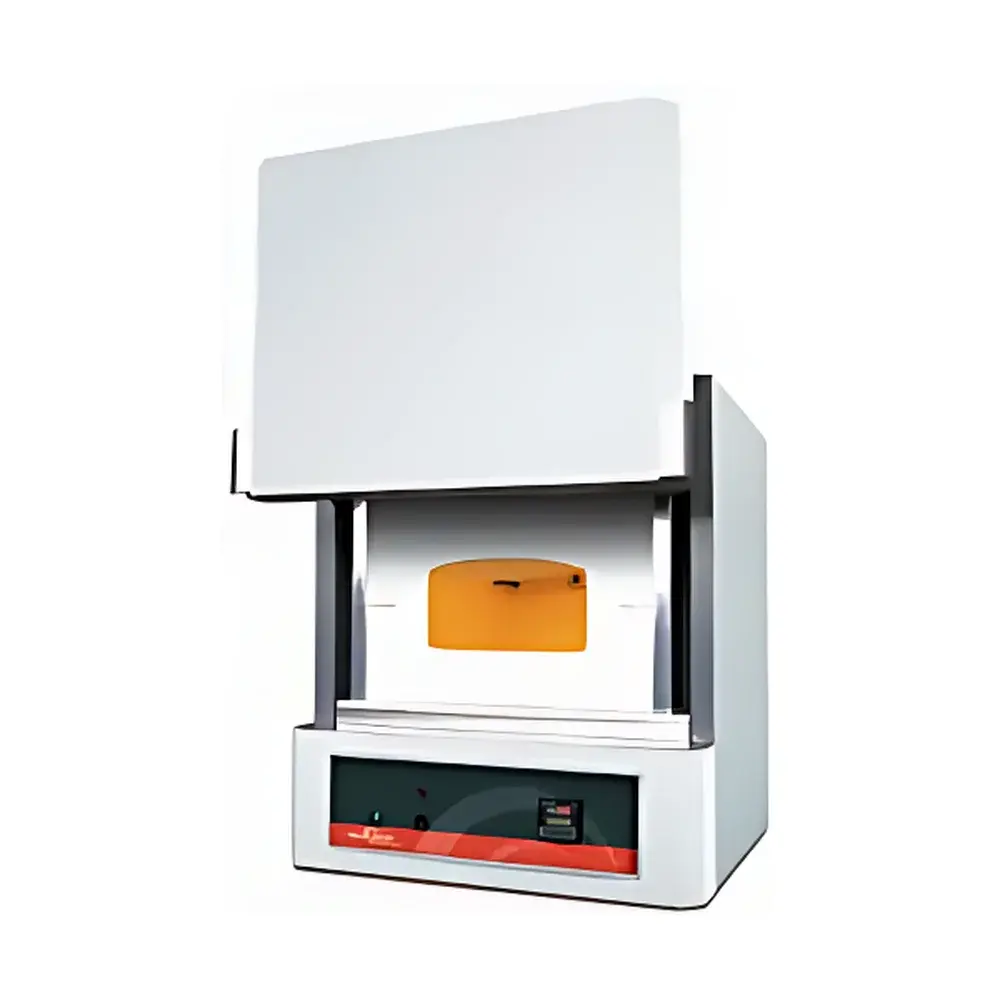
Thermconcept KLS Series Ceramic-Lined Box Muffle Furnace
| Brand | Thermconcept |
|---|---|
| Origin | Germany |
| Model | KLS 07/11/M (1150 °C) / KLS 05/13/M (1300 °C) |
| Max Operating Temperature | 1150 °C or 1300 °C |
| Chamber Construction | High-purity ceramic muffle liner |
| Heating Configuration | Four-sided embedded heating elements |
| Insulation | Dual-wall steel housing with rear ventilation and low-surface-temperature design |
| Door Type | Top-lifting (KLS 07/11/M) or side-hinged (KLS 05/13/M) with ceramic fiber insulation |
| Control System | Silent solid-state relay temperature controller |
| Safety | EN 60519-2 compliant overtemperature limiter |
| Accessories | Stackable crucibles, ceramic/stainless steel collection trays (1300 °C / 1100 °C max), heat-resistant tongs (300 mm / 500 mm), gloves (600 °C / 900 °C) |
Overview
The Thermconcept KLS Series ceramic-lined box muffle furnace is an engineered solution for high-precision thermal processing in analytical, materials science, and quality control laboratories. Designed around the fundamental principle of radiant heat transfer within a fully enclosed, inert atmosphere, the furnace employs a monolithic high-alumina ceramic muffle liner—chemically inert, mechanically robust, and thermally stable up to 1300 °C. This architecture isolates samples from direct contact with heating elements and metallic surfaces, eliminating contamination risks during ashing, calcination, or residue analysis. The four-sided heating configuration ensures uniform radial and axial temperature distribution across the chamber (±3 °C at setpoint under steady-state conditions), critical for reproducible gravimetric analysis per ASTM E1867 and ISO 1171. Dual-wall construction with rear-mounted passive ventilation maintains external surface temperatures below 50 °C at maximum operating temperature—meeting ergonomic safety requirements outlined in EN 61000-6-4 for laboratory equipment.
Key Features
- Ceramic muffle liner: High-purity alumina-based material with exceptional resistance to acidic and alkaline corrosion—validated for repeated use in heavy metal digestion (e.g., EPA Method 3050B) and organic matrix ashing.
- Embedded four-sided heating elements: Fully encapsulated within the muffle wall to prevent oxidation, ensure long-term calibration stability, and eliminate hot-spot formation.
- Top-lifting (KLS 07/11/M) or side-hinged (KLS 05/13/M) door mechanism: Minimizes operator exposure to radiant heat; door gasketing and ceramic fiber insulation reduce thermal loss to <1.2 kW/h at 1150 °C.
- Silent solid-state relay control: Enables precise proportional-integral-derivative (PID) regulation with ±1 °C accuracy over full range and zero audible switching noise—essential in shared lab environments.
- Integrated rear exhaust port: Compatible with fume extraction systems for volatile byproduct removal during sulfur-rich or halogenated sample processing.
- EN 60519-2 certified overtemperature protection: Independent mechanical limiter disconnects power if chamber exceeds user-defined threshold—audible alarm and visual indicator included.
Sample Compatibility & Compliance
The KLS furnace accommodates standard crucibles (Pt, Al₂O₃, SiC, quartz), stackable ceramic boats, and custom-fit sample holders. Its inert ceramic interior supports applications requiring strict elemental purity—such as ICP-MS sample preparation, pharmaceutical residual solvent ashing (USP ), and cement clinker LOI testing (ASTM C114). All models comply with CE marking requirements under the EU Machinery Directive 2006/42/EC and Electromagnetic Compatibility Directive 2014/30/EU. Temperature uniformity validation reports (per EURAMET cg-18) and factory calibration certificates traceable to PTB (Physikalisch-Technische Bundesanstalt) are available upon request. Optional IQ/OQ documentation packages support GLP and GMP laboratory audits.
Software & Data Management
While the base model features analog/digital front-panel control, optional RS485 Modbus RTU interface enables integration into centralized LabVantage or Thermo Fisher SampleManager LIMS environments. Data logging (via external USB recorder or PLC) captures time-stamped temperature profiles, ramp rates, hold durations, and alarm events—supporting 21 CFR Part 11 compliance when paired with validated electronic signature modules. Firmware updates maintain compatibility with evolving IEC 62443-3-3 cybersecurity benchmarks for connected lab instrumentation.
Applications
- Gravimetric ash content determination in food, feed, and biomass per AOAC 942.05 and ISO 2171.
- Pre-concentration of environmental water extracts prior to AAS or ICP-OES analysis (EPA 200.7).
- Calcination of catalyst precursors and battery cathode materials (LiCoO₂, NMC) under controlled airflow.
- Thermal decomposition studies of polymers and composites per ISO 11358.
- Residue-on-ignition testing in pharmaceutical excipients (Ph. Eur. 2.2.34).
FAQ
What is the maximum recommended continuous operating temperature for the KLS 07/11/M model?
The KLS 07/11/M is rated for continuous operation at 1150 °C; exceeding this limit may accelerate degradation of the ceramic muffle and compromise temperature uniformity.
Can the furnace be used under inert gas purge?
Yes—standard rear exhaust port accepts 6 mm OD tubing; optional gas inlet fitting (NPT 1/4″) and flowmeter enable controlled N₂ or Ar purging for oxygen-sensitive processes.
Is third-party calibration certification available?
Thermconcept provides UKAS-accredited calibration services (ISO/IEC 17025) for temperature uniformity and accuracy verification, including on-site validation per IQ/OQ protocols.
What maintenance intervals are recommended for the ceramic muffle?
Visual inspection every 200 operating hours; replacement advised after 1500 h at 1300 °C or following mechanical impact damage—no scheduled replacement required under typical ashing duty cycles.
Are custom chamber dimensions supported?
Yes—Thermconcept offers bespoke engineering for non-standard internal volumes (from 1.5 L to 45 L), modified door configurations, and integrated thermocouple ports for process monitoring.



