MBE-400 Molecular Beam Epitaxy System by Truth Instruments
| Brand | Truth Instruments Company Limited |
|---|---|
| Origin | Anhui, China |
| Manufacturer Type | Authorized Distributor |
| Origin Category | Domestic (PRC) |
| Model | MBE-400 |
| Quotation | Upon Request |
| Substrate Heating | 2-inch Wafer Compatibility |
| Base Pressure | ≤1×10⁻¹⁰ mbar |
| Substrate Temperature Control | Room Temperature to 800 °C |
| Effusion Cell Sources | 6–10 Knudsen Cells |
Overview
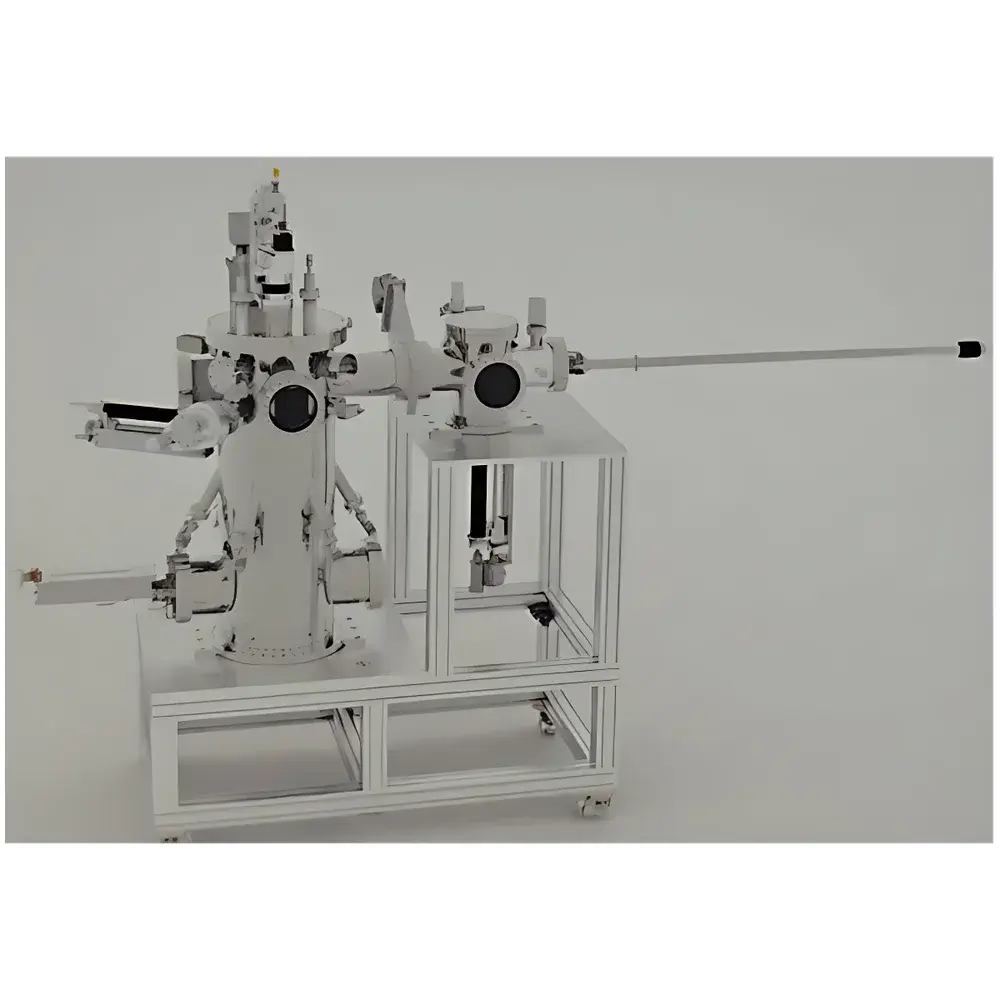
The MBE-400 Molecular Beam Epitaxy System is a high-vacuum, ultra-precise thin-film growth platform engineered for atomic-layer-resolved epitaxial synthesis of compound semiconductors, quantum heterostructures, and low-dimensional materials. Operating on the principle of thermal effusion in ultrahigh vacuum (UHV), the system directs collimated molecular or atomic beams—generated from independently controlled Knudsen cells—onto a heated crystalline substrate under real-time monitoring. This enables stoichiometrically accurate, layer-by-layer growth with sub-monolayer control, essential for fabricating high-electron-mobility transistors (HEMTs), quantum wells, superlattices, and topological insulator heterostructures. Designed for university research labs, national institutes, and semiconductor process development centers, the MBE-400 integrates UHV architecture, precise thermal management, and modular source configuration to support reproducible, contamination-free epitaxy under cleanroom-compatible conditions.
Key Features
- Ultra-high vacuum chamber with all-metal sealing and bake-out capability, achieving a base pressure of ≤1×10⁻¹⁰ mbar—critical for minimizing residual gas incorporation and oxide formation during III–V or II–VI growth.
- Programmable substrate heater with closed-loop PID control, supporting temperature ramping and stabilization from room temperature to 800 °C with ±0.5 °C stability over 24-hour operation.
- Modular effusion cell array accommodating 6–10 independently heated Knudsen cells, each equipped with precision shutters, thermocouple feedback, and digital current/voltage monitoring for flux calibration and repeatability.
- 2-inch wafer-compatible sample stage with azimuthal rotation, tilt adjustment (±5°), and integrated thermocouple-based substrate temperature measurement at the backside.
- Integrated UHV-compatible load-lock interface (optional), enabling rapid sample exchange without breaking main chamber vacuum—reducing system downtime and cross-contamination risk.
- Standard UHV feedthroughs for RHEED (Reflection High-Energy Electron Diffraction) gun, ion gauge, Bayard–Alpert gauge, and quadrupole mass spectrometer (QMS) ports for in situ process diagnostics.
Sample Compatibility & Compliance
The MBE-400 accommodates conductive and insulating substrates including GaAs, InP, Si, SiC, sapphire, and graphene-on-SiC wafers up to 2 inches in diameter. Substrate holders are compatible with standard MBE-compatible mounting fixtures (e.g., Ta or Mo clips with graphite spacers). All wetted materials—including chamber body, flanges, and shielding—comply with ASTM F798 (Standard Specification for Ultra-High-Purity Stainless Steel for Semiconductor Applications) and meet ISO Class 5 (Class 100) cleanroom compatibility requirements when operated within certified environments. The system supports GLP-aligned documentation workflows and is configurable with audit-trail-enabled controllers for GMP-relevant R&D environments.
Software & Data Management
Control is executed via a real-time Linux-based industrial PC running custom-developed MBE Control Suite v3.x. The software provides synchronized multi-channel data logging (cell temperatures, shutter states, pressure readings, RHEED intensity, substrate temperature) at 10 Hz resolution, with timestamped binary + CSV export. Recipe-driven automation supports multi-step growth sequences, conditional logic (e.g., “hold until RHEED oscillation amplitude stabilizes”), and interlock safety protocols. Data files conform to HDF5 format for interoperability with Python-based analysis pipelines (e.g., SciPy, Matplotlib) and are compatible with LabArchives ELN integration. Optional FDA 21 CFR Part 11-compliant user access control, electronic signatures, and change history tracking are available upon configuration.
Applications
- Growth of lattice-matched and strained III–V heterostructures (e.g., AlGaAs/GaAs, InGaAs/InP) for photonic integrated circuits and laser diodes.
- Atomic-layer engineering of 2D transition metal dichalcogenides (TMDs) and van der Waals heterostructures.
- Epitaxial synthesis of dilute magnetic semiconductors (e.g., GaMnAs) and topological insulator films (e.g., Bi₂Se₃, Sb₂Te₃).
- Development of quantum dot arrays and nanowire nucleation templates on patterned substrates.
- In situ calibration of flux ratios using RHEED intensity oscillations and Auger electron spectroscopy (AES) cross-validation.
FAQ
What vacuum pumping configuration is recommended to achieve ≤1×10⁻¹⁰ mbar?
A combination of turbomolecular pumps (≥1200 L/s for chamber + ≥300 L/s for load-lock), cryogenic panels (20 K), and non-evaporable getter (NEG) strips is required; ion pumps may be added for ultimate pressure stabilization.
Is the MBE-400 compatible with reflection high-energy electron diffraction (RHEED)?
Yes—the chamber includes a standard DN63CF RHEED port with angular alignment capability and differential pumping to maintain beam integrity under UHV conditions.
Can the system be upgraded to support 3-inch substrates?
Mechanical redesign of the manipulator and heater assembly is required; this is supported as a factory retrofit with revised thermal uniformity validation per ASTM F1592.
Does the control software support remote monitoring via secure network connection?
Yes—SSH-enabled remote desktop access and RESTful API endpoints for real-time parameter polling and alarm notification are included in the base software license.
Are calibration certificates provided for temperature and pressure sensors?
NIST-traceable calibration reports for all primary sensors (Type K thermocouples, capacitance manometers) are issued pre-shipment and updated annually per ISO/IEC 17025 guidelines.