
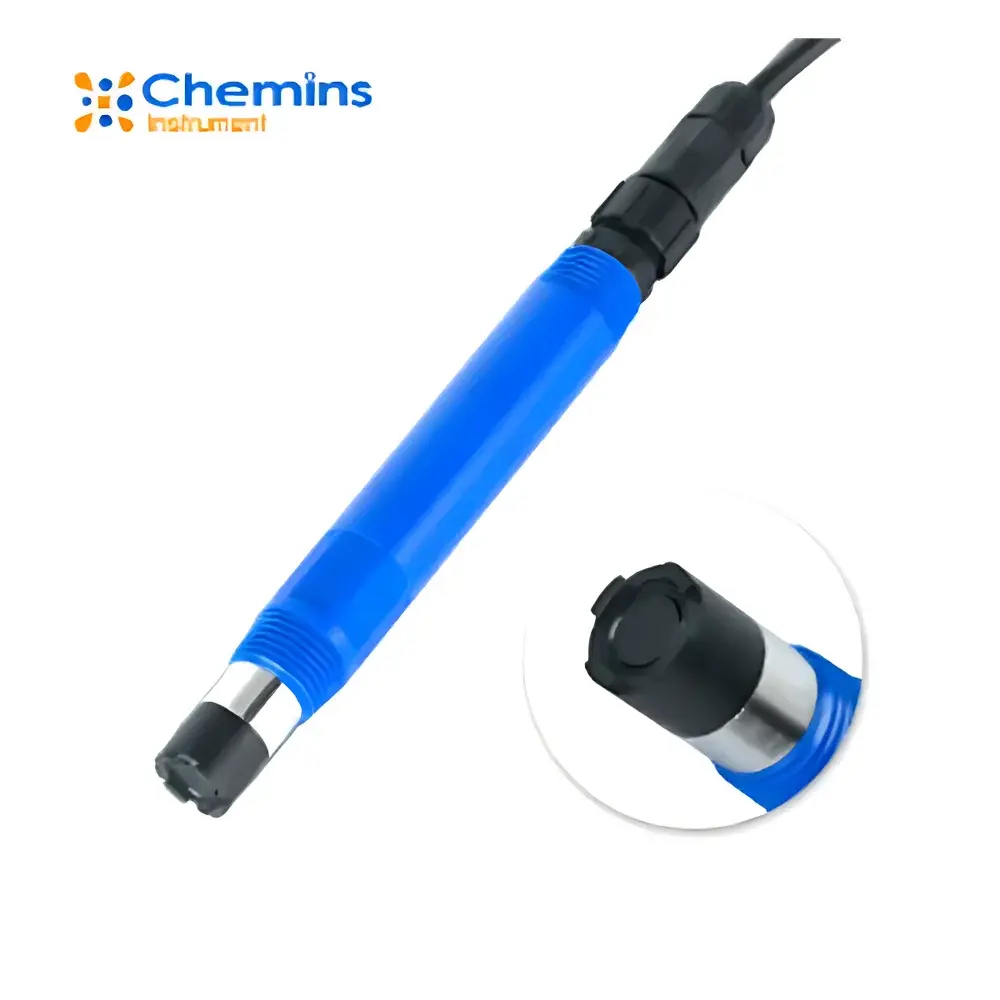
Chemins iDO-306 Integrated Fluorescence-Based Dissolved Oxygen Sensor
| Brand | Chemins |
|---|---|
| Origin | Zhejiang, China |
| Manufacturer Type | Original Equipment Manufacturer (OEM) |
| Product Origin | Domestic (China) |
| Model | iDO-306 |
| Pricing | Available Upon Request |
Overview
The Chemins iDO-306 is an integrated, submersible dissolved oxygen (DO) sensor engineered for continuous, high-stability online water quality monitoring in municipal wastewater treatment plants, surface water surveillance networks, aquaculture systems, and industrial process effluent streams. It operates on the principle of fluorescence quenching—a photophysical phenomenon wherein molecular oxygen dynamically collides with and non-radiatively deactivates excited-state fluorophores. A solid-state blue LED excites a proprietary oxygen-sensitive fluorophore immobilized within a gas-permeable optical sensing cap. The resulting red phosphorescent emission exhibits a measurable phase shift relative to the excitation signal; this phase delay (τ) is inversely proportional to local oxygen partial pressure and is quantified via time-domain phase fluorometry. Unlike electrochemical DO sensors, the iDO-306 requires no electrolyte gel, membrane replacement, or cathodic polarization—eliminating zero drift caused by electrolyte depletion, membrane fouling, or oxygen consumption at the electrode surface.
Key Features
- Optical fluorescence-based detection ensures long-term stability and immunity to electrochemical interference (e.g., H₂S, Cl⁻, heavy metals, and reducing agents)
- Integrated Pt1000 temperature sensor enables real-time, algorithmic temperature compensation per ISO 5814:2012 and ASTM D888–22 standards
- Built-in salinity compensation function supports accurate DO reporting across freshwater, brackish, and seawater matrices (0–70 g/kg NaCl equivalent)
- No oxygen consumption during measurement—ideal for low-flow or stagnant environments where diffusion-limited electrochemical sensors fail
- Phase-shift detection architecture delivers <±0.1 mg/L DO accuracy at 20 °C and <±1% FS repeatability over 12-month intervals
- Low-power design (<1.2 W typical operating power) with EMI-hardened circuitry compliant with IEC 61326-1 Class A for industrial electromagnetic environments
- Modbus RTU protocol over RS-485 interface (2-wire, half-duplex) enables seamless integration into SCADA, PLC, and data acquisition systems
- Quick-release optical cap allows field replacement of the fluorophore membrane without calibration loss or tooling
Sample Compatibility & Compliance
The iDO-306 is validated for direct immersion in natural waters (rivers, lakes, reservoirs), activated sludge basins, trickling filter effluents, recirculating aquaculture tanks, and cooling tower circuits. It meets material compatibility requirements per NSF/ANSI Standard 61 for potable water contact and conforms to CE marking directives (EMC Directive 2014/30/EU and RoHS 2011/65/EU). Its measurement methodology aligns with the technical basis of ISO 5814:2012 (Water quality — Determination of dissolved oxygen — Electrochemical probe method) and serves as a recognized alternative to amperometric methods under EPA Method 360.1 and APHA Standard Method 4500-O G. The sensor housing (IP68-rated 316L stainless steel + PEEK body) resists biofouling and chemical corrosion in pH 4–10 and ≤60 °C operational environments.
Software & Data Management
The iDO-306 communicates via standard Modbus RTU register mapping, supporting readout of calibrated DO (mg/L), temperature (°C), salinity (g/kg), and internal diagnostics (e.g., fluorophore aging index, signal-to-noise ratio, cap integrity flag). When deployed with Chemins’ optional iMonitor-Link gateway or third-party Modbus-compatible DAQ platforms, it supports time-stamped data logging, alarm thresholds (high/low DO, sensor fault), and audit-trail-capable data export compliant with GLP/GMP documentation workflows. Firmware updates are performed remotely via ASCII command set over RS-485, eliminating the need for physical recalibration after routine maintenance.
Applications
- Real-time DO control in aerobic bioreactors and nitrification-denitrification sequencing batch reactors (SBRs)
- Early-warning monitoring of hypoxic events in eutrophic lakes and estuarine zones
- Process optimization in fish hatcheries and marine aquarium life-support systems
- Compliance reporting for municipal wastewater discharge permits (e.g., EU Urban Wastewater Treatment Directive, US Clean Water Act NPDES)
- Long-term environmental monitoring in remote, solar-powered telemetry stations
- Validation reference for portable DO meters in field QA/QC programs
FAQ
Does the iDO-306 require periodic calibration? Why or why not?
Yes—initial two-point calibration (zero-oxygen and saturated-air points) is required before deployment. However, due to inherent stability of the fluorophore chemistry and built-in temperature/salinity compensation, recalibration intervals extend to 6–12 months under typical field conditions, significantly exceeding electrochemical sensor maintenance cycles.
Can the sensor operate in highly turbid or biofouling-prone water?
Yes—the optical sensing cap features a hydrophobic, anti-adhesive surface coating that delays biofilm formation. Optional ultrasonic cleaning modules or mechanical wipers can be integrated upstream for extended deployment in algae-rich or wastewater applications.
Is Modbus RTU configuration supported via software or only hardware DIP switches?
Configuration is fully software-driven via ASCII commands sent over RS-485. Baud rate (9.6–115.2 kbps), slave ID, parity, and polling interval are programmable without physical access to the sensor housing.
What is the expected service life of the optical cap?
Under continuous operation in ambient freshwater at ≤25 °C, the fluorophore cap maintains metrological integrity for ≥24 months. Accelerated aging occurs above 45 °C or under prolonged UV exposure; replacement caps are field-swappable with factory pre-calibration coefficients stored in embedded EEPROM.
Related Products







