
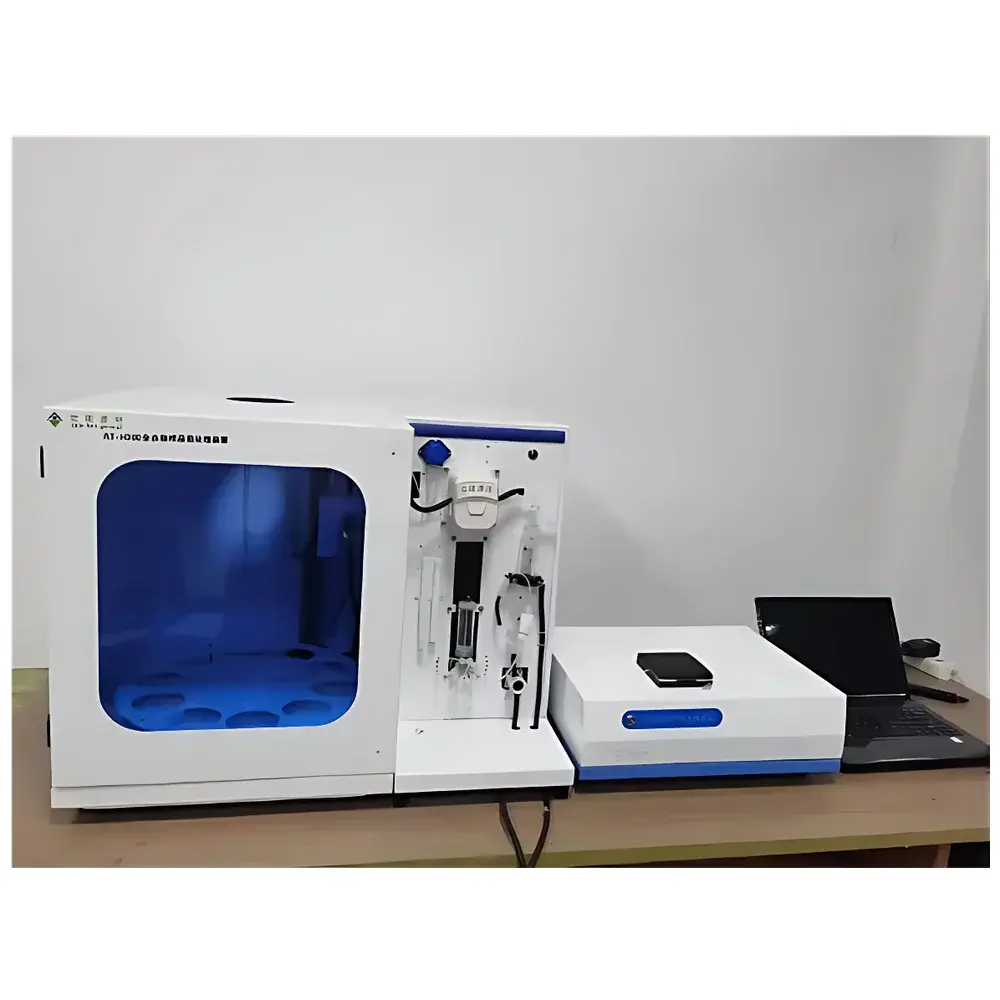
Safe AT-H300 Fully Automated Infrared Oil Analyzer
| Brand | Safe |
|---|---|
| Origin | Beijing, China |
| Manufacturer Type | Manufacturer |
| Regional Classification | Domestic (China) |
| Model | AT-H300 |
| Instrument Type | Laboratory |
| Measurement Principle | Infrared Spectrophotometry (Fourier-transform-free, dual-beam fixed-wavelength absorption at 2930 cm⁻¹, 2960 cm⁻¹, and 3030 cm⁻¹) |
| Measurement Range | 0.01–64,000 mg/L |
| Detection Limit | 0.01 mg/L |
| Accuracy | ±0.01 mg/L |
| Resolution | 0.004 mg/L |
| Sample Throughput | 7–10 minutes per sample |
| Compliance | HJ 637–2018, HJ 1051–2019, HJ 1077–2019, JJG 1153–2023 |
Overview
The Safe AT-H300 Fully Automated Infrared Oil Analyzer is an integrated laboratory instrument engineered for precise, standardized quantification of total oil, petroleum hydrocarbons, and animal/vegetable oils in aqueous, soil, and gaseous (fume/ mist) matrices. It operates on the principle of infrared spectrophotometry as defined in Chinese environmental standards HJ 637–2018, HJ 1051–2019, and HJ 1077–2019—methods aligned with internationally recognized IR-based hydrocarbon analysis frameworks. The system employs a fixed-wavelength, dual-beam optical architecture optimized for absorbance measurements at three critical wavenumbers: 2930 cm⁻¹ (aliphatic CH₂ stretch), 2960 cm⁻¹ (aliphatic CH₃ stretch), and 3030 cm⁻¹ (aromatic C–H stretch). Quantitative determination follows the four-component correction algorithm specified in HJ 637–2018, enabling independent calculation of total oil, petroleum hydrocarbons (after silica-magnesium adsorption), and biogenic oils (by difference). Sample preparation—including acidification (pH ≤2), solvent extraction using tetrachloroethylene, water removal, and post-adsorption cleanup—is fully automated within a sealed, inert fluidic pathway to minimize operator exposure and analytical variability.
Key Features
- Fully automated 12-position sample carousel with precision rail-guided cup positioning and programmable 1–8 position pre-processing alerts—reducing manual intervention and enhancing lab safety.
- Modular, detachable optical unit featuring short-path absorption cells, high-energy broadband IR source, and thermally stabilized optical chamber—ensuring long-term baseline stability and signal-to-noise ratio >2500:1 (typical).
- Switch-mode IR source with active thermal regulation and passive heat dissipation architecture—eliminating mechanical warm-up drift and improving inter-day reproducibility.
- Real-time dynamic zero calibration: simultaneous acquisition of illuminated and dark-state detector signals enables continuous electronic zero-point correction without mechanical shuttering or reference cell cycling.
- Parallelized 4-channel liquid handling module: synchronized volumetric aspiration (water sample), reagent dispensing (tetrachloroethylene), gas-agitated extraction, and phase-separated waste/extract routing—minimizing cross-contamination and cycle time.
- EMC-optimized PCB layout and shielded power distribution—validated per IEC 61326-1 Class A for electromagnetic compatibility in shared laboratory environments.
Sample Compatibility & Compliance
The AT-H300 supports analysis across three regulated environmental matrices: wastewater and sewage (HJ 637–2018), soil extracts (HJ 1051–2019), and stack emission condensates/oil mists (HJ 1077–2019). All workflows adhere to the mandatory procedural controls outlined in these standards—including pH adjustment prior to extraction, strict solvent purity requirements (tetrachloroethylene ≥99.9%), silica-magnesium column conditioning protocols, and spectral interference verification at 2930/2960/3030 cm⁻¹. The instrument’s measurement traceability is certified under JJG 1153–2023 (National Verification Regulation for Oil-in-Water Analyzers), covering linearity verification, limit-of-detection validation, and repeatability assessment (RSD ≤3% at 10 mg/L). While not FDA 21 CFR Part 11–certified out-of-the-box, its audit trail logs (time-stamped method parameters, raw absorbance values, calibration history, and operator ID) are structured to support GLP-compliant data review and internal GMP-aligned QA processes.
Software & Data Management
Control and analysis are managed via SafeOil v3.2 software—a Windows-based application supporting method template creation, multi-point calibration curve generation (linear and quadratic), and automatic application of HJ 637–2018 correction coefficients (F₁, F₂, F₃). Raw spectral data (A₂₉₃₀, A₂₉₆₀, A₃₀₃₀) and derived concentrations are stored in encrypted SQLite databases with immutable timestamps. Audit logs record every user action—including method modification, calibration execution, and result export—with optional integration into LIMS via CSV or ASTM E1384-compliant XML export. Software validation documentation (IQ/OQ protocols) is available upon request for regulated laboratories requiring formal instrument qualification.
Applications
- Regulatory compliance testing for municipal and industrial wastewater discharge permits (e.g., effluent monitoring per GB 8978–1996).
- Soil contamination assessment at brownfield sites—quantifying petroleum hydrocarbon residues in TCLP-like extractions.
- Stack testing of cooking fume abatement systems—measuring油烟 (cooking oil mist) and oil fog mass concentration in mg/m³.
- Process water quality control in petrochemical, metalworking, and food processing facilities.
- Research-grade hydrocarbon speciation studies requiring differentiation between aliphatic dominance (petroleum) and ester-rich signatures (biogenic oils).
FAQ
Does the AT-H300 require external gas supply for extraction?
No—extraction is driven by controlled air pulse agitation; no compressed gas cylinder or regulator is needed.
Can the instrument analyze seawater samples directly?
Yes, provided salinity is reported and matrix-matched calibration standards are used; high chloride content may necessitate additional solvent wash steps per HJ 637–2018 Annex B.
Is tetrachloroethylene the only approved extraction solvent?
Per HJ 637–2018 and HJ 1051–2019, tetrachloroethylene is the mandated solvent; alternative solvents invalidate regulatory compliance.
How often must the silica-magnesium adsorption column be replaced?
Column lifetime is method-dependent but typically supports ≥200 extractions when preconditioned per standard protocol; breakthrough verification is recommended every 50 samples.
What maintenance intervals are recommended for optical alignment?
The integrated optical module is factory-aligned and sealed; no user-accessible collimation is required—only quarterly cleaning of the ZnSe window with spectroscopic-grade methanol.
Related Products







