
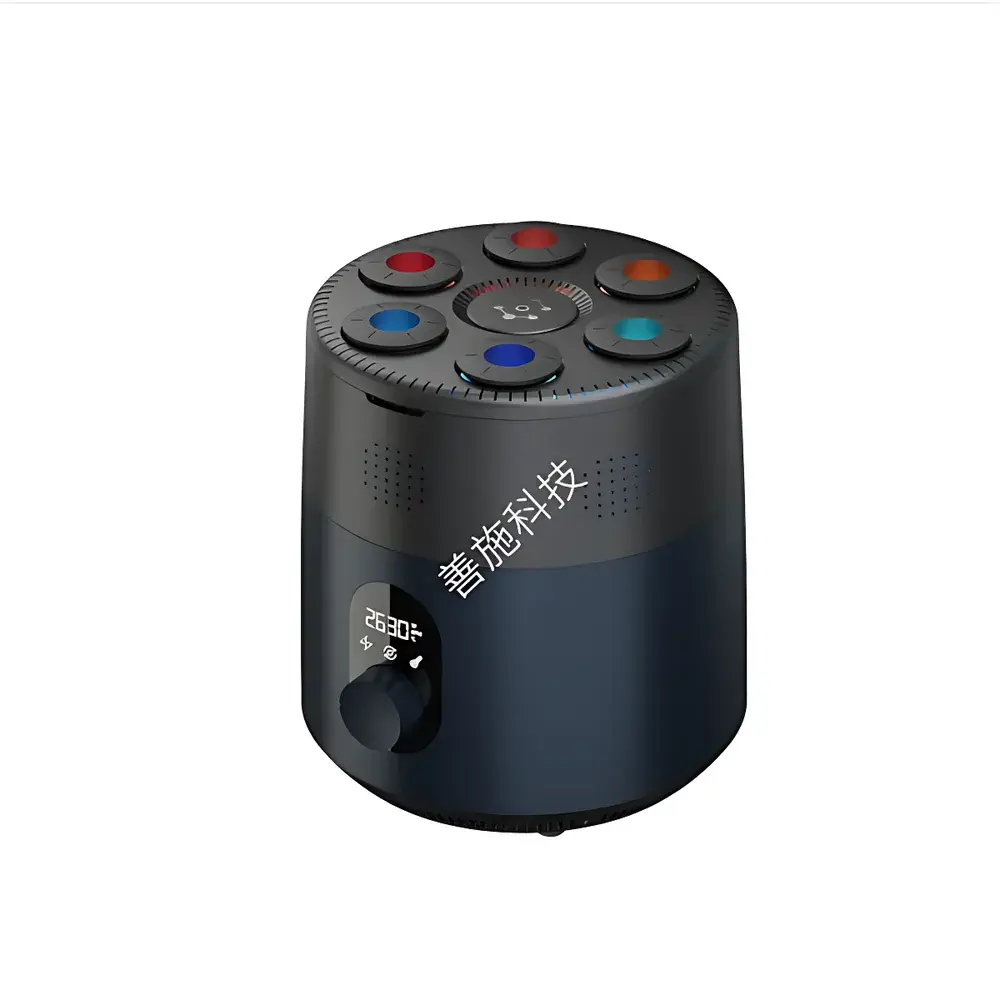
Shanghai 3S AL(9) Photochemical Reactor
| Brand | Shanghai 3S Technology Co., Ltd |
|---|---|
| Origin | Shanghai, China |
| Manufacturer Type | Direct Manufacturer |
| Product Origin | Domestic (China) |
| Model | AL(9) |
| Pricing | Available Upon Request |
| Light Wavelength Range | 365–975 nm |
| Maximum Irradiance | ~700 mW/cm² |
| Illuminance | >2,000,000 lux |
| Optical Decay Rate | <5% per year |
| Temperature Control | Air-cooled, 25–40 °C (ambient-adjusted) |
| Magnetic Stirring Speed | 300–1500 rpm |
| Compatible Vessels | NMR tubes, 5/10/20 mL vials, 25/50/100 mL reaction tubes (custom sizes available) |
Overview
The Shanghai 3S AL(9) Photochemical Reactor is an engineered benchtop system designed for controlled, reproducible photochemical synthesis under inert or ambient atmospheres. It operates on the principle of photon-induced bond cleavage, energy transfer, or electron excitation—enabling radical generation, [2+2] cycloadditions, C–H functionalization, and redox-neutral transformations. Unlike conventional thermal reactors, the AL(9) delivers spatially uniform irradiation across sample volumes via collimated LED or mercury/xenon lamp modules (user-selectable), while integrating real-time magnetic agitation to ensure homogeneous photon flux distribution and mass transfer. Its architecture supports both steady-state and time-resolved reaction profiling, making it suitable for kinetic studies, quantum yield determination, and scalable parameter mapping in early-stage process development.
Key Features
- Multi-wavelength optical platform: Interchangeable light sources covering 365–975 nm—including UVA (365 nm), visible blue (450 nm), green (530 nm), red (630 nm), and NIR (850 nm)—with narrow-band spectral output (<10 nm FWHM) and calibrated irradiance traceability.
- High-intensity illumination: Delivers up to ~700 mW/cm² at sample plane (measured at 1 cm distance with calibrated photodiode sensor); optical output stability maintained at <±2% over 100 h, with annual photometric decay <5%—verified per ISO/CIE photobiological safety protocols.
- Integrated magnetic stirring: Brushless DC motor-driven stirrer with speed control from 300 to 1500 rpm, enabling turbulent-to-laminar flow regimes without shaft penetration or seal degradation—critical for air/moisture-sensitive reactions and long-duration irradiations.
- Active thermal management: Closed-loop air-cooling system maintains chamber temperature between 25 °C and 40 °C with ±1.5 °C accuracy; no external chiller required, minimizing footprint and operational complexity.
- Modular reactor compatibility: Standardized mounting interface accepts standard NMR tubes (5 mm OD), screw-cap vials (5/10/20 mL), borosilicate glass tubes (25/50/100 mL), and custom quartz or sapphire vessels for UV-C or high-temperature applications.
Sample Compatibility & Compliance
The AL(9) accommodates heterogeneous and homogeneous reaction mixtures—including suspensions, colloidal catalysts, organometallic complexes, and photocatalytic slurries—without compromising optical path integrity. All wetted components are constructed from borosilicate glass (DIN 28812) or PTFE-lined stainless steel, ensuring chemical resistance to common solvents (acetonitrile, DMF, THF, DCM, alcohols) and mild acids/bases. The system conforms to IEC 61000-6-3 (EMC emissions) and IEC 61000-6-2 (immunity), and its optical enclosure meets Class 1 laser product safety requirements per IEC 60825-1 when operated with optional filtered lamp modules. For GLP/GMP-aligned workflows, the reactor supports audit-ready documentation through third-party LIMS integration and manual logbook templates aligned with ISO/IEC 17025 calibration traceability standards.
Software & Data Management
While the AL(9) operates via intuitive front-panel digital controls (rotary encoder + OLED display), optional RS-485 or USB-C connectivity enables integration with laboratory automation platforms (e.g., LabVIEW, Python-based control scripts). Users may record irradiation duration, setpoint temperature, stirring speed, and lamp-on status in timestamped CSV logs. Though no proprietary software suite is bundled, the device complies with Modbus RTU protocol for SCADA-level monitoring and satisfies basic FDA 21 CFR Part 11 readiness when paired with validated electronic lab notebook (ELN) systems—provided user-defined access controls, electronic signatures, and audit trail retention policies are implemented externally.
Applications
- Pharmaceutical process R&D: Late-stage functionalization of APIs via C(sp³)–H activation, decarboxylative couplings, and asymmetric photocatalysis under GMP-feasible small-scale conditions.
- Materials science: Synthesis of conjugated polymers, MOF linkers, and carbon nitride photocatalysts requiring precise photon dosage control and oxygen-free environments.
- Flavor & fragrance chemistry: Selective photooxidation or Norrish-type cleavage for terpene derivatization and lactone formation—reducing reliance on stoichiometric oxidants.
- Mechanistic investigation: In situ EPR or UV-Vis spectroelectrochemical coupling (via optional quartz cuvette adapter) to correlate transient species formation with irradiation parameters.
- Education & methodology development: Standardized platform for teaching photochemical kinetics, quantum efficiency calculations (Φ), and wavelength-dependent reactivity profiling.
FAQ
Is the AL(9) compatible with inert atmosphere operation?
Yes—reaction vessels can be sealed with septa or connected to Schlenk lines via standard ground-glass joints; optional gas inlet/outlet ports support continuous N₂ or Ar purging.
Can irradiance be calibrated for quantitative photochemical studies?
Yes—each lamp module includes a NIST-traceable calibration certificate; users may validate in situ irradiance using a handheld spectroradiometer (e.g., Ocean Insight HDX) placed at the sample position.
What maintenance is required for long-term optical performance?
Annual verification of lamp output intensity and spectral profile is recommended; cleaning of quartz windows with IPA and lint-free wipes preserves transmission efficiency above 92% across UV-Vis range.
Does the system support sequential multi-wavelength irradiation protocols?
Not natively—but external programmable power supplies or TTL-triggered lamp drivers (sold separately) enable timed switching between installed modules.
Are replacement lamps and reactor vessels supplied by Shanghai 3S?
Yes—original equipment manufacturer (OEM) parts, including certified LED arrays, mercury-xenon bulbs, and precision-ground borosilicate tubes, are available with documented lot-specific photometric data.



