
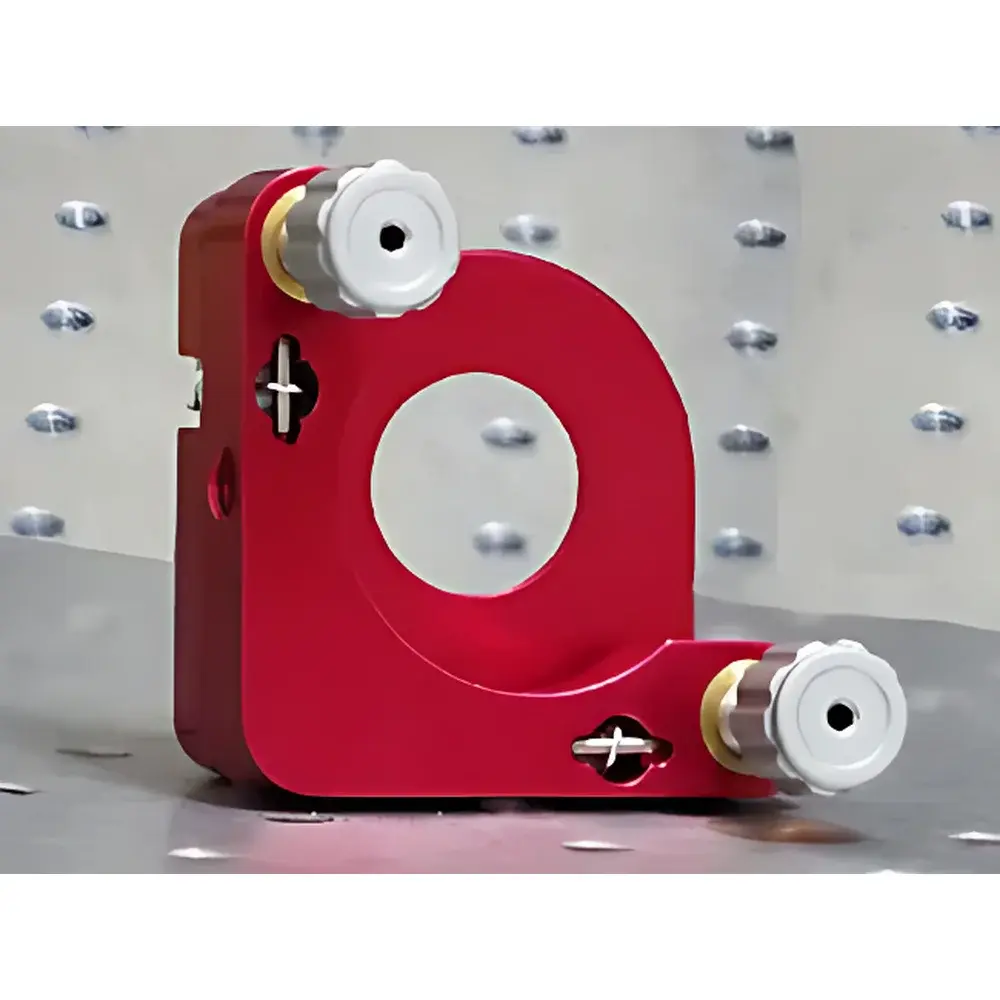
HTMM20-C Closed-Loop Two-Axis High-Stability Kinematic Mirror Mount
| Brand | Han Ding (HT) |
|---|---|
| Model | HTMM20-C |
| Mount Type | Closed-Loop Piezo-Driven Tip/Tilt Kinematic Mount |
| Aperture Compatibility | 20 mm Diameter Optics |
| Actuation Principle | Capacitive Feedback Piezoelectric Positioning |
| Angular Range (Tip/Tilt) | ±1.5 mrad (typ.) |
| Resolution | <50 nrad (open-loop), <200 nrad (closed-loop with capacitive sensor) |
| Repeatability | ±0.15 µrad |
| Thermal Drift | <10 nrad/°C (over 8-hour stabilization) |
| Material | Anodized 6061-T6 Aluminum Body with Invar Flexures |
| Mounting Interface | Standard M4 & M6 Threaded Holes, Compatible with 30 mm and 60 mm Optical Rails |
Overview
The HTMM20-C is a precision-engineered, closed-loop two-axis kinematic mirror mount designed for ultra-stable tip/tilt positioning of 20 mm diameter optical elements in demanding research and industrial metrology environments. Unlike conventional manual or open-loop piezo mounts, the HTMM20-C integrates dual-axis capacitive position sensors directly within its monolithic flexure architecture, enabling real-time feedback control of angular orientation with sub-microradian stability. Its operational principle relies on high-stiffness, low-hysteresis piezoelectric actuators coupled to compliant Invar flexure hinges—eliminating backlash, wear, and mechanical play inherent in screw-based or ball-bearing mechanisms. This architecture ensures long-term angular retention under thermal fluctuation and mechanical vibration, making it suitable for interferometric alignment, cavity locking in ultra-stable lasers, adaptive optics beam steering, and gravitational wave detector path stabilization where drift-induced phase error must remain below 10−9 rad.
Key Features
- Capacitive closed-loop control delivering <200 nrad angular resolution and ±0.15 µrad repeatability over full tip/tilt range
- Monolithic Invar flexure design minimizing thermal expansion mismatch and creep effects
- Integrated strain-relieved mounting interface compatible with standard 30 mm and 60 mm optical breadboards and rail systems
- Anodized 6061-T6 aluminum housing providing EMI shielding, corrosion resistance, and thermal mass buffering
- Optional UHV-rated version available with non-outgassing materials and bakeable construction (≤150 °C)
- Driver-agnostic analog input (±10 V) and digital interface support (USB 2.0, RS-422) for integration into automated alignment sequences
Sample Compatibility & Compliance
The HTMM20-C accommodates plano or wedged mirrors, beamsplitters, and waveplates with clear apertures up to 20 mm and thicknesses ranging from 3 mm to 12 mm. Its kinematic clamping mechanism applies uniform radial preload via three symmetrically distributed spring-loaded collets, preventing optic distortion while maintaining surface flatness within λ/20 PV across the aperture. The mount complies with ISO 10110-7 (optical element mounting stress specifications) and meets mechanical shock requirements per MIL-STD-810G Method 516.6 (Shock). When used with certified calibration optics traceable to NIST, angular positioning data satisfies GLP documentation standards for metrology-critical applications in laser cavity optimization and optical coherence tomography reference arm alignment.
Software & Data Management
The HTMM20-C supports deterministic motion profiling via vendor-provided SDKs (C/C++, Python, LabVIEW) and third-party compatibility with EPICS, MATLAB Instrument Control Toolbox, and National Instruments DAQmx. All closed-loop operations generate timestamped position logs with nanosecond-resolution hardware triggers, enabling synchronized acquisition with photodiode arrays or lock-in amplifiers. Audit trails—including setpoint history, sensor readback variance, and thermal compensation offsets—are stored in HDF5 format with SHA-256 checksums, satisfying FDA 21 CFR Part 11 requirements for electronic records in regulated R&D environments. Firmware updates preserve configuration integrity through dual-bank memory architecture.
Applications
- Active stabilization of interferometer arms in gravitational wave detection prototypes
- Precision pointing control for free-space quantum communication terminals
- In-situ alignment of high-finesse optical cavities in narrow-linewidth laser systems
- Dynamic wavefront correction in multi-conjugate adaptive optics testbeds
- Thermal-drift-compensated beam steering in ultrafast pump-probe spectroscopy setups
- Automated collimation verification in fiber-optic component manufacturing lines
FAQ
What is the maximum recommended optic weight for stable operation?
Optics up to 85 g are supported without degradation in angular resolution or settling time; heavier loads require custom flexure recalibration.
Is the mount compatible with vacuum environments?
Yes—the UHV variant (HTMM20-C-UHV) uses ceramic-coated piezos, stainless steel fasteners, and Viton-free elastomers, rated for 1×10⁻⁹ mbar base pressure.
Can multiple HTMM20-C units be synchronized in a master-slave configuration?
Yes—using the RS-422 daisy-chain interface and deterministic jitter compensation firmware, up to 16 axes can achieve sub-100 ns inter-unit timing skew.
Does the capacitive sensor require periodic recalibration?
No—factory-trimmed sensor gain and offset are stored in non-volatile memory; drift remains below 0.02% FS/year at 23 °C ambient.
How is thermal drift compensated during extended operation?
An embedded thermistor network feeds real-time temperature gradients to the PID controller, applying predictive angular offset correction based on empirical thermal expansion models of the Invar flexure geometry.



