
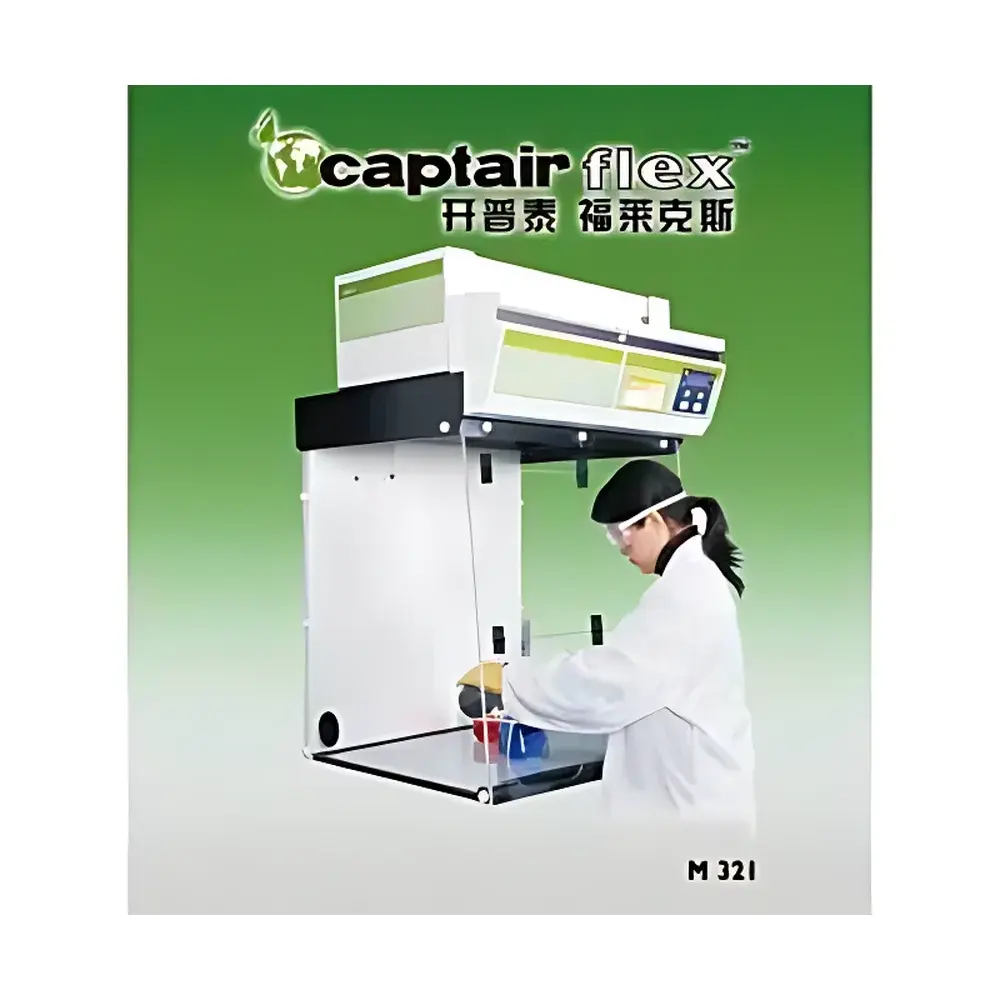
Erlab Captair Smart S/M321 Ductless Fume Hood
| Brand | Erlab |
|---|---|
| Origin | France |
| Model | S/M321 |
| Construction | Fully Steel Enclosure |
| Configuration | Double-Sided Operation |
| Airflow Capacity | 230 m³/h |
| Face Velocity Range | 0.4–0.6 m/s (compliant with AFNOR NF X 15-211:2009) |
| Filtration System | Dual-Layer Molecular Filter Assembly (Class 1 per NFX 15-211) |
| Power Consumption | 58 W |
| Input Voltage | 100–240 V AC, 50–60 Hz |
| Internal DC Voltage | 24 V DC |
| Sound Pressure Level | 52 dB(A) |
| Lighting | 18 W IP67 Fluorescent Lamp(s), ≥500 lux |
| Dimensions (S model, mm) | L 800 × D 556 × H 1016–1200 (external) |
| Dimensions (M model, mm) | L 800 × D 620 × H 1161–1345 (external) |
| Operating Aperture | Elliptical |
| Certification | Compliant with NFX 15-211:2009 Class 1 |
Overview
The Erlab Captair Smart S/M321 is a certified ductless fume hood engineered for high-reliability chemical containment in modern laboratories where infrastructure constraints, energy efficiency, and flexible installation are critical operational requirements. Unlike conventional ducted hoods that exhaust conditioned air to the exterior—demanding costly HVAC make-up air—the Captair Smart operates on a closed-loop recirculation principle based on active molecular adsorption. Ambient laboratory air is drawn inward across the work surface at a controlled face velocity (0.4–0.6 m/s), passes through a dual-stage molecular filtration system housed within the unit’s vertical column, and is returned as chemically purified air directly into the lab environment. This process eliminates external ductwork, reduces building load, and maintains thermal integrity—making it especially suitable for retrofit installations, modular labs, cleanrooms, and facilities governed by strict energy performance mandates.
Key Features
- Dual-layer molecular filtration architecture: Two identical, vertically stacked molecular filter cartridges (top and bottom) provide redundant chemical capture. When the lower cartridge reaches saturation—as monitored via integrated timer-based alerts or optional Melecode® S organic vapor sensor—the upper cartridge continues uninterrupted operation without breakthrough risk, ensuring continuous Class 1 containment per NFX 15-211:2009.
- Captair Flex™ digital control panel: A centralized 24V DC touchscreen interface manages all safety-critical functions: real-time airflow monitoring with audible/visual alarms for velocity deviation; programmable maintenance timers (0–250 operating hours); configurable service protocols; and optional integration of Melecode® S saturation detection for volatile organic compounds.
- Ergonomic workstation design: Tilted front sash (15° angle), elliptical access aperture, central splash guard, and radius-edged work surface collectively reduce operator fatigue while enhancing dexterity and visual field during extended handling of hazardous liquids and powders.
- Low-energy operation: Rated at only 58 W under full airflow load, the unit consumes <1% of the energy required by equivalent ducted systems. Annual filter replacement cost is demonstrably lower than HVAC energy expenditures associated with single ducted hood operation—achieving up to 85% reduction in climate-control overhead.
- Plug-and-play deployment: No civil works, ducting, or electrical upgrades required. Units arrive fully assembled and become operational within 30 minutes of unboxing—simply position, level, connect to standard 100–240 V AC outlet, and calibrate airflow.
Sample Compatibility & Compliance
The Captair Smart S/M321 is validated for safe handling of low-to-moderate volatility chemicals including aqueous reagents, alcohols, ketones, esters, halogenated solvents (e.g., chloroform, dichloromethane), and particulate-generating procedures such as powder weighing and lyophilization. It is not intended for perchloric acid, hydrofluoric acid, radioactive isotopes, or highly polymerizing monomers. All configurations comply with French national standard NFX 15-211:2009 (Class 1 for dual-filter models), and third-party validation reports from SGS and Intertek confirm performance against ISO 10993 biocompatibility and EN 61000-6-3 EMC emission limits. The unit meets general laboratory safety expectations aligned with OSHA 1910.1450 and EU Directive 2004/40/EC for electromagnetic field exposure.
Software & Data Management
The Captair Flex™ control system logs timestamped operational data—including cumulative runtime, airflow deviations, alarm events, and filter usage cycles—in non-volatile memory. While no cloud connectivity or remote diagnostics are embedded, the system supports GLP-compliant record retention via USB export of CSV-formatted logs. Audit trails include user-initiated calibration actions, alarm acknowledgments, and maintenance interventions—all traceable by operator ID when paired with optional networked facility management platforms. The interface conforms to IEC 62366 usability engineering standards, minimizing misoperation risk during high-stress workflows.
Applications
This ductless hood serves routine analytical chemistry workflows (e.g., HPLC sample prep, titration, solvent evaporation), pharmaceutical QC testing (USP compliant instrument qualification support), academic teaching labs requiring scalable containment, and R&D environments where rapid reconfiguration is essential. Its compact footprint and double-sided configuration enable shared use between adjacent benches—ideal for synthetic chemistry suites, formulation labs, and quality control areas operating under ISO/IEC 17025 or FDA 21 CFR Part 11-aligned documentation frameworks.
FAQ
What types of chemicals can be safely handled in the Captair Smart S/M321?
It is validated for low-to-moderate volatility organic solvents, aqueous acids/bases, and particulates—but excludes perchloric acid, HF, radionuclides, and reactive monomers.
How often must the molecular filters be replaced?
Replacement intervals depend on chemical type, concentration, and usage frequency; typical service life ranges from 6–18 months. The built-in timer triggers alerts every 250 operating hours, and optional Melecode® S sensors provide real-time organic vapor breakthrough detection.
Does the unit require external exhaust ducting?
No. It is fully self-contained and recirculates filtered air into the laboratory space—eliminating need for roof penetrations or HVAC coordination.
Is the Captair Smart compatible with GMP/GLP documentation requirements?
Yes. Its event-logged operational history, alarm traceability, and configurable maintenance protocols support audit readiness for regulated environments under ISO 17025, FDA 21 CFR Part 11, and EU Annex 11.
Can multiple units operate simultaneously in one room without compromising air quality?
Yes. Since each unit recirculates only its own processed air and introduces no net air loss, installing several Captair Smart hoods does not affect room pressurization or require supplemental fresh-air supply.



