
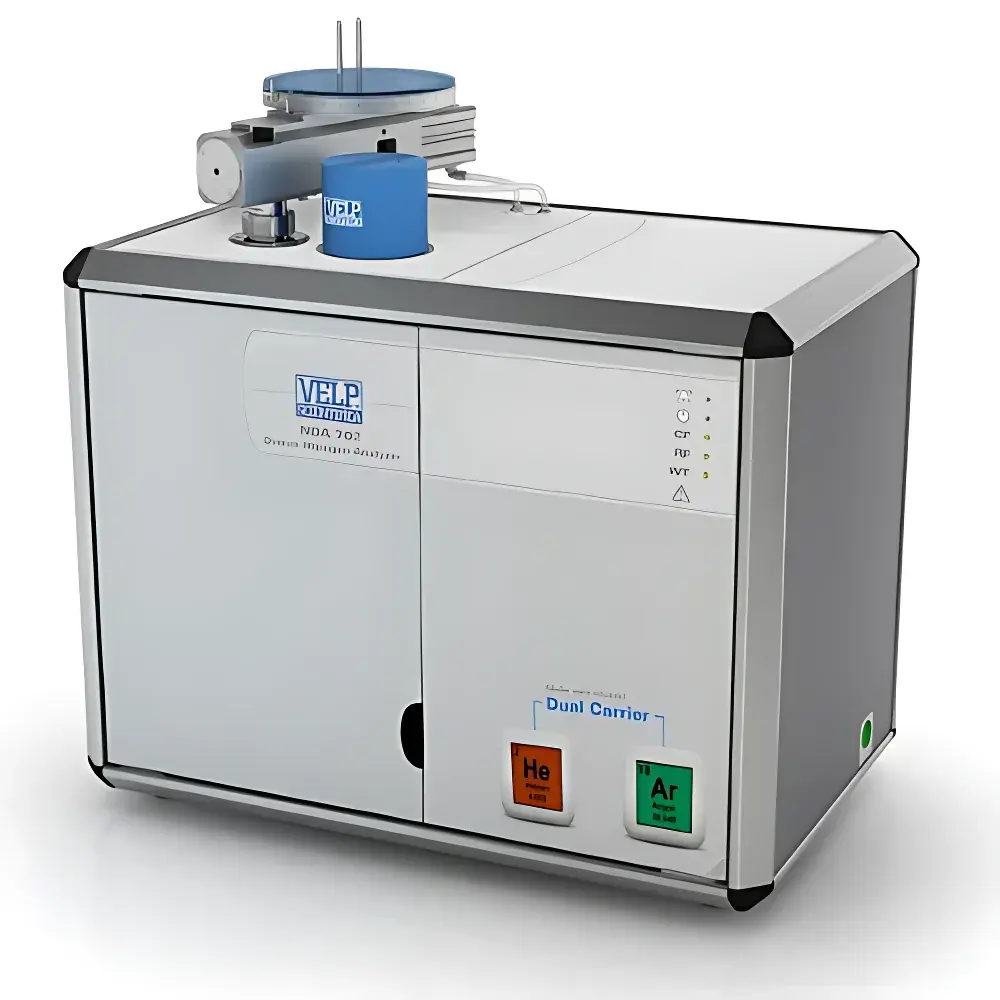
VELP NDA702 Dual-Carrier Gas Dumas Combustion Nitrogen Determinator
| Brand | VELP |
|---|---|
| Origin | Italy |
| Model | NDA702 |
| Analysis Principle | Dumas Combustion Method |
| Carrier Gases | Helium or Argon (switchable without hardware modification) |
| Digestion/Combustion Time | 3–4 min per sample |
| Repeatability (RSD) | < 0.5% |
| Recovery Rate | > 99.5% |
| Detection Limit | 0.001 mg N (He), 0.01 mg N (Ar) |
| Combustion Temperature | 1030 °C |
| Power Consumption | 1400 W |
| Auto-sampler Capacity | Up to 117 positions (4 trays × 30 positions) |
| Dimensions (W×D×H) | 655 × 510 × 410 mm |
| Weight | 55 kg |
| Electrical Supply | 230 V / 50 Hz |
| Gas Purity Requirement | ≥99.999% for He/Ar and O₂ |
| Gas Pressure Requirement | 2 bar for carrier gas and O₂ |
| Detector | Calibrated Thermal Conductivity Detector (TCD), reference-gas-free operation |
| Sample Mass Range | Up to 1.0 g |
| Data Interfaces | USB, RS232 |
Overview
The VELP NDA702 is a high-precision, dual-carrier gas Dumas combustion nitrogen determinator engineered for laboratories requiring regulatory-compliant, high-throughput elemental nitrogen and protein quantification. It implements the standardized Dumas combustion method—ASTM D5623, AOAC 992.15, ISO 14891, and EN ISO 16634—where solid or liquid samples are combusted in a high-temperature furnace (1030 °C) under controlled oxygen flow, converting organic nitrogen into molecular nitrogen (N₂). The resulting gases—CO₂, H₂O, and NOx—pass through a reduction chamber where NOx species are catalytically reduced to N₂, while CO₂ and H₂O are selectively removed via chemical and physical traps. The purified N₂ stream is then quantified using a factory-calibrated, reference-gas-free Thermal Conductivity Detector (TCD), eliminating drift-related calibration dependencies and ensuring long-term measurement stability.
Key Features
- Dual-carrier gas flexibility: Switch seamlessly between helium and argon as carrier gas—without hardware modification, valve replacement, or recalibration—addressing global helium supply volatility and cost escalation while maintaining analytical integrity.
- TEMSTM technology platform: Integrated thermal management and optimized gas flow dynamics ensure uniform combustion efficiency across heterogeneous matrices (e.g., cereals, dairy powders, soil, polymers), minimizing matrix effects and enhancing robustness.
- LoGas™ & DriStep™ gas-saving modes: Dynamically modulates carrier and oxygen flow rates based on sample mass and nitrogen content, reducing gas consumption by up to 40% versus conventional Dumas systems—verified per ISO 17025 internal validation protocols.
- 24/7 unattended operation: Industrial-grade furnace architecture, redundant thermal sensors, and predictive maintenance alerts enable continuous batch processing under GLP/GMP-aligned operational conditions.
- High-capacity auto-sampler: Supports up to 117 sample positions (4 trays × 30 positions) with programmable tray sequencing, integrated weigh station interface, and automatic tin capsule loading—compatible with both standard and low-mass (<5 mg) micro-capsules.
Sample Compatibility & Compliance
The NDA702 accommodates a broad spectrum of organic and semi-organic materials without derivatization or pre-treatment: foodstuffs (cereals, meat, infant formula), feedstuffs (soybean meal, fishmeal), environmental samples (soil, compost, plant tissue), pharmaceutical excipients, petrochemicals (lubricants, biofuels), and synthetic polymers. All measurements comply with international standards including AOAC Official Method 992.15 (protein in foods), ASTM D5623 (petroleum products), ISO 16634-1/-2 (food and feed), and EN ISO 14891 (water and sludge). Instrument firmware and DUMASOFT™ software support 21 CFR Part 11-compliant audit trails, electronic signatures, and role-based access control—validated for use in FDA-registered and EU GMP-certified facilities.
Software & Data Management
DUMASOFT™ v4.2 provides full instrument control, method development, and reporting within a validated Windows-based environment. Key capabilities include: real-time TCD signal visualization with baseline correction; automated calculation of nitrogen content, crude protein (×6.25 or user-defined factor), and % recovery against certified reference materials (e.g., EDTA, BSA); statistical summaries (mean, SD, RSD) across multi-run sequences without report regeneration; customizable unit display (°C/°F, bar/psi); multilingual UI (English, German, French, Spanish, Chinese—downloadable language packs); and named calibration curve storage with version timestamping. Raw data export is supported in CSV, PDF, and XML formats compatible with LIMS integration via ODBC or HL7 interfaces.
Applications
- Food & Beverage QC: Rapid verification of protein labeling compliance (EU Regulation 1169/2011), raw material acceptance testing, and shelf-life stability studies.
- Animal Feed Certification: Routine analysis of soy, corn gluten, and rendered meals per AAFCO and FAMI-QS requirements.
- Environmental Monitoring: Total Kjeldahl Nitrogen (TKN)-equivalent quantification in wastewater biosolids, agricultural soils, and compost—aligned with EPA Method 351.2 and ISO 13878.
- Pharmaceutical Development: Nitrogen content verification in APIs, excipients, and biopolymer carriers per USP and Ph. Eur. 2.5.25.
- Petrochemical R&D: Nitrogen speciation screening in lubricants and fuels per ASTM D4294 and D5762.
FAQ
Can the NDA702 switch between helium and argon during a single analytical sequence?
Yes—gas selection is fully software-controlled and dynamically configurable per sample or batch, with automatic pressure and flow re-optimization.
Is method validation documentation available for regulatory submissions?
VELP provides IQ/OQ/PQ protocols, system suitability test templates, and a complete 21 CFR Part 11 validation package upon request.
What is the minimum detectable nitrogen mass when using argon carrier gas?
The detection limit is 0.01 mg N under standard operating conditions (1.0 g sample, 1030 °C combustion, 30 s integration time).
Does the instrument require external cooling water or compressed air?
No—NDA702 operates with passive air cooling and does not require auxiliary utilities beyond electrical supply and high-purity gases.
How is calibration traceability maintained over time?
Each TCD is factory-calibrated against NIST-traceable nitrogen standards; users perform daily system suitability checks using EDTA or urea CRM, with optional automated calibration verification via built-in reference gas injection port.





