
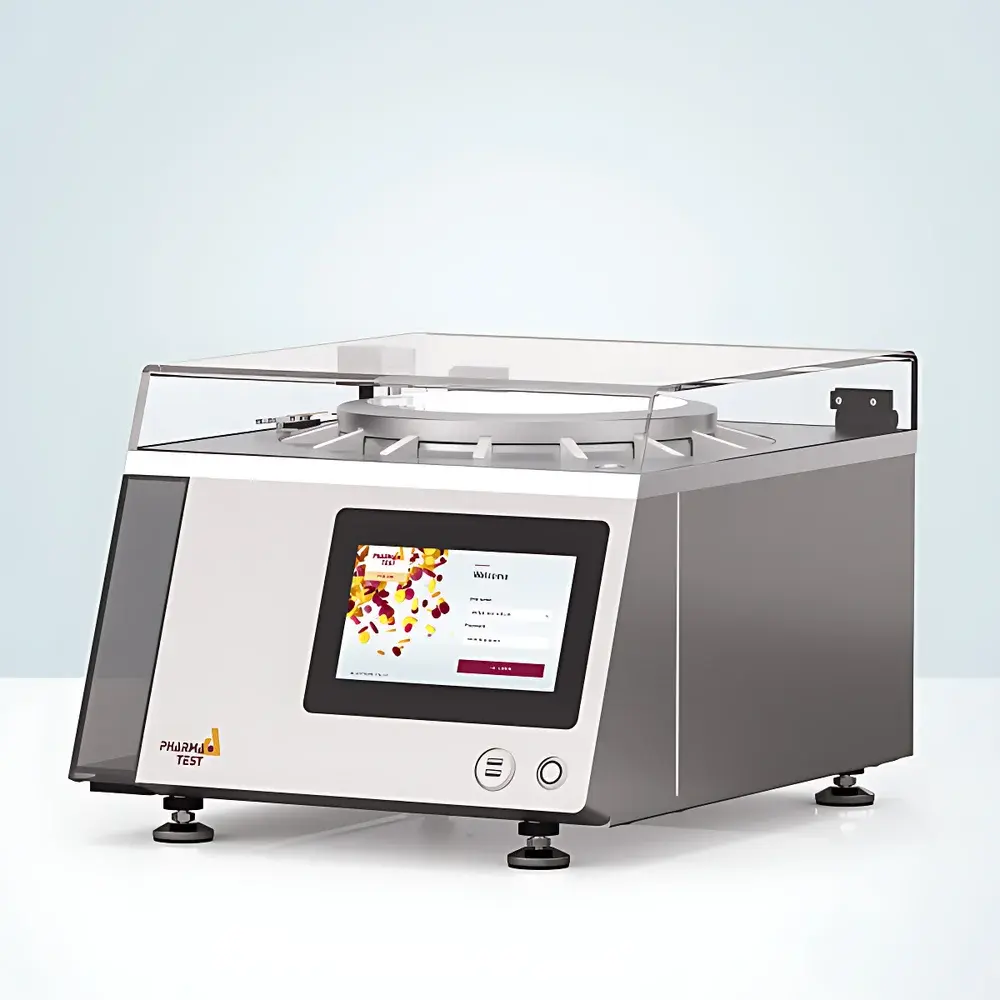
Pharma-test PTB 500 Semi-Automated Tablet Testing System
| Brand | Pharma-test |
|---|---|
| Origin | Germany |
| Model | PTB 500 |
| Compliance | USP <1217>, EP <2.9.8> |
| Test Modes | Dual-force (linear speed increase & linear force increase) |
| Measured Parameters | Hardness, Thickness, Width, Diameter/Length, Weight (via external analytical balance) |
| Integrated Components | Sample carousel, GUI-controlled actuation, statistical engine, network interface |
| Validation | Built-in multi-point validation protocol |
| Output | Force–displacement curve, full statistical summary (mean, SD, RSD, min/max), configurable print/export |
Overview
The Pharma-test PTB 500 Semi-Automated Tablet Testing System is an engineered solution for comprehensive physical characterization of solid oral dosage forms in regulated pharmaceutical quality control and development laboratories. Designed to operate under strict pharmacopoeial compliance, the PTB 500 implements deterministic mechanical testing based on controlled axial compression and dimensional metrology—principles aligned with the fundamental requirements of USP Chapter “Tablet Breaking Force” and European Pharmacopoeia monograph 2.9.8 “Hardness of Tablets”. Unlike fully manual testers or single-parameter instruments, the PTB 500 performs five coordinated measurements on a single tablet specimen without operator repositioning: hardness (breaking force in Newtons), thickness (mm), width (mm), diameter or length (mm), and mass (g, via external analytical balance interface). Its dual-force mode architecture supports both linear speed-controlled and linear force-controlled compression profiles—enabling method flexibility for evaluating brittle fracture behavior, plastic deformation thresholds, and consistency across diverse formulation types (e.g., direct-compressed, wet-granulated, or coated tablets).
Key Features
- Dual-force testing methodology: Selectable linear speed ramp (mm/s) or linear force ramp (N/s) modes for precise control over loading kinetics—critical for differentiating between formulation-dependent failure mechanisms.
- Integrated sample carousel: Holds up to 20 tablets; automated indexing ensures sequential, repeatable positioning under the load cell and optical sensors.
- Multi-parameter acquisition per specimen: Simultaneous capture of hardness, thickness, width, diameter/length, and weight—eliminating inter-test variability from manual handling.
- Pharmacopoeia-compliant hardware architecture: Load cell resolution ≤ 0.01 N, displacement sensor accuracy ±0.01 mm, and force application axis orthogonal to tablet surface per USP geometric specifications.
- Built-in multi-point validation protocol: Automated verification of force and displacement calibration at ≥3 points across the operational range—documented with timestamped audit trail for GLP/GMP traceability.
- Configurable force–displacement curve export: Raw data output in CSV format; programmable print or screen display of real-time compression curves with annotated yield point and peak force.
Sample Compatibility & Compliance
The PTB 500 accommodates standard tablet geometries—including round, oblong, caplet, and modified-release shapes—with dedicated tooling fixtures for consistent edge alignment during hardness measurement. It supports tablets ranging from 4 mm to 25 mm in diameter (or length) and up to 12 mm in thickness. All mechanical and software functions conform to the normative definitions and procedural constraints outlined in USP and Ph. Eur. 2.9.8, including platen parallelism tolerance, maximum allowable dwell time before force application, and minimum sampling frequency for statistical reporting. The system’s firmware and data handling logic are structured to support FDA 21 CFR Part 11 readiness when deployed with appropriate network authentication, electronic signature workflows, and audit trail configuration.
Software & Data Management
The embedded graphical user interface provides intuitive, icon-driven operation with multilingual support (English, German, French, Spanish) and context-sensitive help overlays. All test methods—including force ramp rate, dwell duration, acceptance criteria, and pass/fail logic—are stored as editable, version-controlled protocols. Statistical outputs include mean, absolute standard deviation (SD), relative standard deviation (RSD %), minimum, and maximum values for each parameter set. Data export supports CSV, PDF, and XML formats; network connectivity enables direct integration with LIMS or ELN platforms via TCP/IP or OPC UA. Audit trails record all user actions, parameter changes, calibration events, and test executions—including operator ID, timestamp, and IP address where applicable.
Applications
- QC release testing of commercial batches against compendial hardness and dimensional specifications.
- Formulation development studies assessing compressibility, tensile strength correlation, and excipient sensitivity.
- Stability program monitoring of mechanical property drift over accelerated or real-time storage conditions.
- Process validation support for tablet presses—correlating punch force profiles with final tablet hardness distributions.
- Investigations into coating integrity, capping propensity, and friability–hardness relationships.
FAQ
Does the PTB 500 comply with 21 CFR Part 11 requirements?
Yes—when configured with user authentication, electronic signatures, and enabled audit trail logging, the system meets technical prerequisites for Part 11 compliance. Full implementation requires site-specific validation documentation.
Can the PTB 500 measure tensile strength directly?
No—it measures breaking force under diametral compression. Tensile strength is calculated post-test using standardized equations (e.g., Hertzian or Fell–Newton models) applied to hardness, diameter, and thickness values.
Is external calibration certification included?
The instrument ships with factory calibration certificates traceable to national standards (DAkkS-accredited where applicable); periodic recalibration must be performed using certified reference weights and gauge blocks per ISO/IEC 17025 guidelines.
What analytical balance is recommended for weight integration?
Any METTLER TOLEDO, SARTORIUS, or SHIMADZU analytical balance with RS232 or USB interface and stable weighing platform (≥0.1 mg readability) is compatible via standard ASCII command protocol.
How is method transfer supported between PTB 500 units?
Test protocols, calibration files, and user-defined limits are exportable as encrypted .ptbconfig packages—ensuring identical method execution across multiple instruments in global manufacturing networks.




