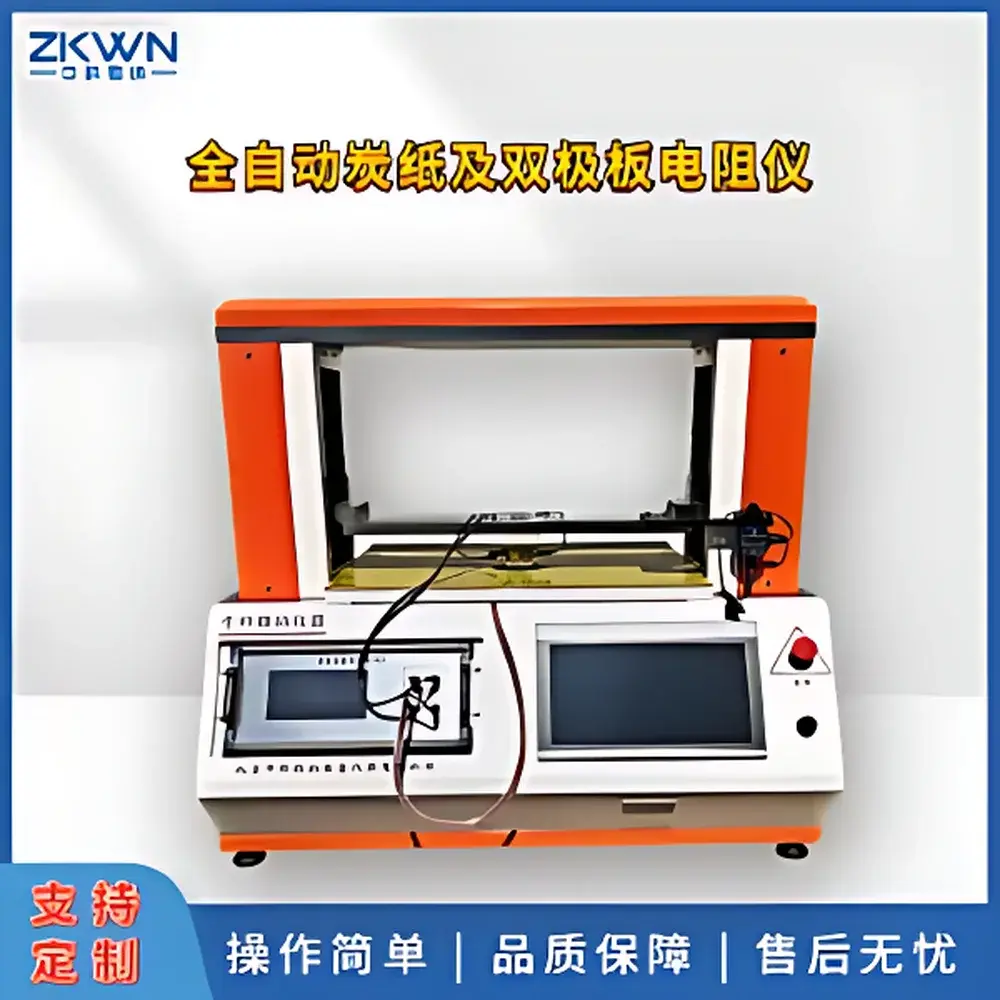
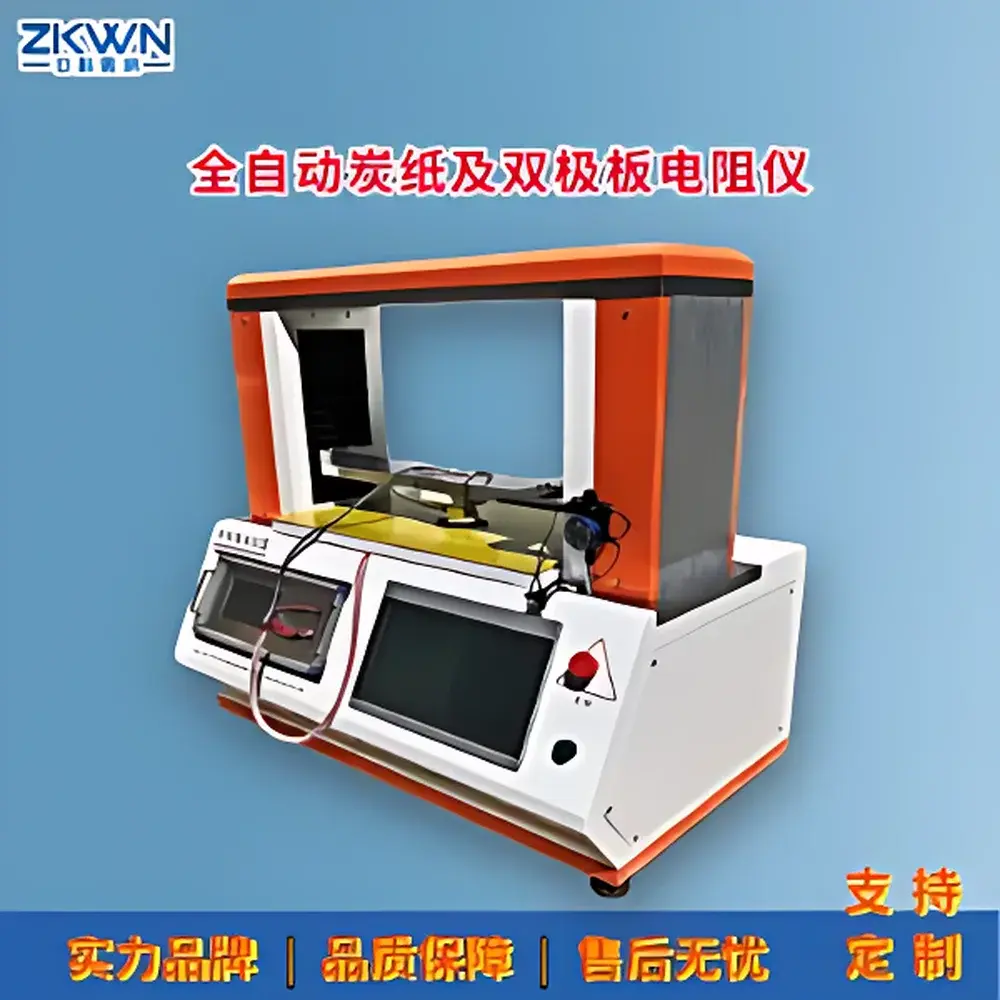
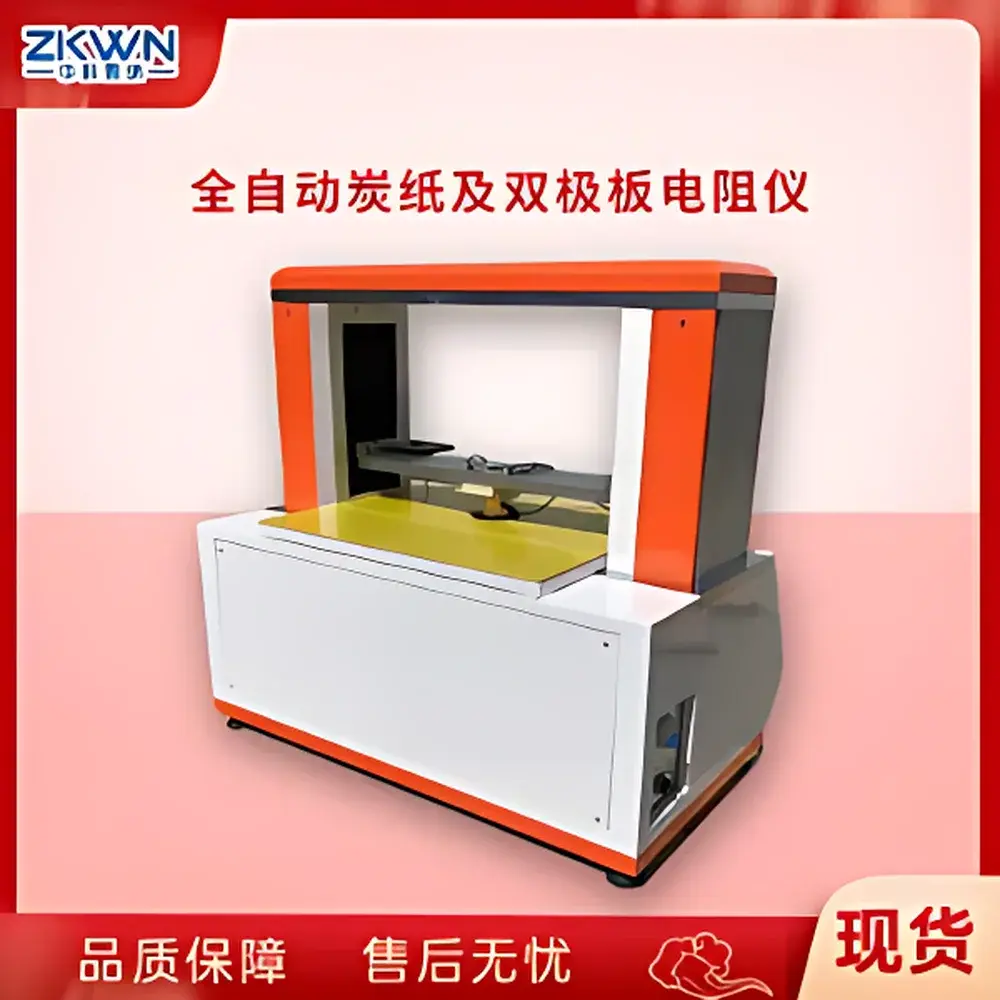
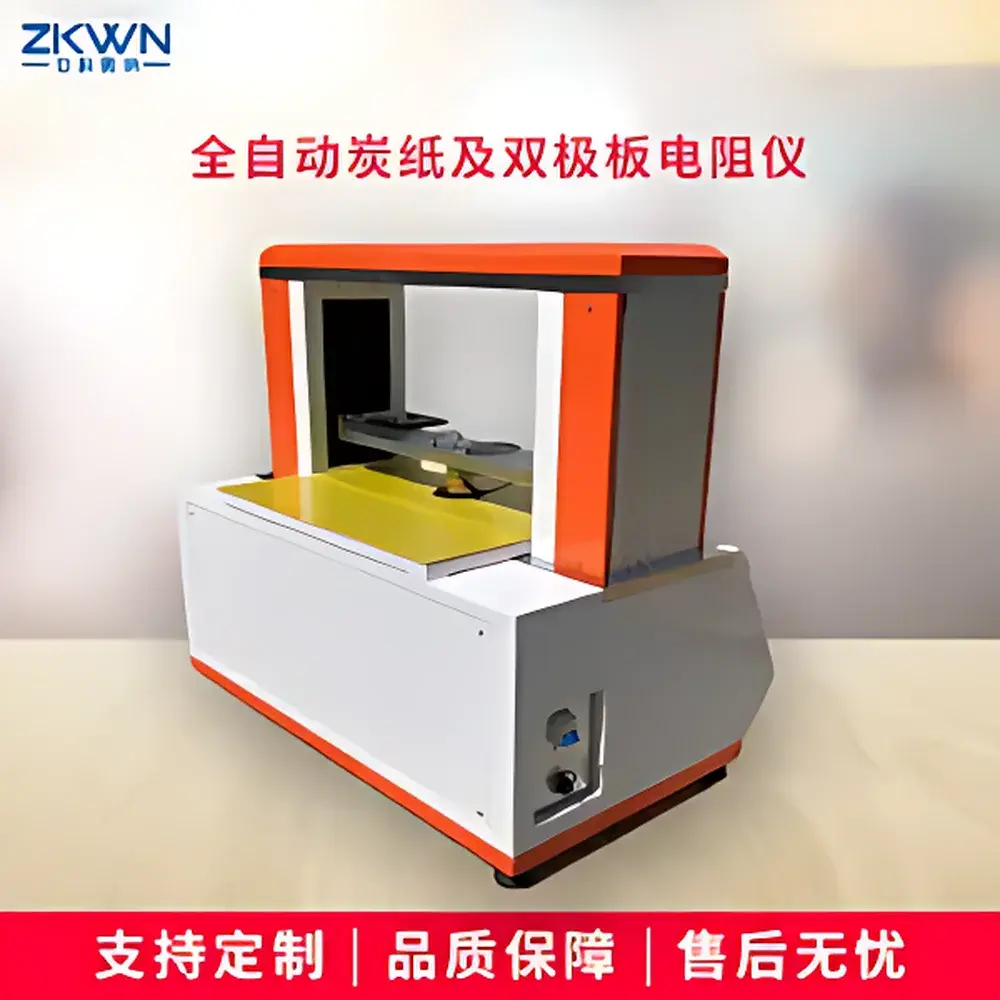
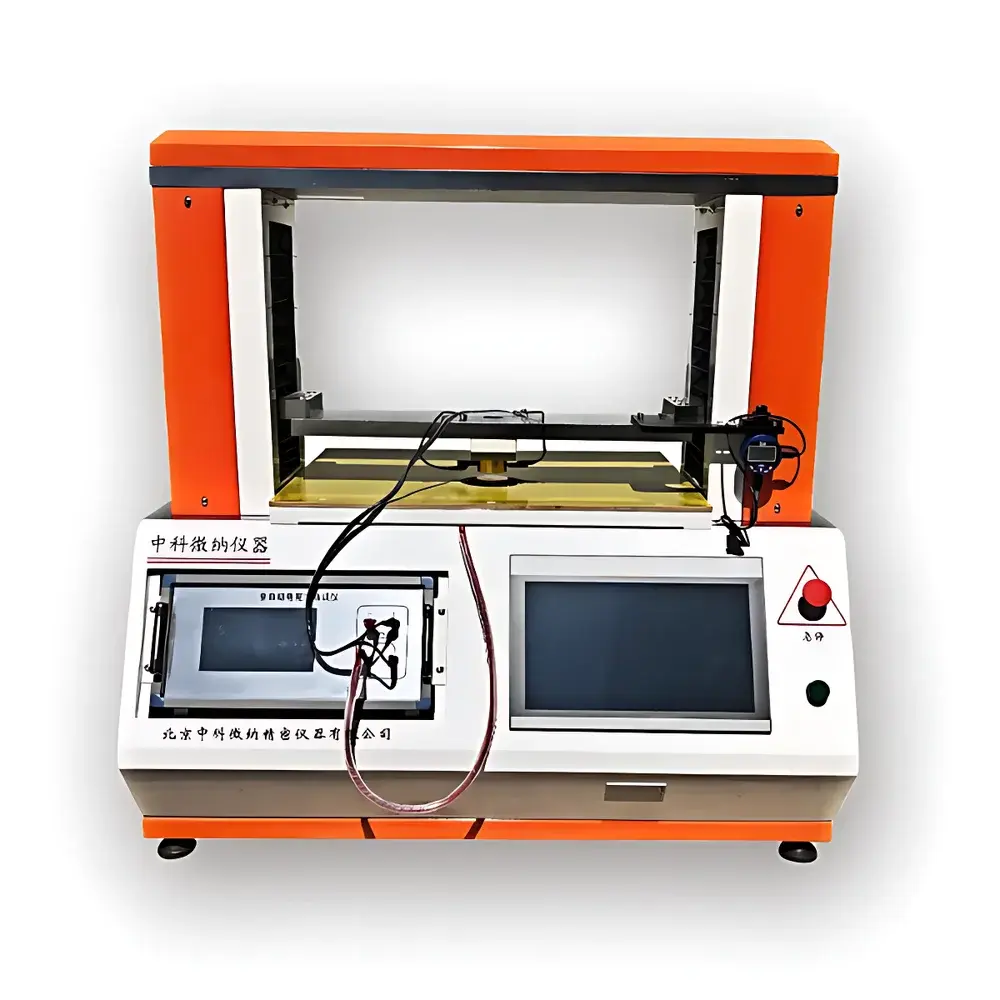
ZKWN GEST-20042 Automated Carbon Paper and Bipolar Plate Resistivity Tester
| Brand | ZKWN |
|---|---|
| Origin | Beijing, China |
| Model | GEST-20042 |
| Compliance Standards | GB/T 20042.7–2014, GB/T 20042.6–2011 |
| Measurement Modes | Through-plane (2-probe) and In-plane (4-probe) resistivity |
| Electrode Configuration | 50 mm gold-plated electrodes |
| Control Interface | 10-inch industrial touchscreen HMI |
| Test Automation | Fully automated pressure application, data acquisition, and post-test reset |
| Data Output | Real-time display and export of pressure, compressive strain, voltage, current, resistance, resistivity (mΩ·cm, Ω·cm, μΩ·m), conductivity (S/m, % IACS), and derived metrics (e.g., ΔR%, gradient-wise differential analysis) |
Overview
The ZKWN GEST-20042 Automated Carbon Paper and Bipolar Plate Resistivity Tester is a precision-engineered instrument designed for quantitative electrical characterization of gas diffusion layers (GDLs) and bipolar plates used in proton exchange membrane fuel cells (PEMFCs). It operates on fundamental principles of DC four-terminal (4-probe) and two-terminal (2-probe) resistivity measurement under controlled mechanical compression—enabling both in-plane (lateral) and through-plane (transverse) conductivity evaluation. The system implements ASTM D257-compliant low-voltage, high-accuracy resistance measurement while maintaining strict mechanical boundary conditions per GB/T 20042.6–2011 (bipolar plate characterization) and GB/T 20042.7–2014 (carbon paper testing). Its architecture integrates servo-driven force actuation with real-time feedback control, ensuring reproducible contact pressure (0–5 MPa range typical), precise thickness monitoring via integrated displacement transducers, and synchronized acquisition of electrical and mechanical parameters—critical for correlating microstructural deformation with bulk transport properties.
Key Features
- Fully automated electromechanical test sequence: pressure ramping, dwell, measurement, and auto-reset without manual intervention
- Dual-mode resistivity measurement: selectable 4-probe configuration for in-plane resistivity (eliminating contact resistance error) and 2-probe mode for through-plane resistivity under defined compressive stress
- Gold-plated 50 mm diameter electrodes ensure stable, oxidation-resistant current injection and voltage sensing across heterogeneous porous carbon substrates
- Real-time parametric display: simultaneous visualization of applied load (N), calculated pressure (MPa), sample thickness (µm), compression ratio (%), voltage (mV), current (mA), resistance (mΩ), resistivity (Ω·cm or µΩ·m), and conductivity (S/m)
- Multi-regime test protocols: constant-force, constant-pressure, stepwise pressure gradients, stepwise pressure-ratio gradients, and programmable compression ratio profiles
- On-device statistical engine: automatic calculation of inter-step resistance differentials (ΔR), relative change (%), and cumulative deviation trends across up to 10 user-defined compression levels
- Embedded 10-inch industrial HMI with intuitive touch interface; firmware supports over-the-air updates via Ethernet or USB
Sample Compatibility & Compliance
The GEST-20042 accommodates standard PEMFC component geometries: carbon papers (typically 100 × 100 mm or 150 × 150 mm), machined graphite or metal bipolar plates (up to 200 × 200 mm footprint), and coated or untreated GDL substrates. Sample thickness range: 0.1–3.0 mm. All measurement routines adhere to national standards GB/T 20042.6–2011 and GB/T 20042.7–2014, which align with ISO 14687–2:2012 (hydrogen fuel quality) and IEC 62282–6–100:2021 (fuel cell modules) regarding material qualification testing. While not certified to GLP or FDA 21 CFR Part 11 out-of-box, the system’s audit-ready data logs—including timestamps, operator ID fields, and full parameter traceability—support integration into validated laboratory environments compliant with ISO/IEC 17025 requirements.
Software & Data Management
Data acquisition and control are managed by embedded Linux-based firmware with deterministic real-time scheduling. Each test generates a timestamped CSV file containing all raw and derived parameters at ≥10 Hz sampling rate. Export options include local USB storage, network file transfer (SFTP), and optional OPC UA server integration for MES/SCADA linkage. The interface supports unit switching (e.g., resistivity in Ω·cm, mΩ·cm, or µΩ·m; conductivity in S/m or % IACS) and configurable report templates compatible with LIMS ingestion. Audit trails record operator login, method selection, calibration events, and any parameter override—ensuring traceability required for internal QA documentation.
Applications
- Quality control of carbon fiber paper batches for uniformity in through-plane resistivity under operational compression loads
- Evaluation of coating integrity (e.g., PTFE, conductive polymers) on GDLs via in-plane resistance mapping
- Comparative analysis of graphite vs. stainless steel bipolar plates under thermal-mechanical cycling simulation
- R&D of novel composite bipolar materials where anisotropic conduction must be decoupled from interfacial contact resistance
- Supporting DOE targets for <10 mΩ·cm² area-specific resistance (ASR) in next-generation PEMFC stacks
- Pre-screening of recycled carbon materials for reusability based on resistivity recovery after compression-relaxation cycles
FAQ
What standards does the GEST-20042 directly support?
It implements test procedures specified in GB/T 20042.6–2011 (bipolar plates) and GB/T 20042.7–2014 (carbon papers), which reference underlying metrological principles aligned with ASTM D257 and ISO 3915 for electrical resistance of insulating materials.
Can the instrument perform measurements without operator supervision?
Yes—once a test protocol is loaded and sample positioned, the system executes the full sequence autonomously, including pressure application, data acquisition, statistical analysis, and mechanical reset.
Is calibration traceable to national metrology institutes?
The force sensor is factory-calibrated against NIM-traceable deadweight standards; resistivity measurement circuitry is verified using certified 4-wire shunt resistors (0.1 mΩ to 10 Ω, ±0.02% tolerance).
Does the system support custom test scripting?
The embedded controller accepts Python-based macro scripts via secure shell (SSH) for advanced users requiring non-standard ramp profiles or conditional logic.
What is the maximum recommended sample thickness for reliable through-plane measurement?
For optimal signal-to-noise ratio and mechanical stability, samples between 0.2 mm and 2.5 mm thickness yield highest repeatability; thinner specimens require auxiliary support fixtures to prevent buckling.