
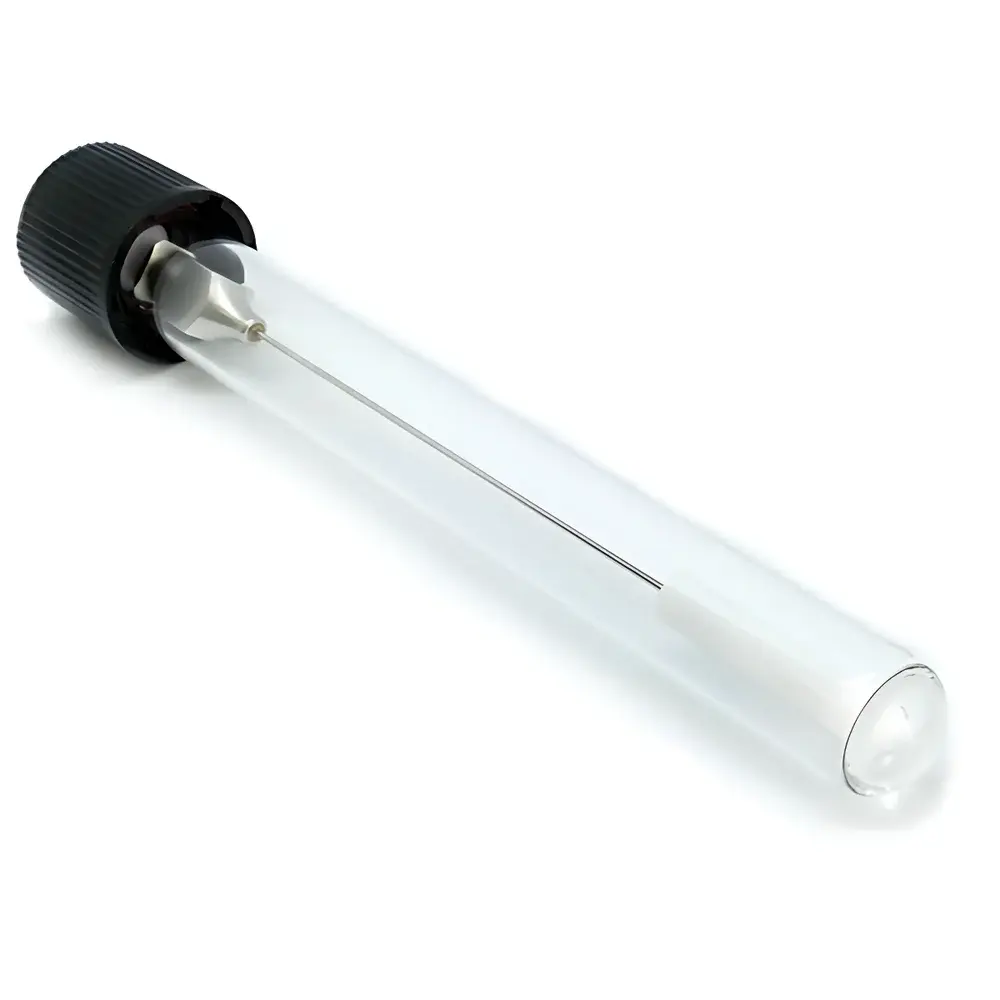
INNOTEG NT Needle Trap Device
| Brand | INNOTEG |
|---|---|
| Origin | Guangdong, China |
| Manufacturer Type | Authorized Distributor |
| Origin Category | Domestic (China) |
| Model | NT Needle Trap |
| Pricing | Upon Request |
| Connector | Luer-Lock |
| Length | 50–70 mm |
| Inner Diameter Options | 0.4 mm (23G), 0.4 mm / 0.72 mm (22G), 0.35 mm / 0.64 mm (23G) |
| Tip Geometry | Conical with side port, blunt tip, or custom-configurable |
| Packing Material | User-selectable solid-phase sorbents (e.g., Tenax TA, Carbopack X, Carboxen 1000) |
| Thermal Desorption Time | ≤30 s |
| Detection Range | Sub-ppb to ppt-level VOCs in gaseous matrices |
| Solvent-Free Operation | Yes |
| Storage Stability | Sealed with PTFE caps at both ends |
Overview
The INNOTEG NT Needle Trap Device is a precision-engineered, solvent-free microextraction tool designed for trace-level volatile organic compound (VOC) analysis in gaseous samples. Based on dynamic needle trap (NT) technology, it integrates sampling, extraction, preconcentration, and thermal desorption into a single, compact consumable unit. Unlike conventional solid-phase microextraction (SPME) fibers or thermal desorption tubes, the NT device embeds a precisely packed sorbent bed directly within the stainless-steel needle lumen — enabling high-efficiency adsorption under controlled flow conditions. Its operation relies on dynamic equilibrium partitioning between the gas phase and the immobilized sorbent surface, followed by rapid resistive heating (≤30 s) without cryogenic focusing. This eliminates peak broadening associated with cold-trap refocusing and supports high chromatographic fidelity, particularly for low-molecular-weight VOCs (e.g., C2–C6 hydrocarbons, formaldehyde, acetaldehyde, chloromethanes). The device is fully compatible with standard GC/GC–MS autosamplers equipped with Luer-Lock inlet adapters and operates under ambient or field-deployable conditions.
Key Features
- Modular sorbent configuration: Supports user-defined packing of three commercially available sorbents — Tenax TA (for mid-to-high volatility compounds), Carbopack X (enhanced retention of C2–C4 aliphatics), and Carboxen 1000 (high surface area, optimal for permanent gases and light VOCs).
- Luer-Lock interface ensures leak-tight, repeatable coupling to GC inlet systems and portable sampling manifolds.
- Three standardized gauge options (22G and 23G) with defined inner/outer diameters (0.35–0.72 mm ID) allow optimization of mass transfer kinetics and breakthrough volume per application.
- Conical needle geometry with side-port design maximizes analyte exposure while minimizing flow resistance and channeling effects.
- PTFE end caps provide inert, hermetic sealing for post-sampling storage up to 72 hours at ambient temperature — validated for stability of target VOCs including benzene, toluene, ethylbenzene, xylenes (BTEX), and halogenated methanes.
- No cryogenic hardware required: Integrated resistive heating enables direct thermal desorption into the GC injector, reducing system complexity and operational cost.
Sample Compatibility & Compliance
The NT Needle Trap is validated for direct headspace, ambient air, industrial stack effluent, and breath gas analysis. It meets method requirements aligned with EPA Method TO-17 (determination of VOCs in air by sorbent tube sampling and thermal desorption/GC–MS) and ISO 16000-6:2011 (indoor air — determination of volatile organic compounds). While not an instrument per se, its use supports GLP-compliant workflows when integrated into validated analytical sequences. Sorbent selection and trapping parameters (flow rate, time, humidity correction) are documented per ISO/IEC 17025:2017 clause 7.2.2 for method validation reporting. Device sterility and extractables profiles conform to USP for polymeric components (PTFE caps).
Software & Data Management
As a passive consumable, the NT Needle Trap requires no embedded firmware or driver software. However, its integration into automated GC workflows is supported via standard autosampler control protocols (e.g., Agilent ALS, Gerstel MPS, CTC CombiPAL). Instrument method files can encode trap-specific parameters — including desorption temperature ramp (typically 250–320 °C), hold time (15–30 s), and purge flow — ensuring reproducible transfer efficiency. Audit trails for batch usage, lot-specific sorbent certification, and calibration verification records are maintained within laboratory information management systems (LIMS) compliant with FDA 21 CFR Part 11 when paired with electronic signature-enabled platforms.
Applications
- Environmental monitoring: Real-time detection of BTEX, MTBE, and chlorinated solvents in ambient air and soil vapor.
- Occupational health & safety: Personal exposure assessment for workplace VOCs using portable pump-driven sampling.
- Food & flavor analysis: Headspace profiling of roasted coffee, fermented dairy, and packaged beverages.
- Clinical research: Exhaled breath biomarker screening (e.g., isoprene, acetone, pentanal) in metabolic disorder studies.
- Materials outgassing testing: Qualitative and quantitative evaluation of VOC emissions from polymers, adhesives, and composites per ASTM D6886.
FAQ
Can the NT Needle Trap be reused?
Yes — up to five cycles under controlled desorption conditions (≤300 °C, inert carrier gas purge); performance verification via blank runs is recommended before each reuse.
Is conditioning required prior to first use?
Yes — preconditioning at 280 °C for 30 minutes under helium flow removes residual volatiles and stabilizes baseline response.
What is the maximum sampling flow rate?
Optimal range is 10–100 mL/min; higher flows may cause breakthrough for polar, low-boiling analytes such as methanol or acetaldehyde.
How does humidity affect trapping efficiency?
Relative humidity >70% may reduce recovery of highly polar VOCs; co-trapping with silica gel or use of humidity-compensated calibration standards is advised.
Are custom sorbent configurations available?
Yes — INNOTEG offers OEM packing services for dual- or triple-bed configurations optimized for specific compound classes, subject to minimum order quantities and analytical validation support.



