
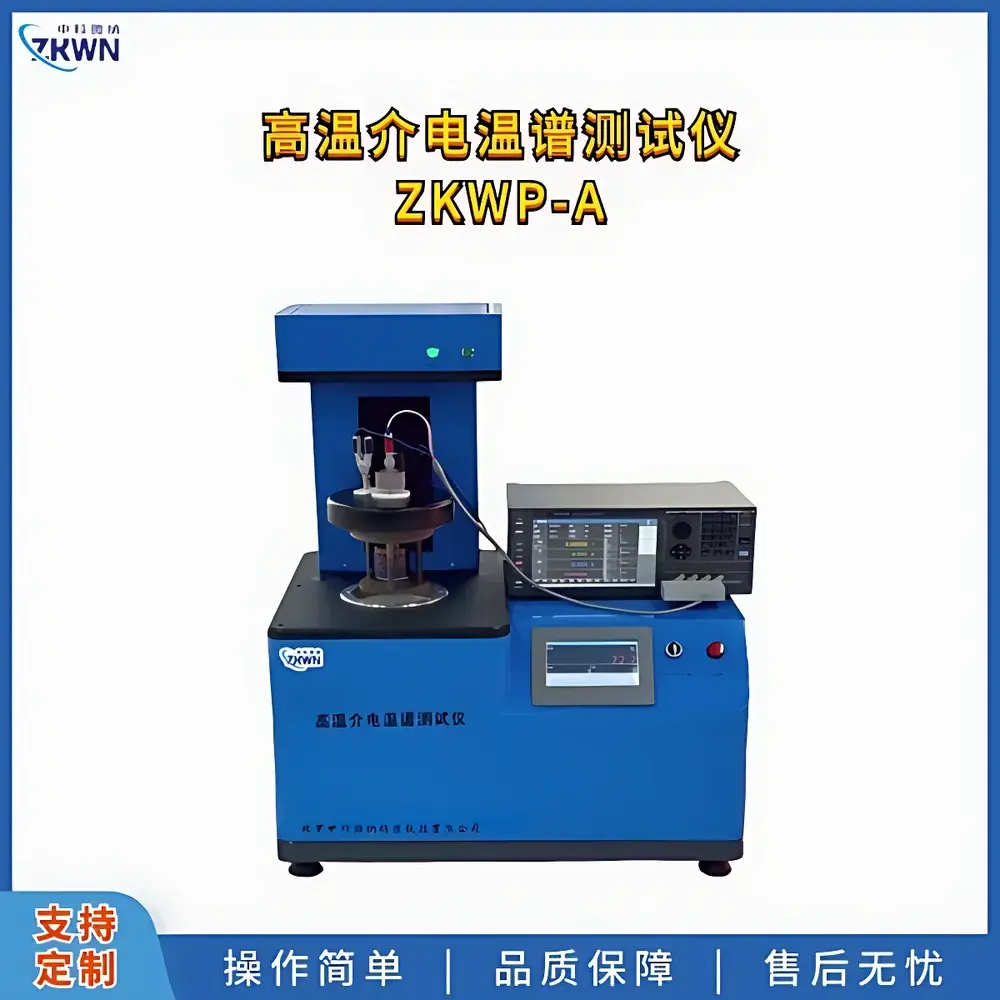
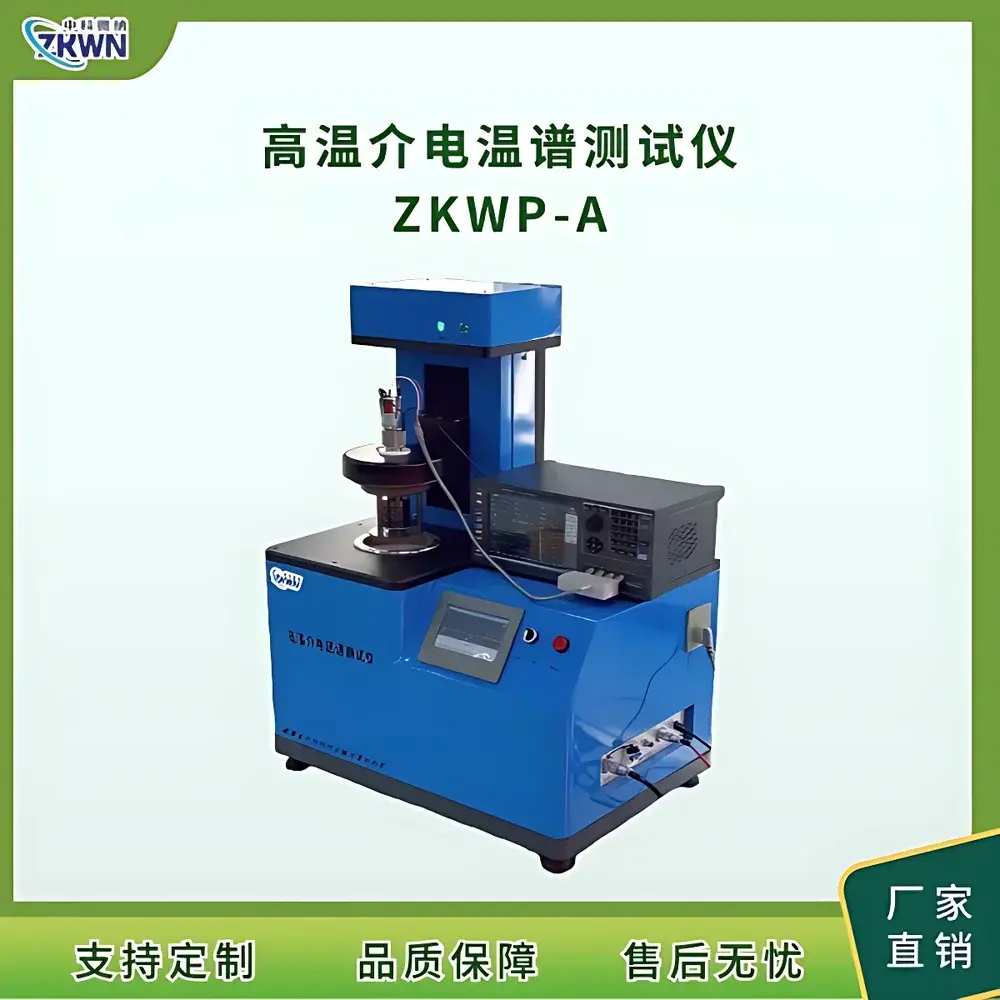
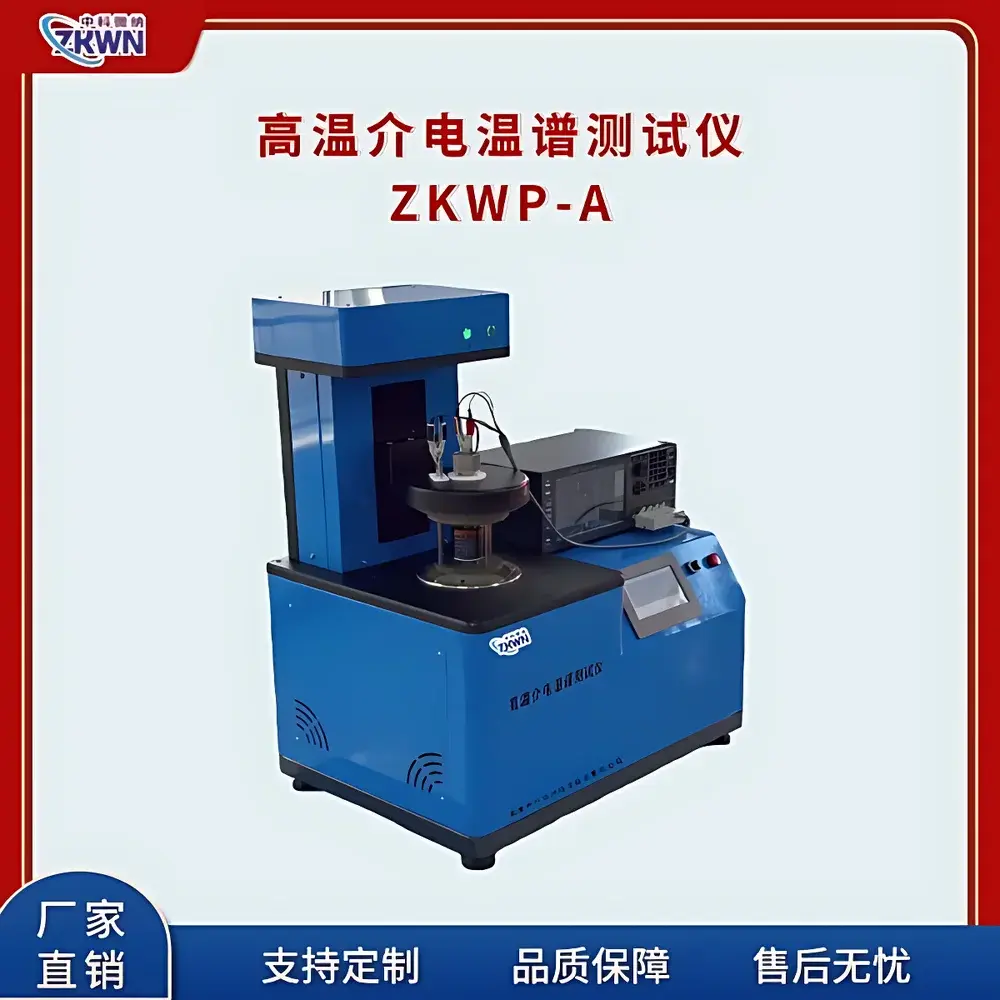
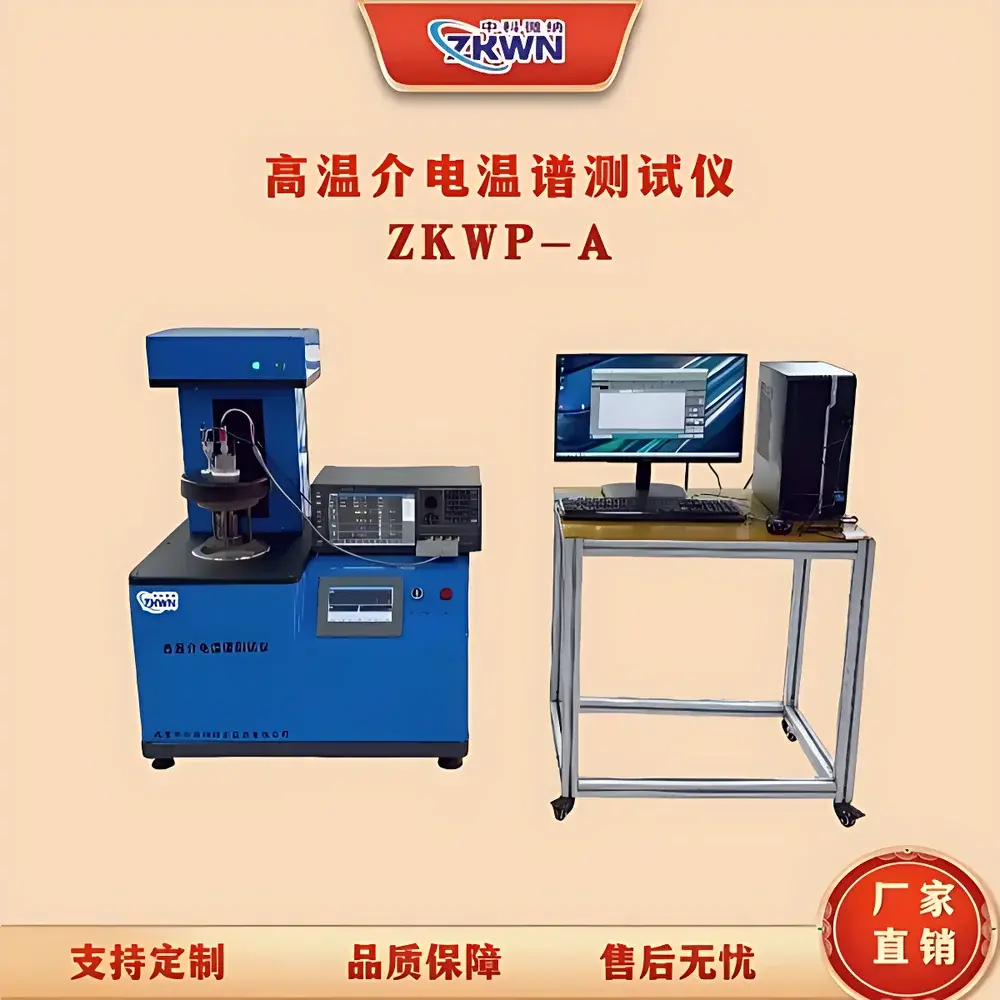
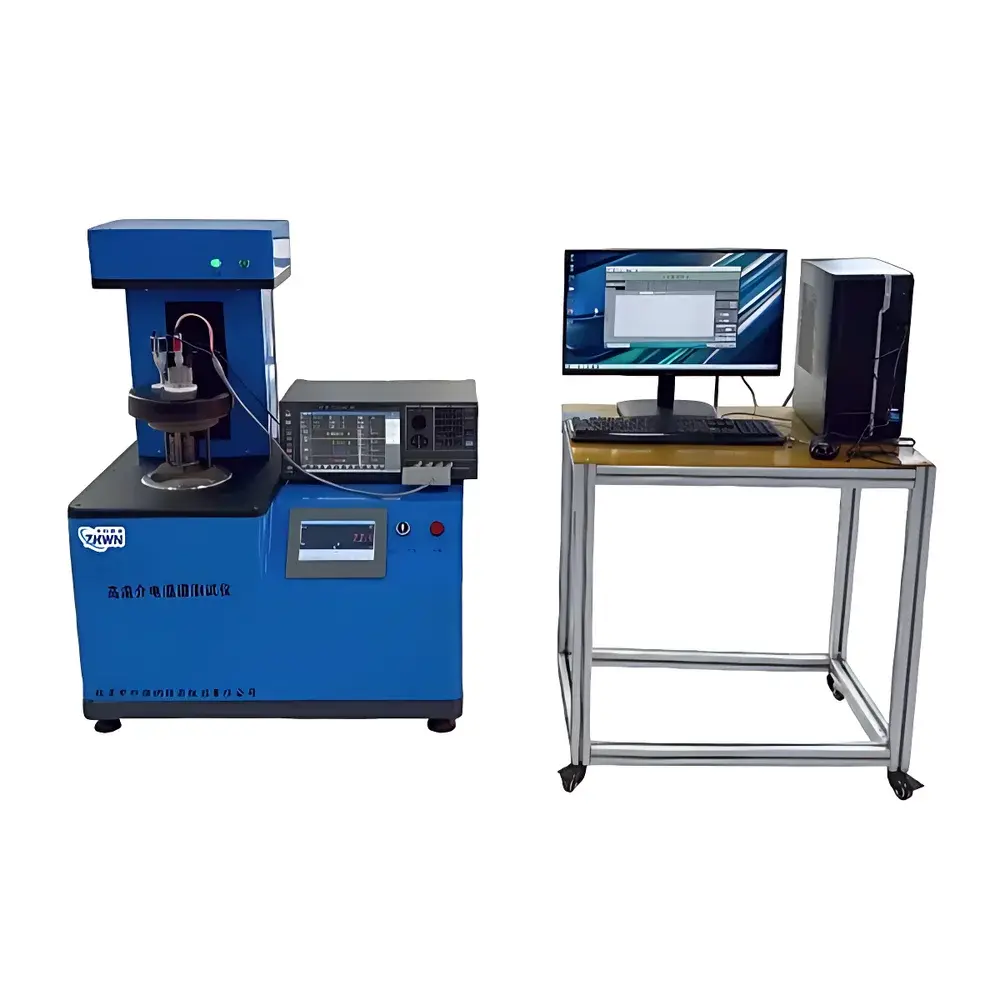
ZKWN ZKWP-A High-Temperature Dielectric Temperature & Frequency Spectroscopy System
| Brand | ZKWN |
|---|---|
| Origin | Beijing, China |
| Manufacturer Type | Authorized Distributor |
| Country of Origin | China |
| Model | ZKWP-A |
| Price | USD 2,150 (FOB Beijing) |
| Heating Method | Electric Resistance Heating |
| Cooling Method | Liquid Nitrogen Cryogenic Cooling |
| Temperature Control Accuracy | ±0.5 °C |
| Temperature Range | −30 °C to +200 °C |
| Electrode Material | Brass |
| Electrode Diameter | 25 mm |
| Test Frequency Range | 20 Hz to 2 MHz |
| Compliance | GB/T 1409–2006, GB/T 1693–2007, ASTM D150, IEC 60250 |
Overview
The ZKWN ZKWP-A High-Temperature Dielectric Temperature & Frequency Spectroscopy System is a precision benchtop instrument engineered for the quantitative characterization of complex permittivity (ε* = ε′ − jε″) and dielectric loss tangent (tan δ) across controlled thermal and frequency domains. It operates on the principle of impedance spectroscopy using a guarded parallel-plate electrode configuration, enabling stable capacitance and conductance measurements under dynamic thermal conditions. Designed specifically for solid and semi-rigid dielectric materials—including ceramics, polymer composites, metal oxides, glass, mica, and advanced insulating plastics—the system delivers reproducible data critical for structure–property correlation in functional material development. Its integrated thermal control architecture supports both continuous heating and cryogenic cooling, allowing users to map phase transitions, relaxation processes, and thermally activated conduction mechanisms with high thermal resolution.
Key Features
- Wide operational temperature range from −30 °C to +200 °C, achieved via dual-mode thermal regulation: resistive heating for precise ramping and liquid nitrogen cooling for sub-ambient stabilization
- High-stability brass parallel-plate electrodes (25 mm diameter) with gold-plated contact surfaces to minimize interfacial resistance and ensure uniform field distribution
- Frequency sweep capability from 20 Hz to 2 MHz, supporting both low-frequency dipole relaxation analysis and high-frequency interfacial polarization assessment
- Temperature control accuracy of ±0.5 °C over full range, verified by calibrated Pt100 sensor embedded within the electrode stage
- Modular hardware design compliant with IEEE 488.2 (GPIB) and USB 2.0 interfaces for seamless integration into automated test benches
- Real-time impedance monitoring with auto-balancing bridge architecture, minimizing stray capacitance and cable-induced phase errors
Sample Compatibility & Compliance
The ZKWP-A accommodates flat, non-porous solid specimens up to 25 mm in diameter and 0.5–5 mm in thickness, including sintered ceramics, pressed polymer pellets, thin-film coatings on conductive substrates (with guard ring compensation), and rigid composite laminates. Sample mounting follows standardized procedures outlined in GB/T 1409–2006 (equivalent to IEC 60250) for permittivity measurement at power, audio, and radio frequencies, as well as GB/T 1693–2007 for vulcanized rubber systems. All thermal protocols—whether isothermal sweeps, linear ramping, or step-and-hold cycles—are traceable to NIST-traceable temperature references. The system meets essential requirements for GLP-compliant laboratories, supporting audit-ready metadata logging (time, temperature, frequency, voltage bias, and raw LCR values) per ISO/IEC 17025 guidelines.
Software & Data Management
The proprietary ZKWP Control Suite (v3.2) provides a deterministic, scriptable environment for multi-dimensional dielectric mapping. It implements four primary test modes: (1) ambient single-frequency acquisition; (2) ambient frequency sweep (logarithmic or linear); (3) temperature-swept dielectric profiling (heating only); and (4) reversible temperature cycling (heat-cool-heat). Each mode records synchronized timestamped datasets containing real and imaginary components of impedance, calculated ε′, ε″, tan δ, and conductivity σ. Export formats include CSV (tabular), HDF5 (hierarchical scientific data), and XML (metadata-rich). The software enforces user-level access control, electronic signature prompts for method validation, and immutable audit trails satisfying FDA 21 CFR Part 11 requirements for regulated R&D environments.
Applications
- Characterization of ferroelectric phase transitions in BaTiO₃-based ceramics through ε′(T) anomalies near Curie temperature
- Quantifying ion mobility activation energy in solid polymer electrolytes via Arrhenius analysis of σ(T) and tan δ(T)
- Evaluating moisture-induced degradation in epoxy encapsulants by tracking low-frequency dispersion shifts during humidity-temperature aging
- Correlating filler dispersion homogeneity in nanocomposites with high-frequency ε″ minima and Cole–Cole plot geometry
- Validating thermal stability of high-k gate dielectrics for semiconductor packaging under accelerated thermal cycling protocols
- Supporting ASTM D150-compliant qualification of aerospace-grade insulation materials for extreme-environment avionics
FAQ
What sample preparation is required prior to measurement?
Flat, parallel-faced specimens must be polished to surface roughness < 0.8 µm Ra and cleaned ultrasonically in anhydrous isopropanol. Electrode contact area must be free of voids or particulate contamination.
Can the system perform simultaneous bias-voltage and temperature sweeps?
Yes—DC bias up to ±100 V is supported during thermal or frequency scans, enabling leakage current and field-dependent permittivity studies.
Is calibration traceable to national standards?
Factory calibration includes verification against NIST-traceable LCR standards (Keysight E4980AL reference) and PTB-certified temperature sensors; optional annual recalibration service available.
Does the software support custom scripting for DOE-based experimental sequences?
Yes—Python API integration (via PyVISA) allows programmatic control of all hardware parameters and automated execution of factorial or response-surface methodology test plans.
What safety certifications does the instrument carry?
CE marking per EN 61010-1:2019 (Safety Requirements for Electrical Equipment for Measurement, Control, and Laboratory Use) and RoHS 3 compliance are fully documented in the technical manual.



