
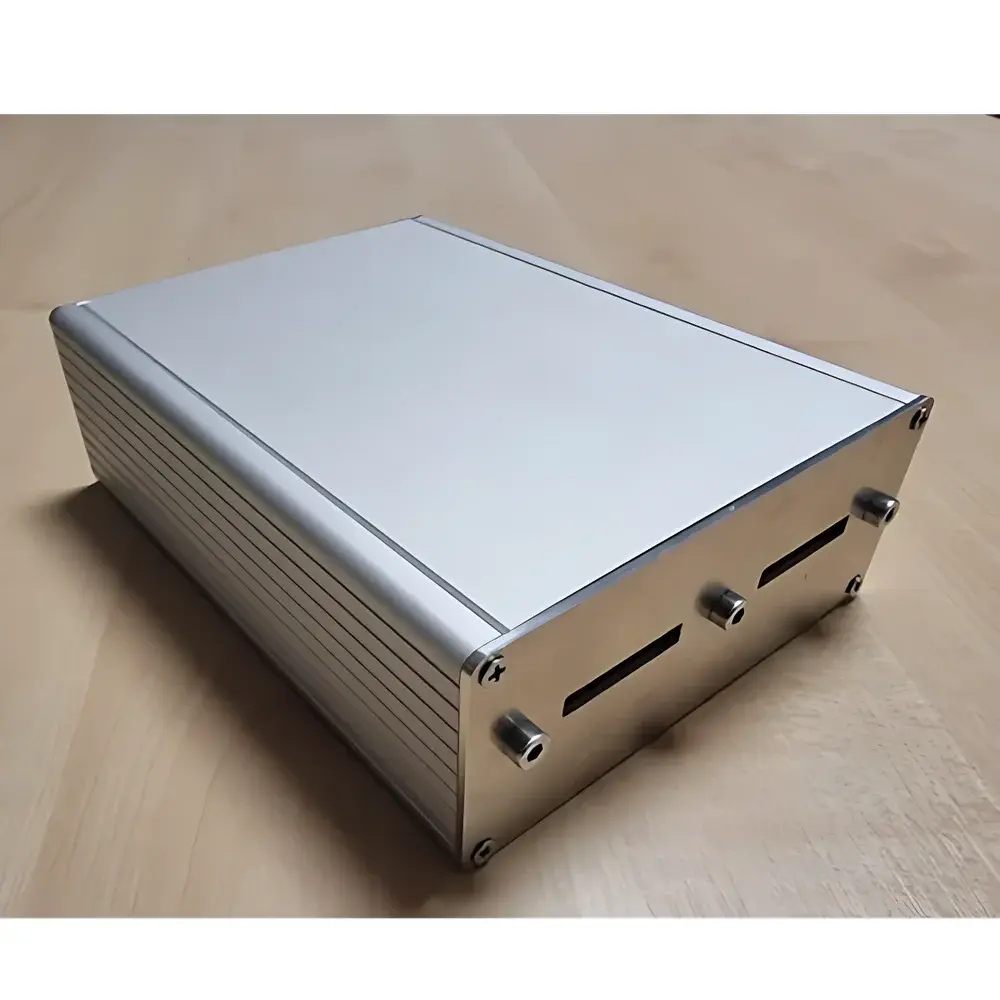
Airel TIC TinyIonCounter Micro-Cluster Ion Counter
| Brand | Airel |
|---|---|
| Origin | Imported (Non-China) |
| Manufacturer Type | Authorized Distributor |
| Model | TIC |
| Measurement Principle | Parallel-Plate Electromobility Analysis with Integrated Electrometer |
| Ion Mobility Range | Z > ±0.5 cm²/V/s |
| Measured Species | Total Positive & Negative Cluster Ions |
| Flow Rate | 2–9 L/min (Standard: 5 L/min, Unipolar Mode) |
| Noise Floor | <100 ions/cm³ (at 5 L/min sample flow) |
| Response Time | 10 s (down to 1 s at high signal levels) |
| Operating Temperature | −20 to +40 °C |
| Ambient Pressure Range | 500–1200 hPa |
| Power Supply | DC 15 V, 0.5 A (nominal), 1 A (max flow) |
| Interface | USB-C Virtual Serial Port (Full Protocol Documentation Available) |
| Concentration Range | Up to ~10⁶ particles/cm³ |
| Software | Cross-Platform GUI & CLI Tools (Windows 7+, Linux), Python SDK (OS-agnostic) |
| Dimensions | H50 × W120 × L160 mm |
| Weight | 11 kg |
Overview
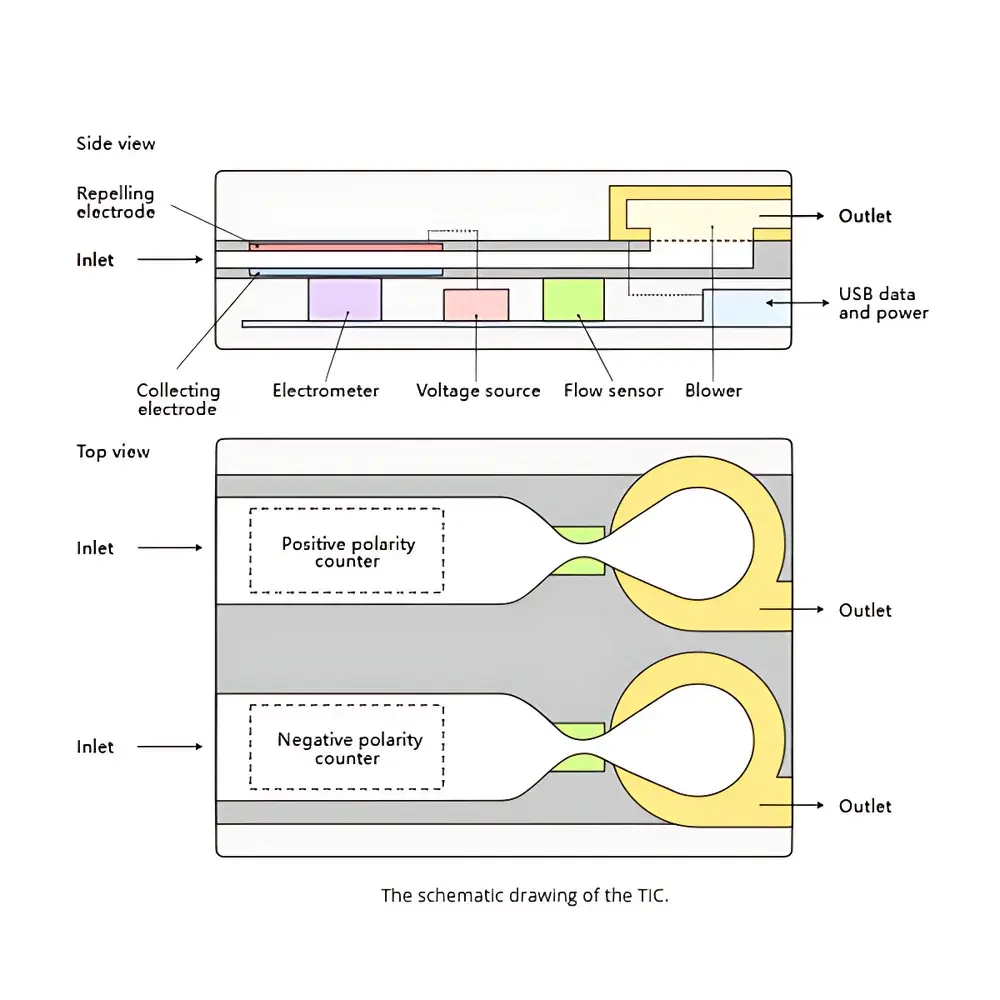
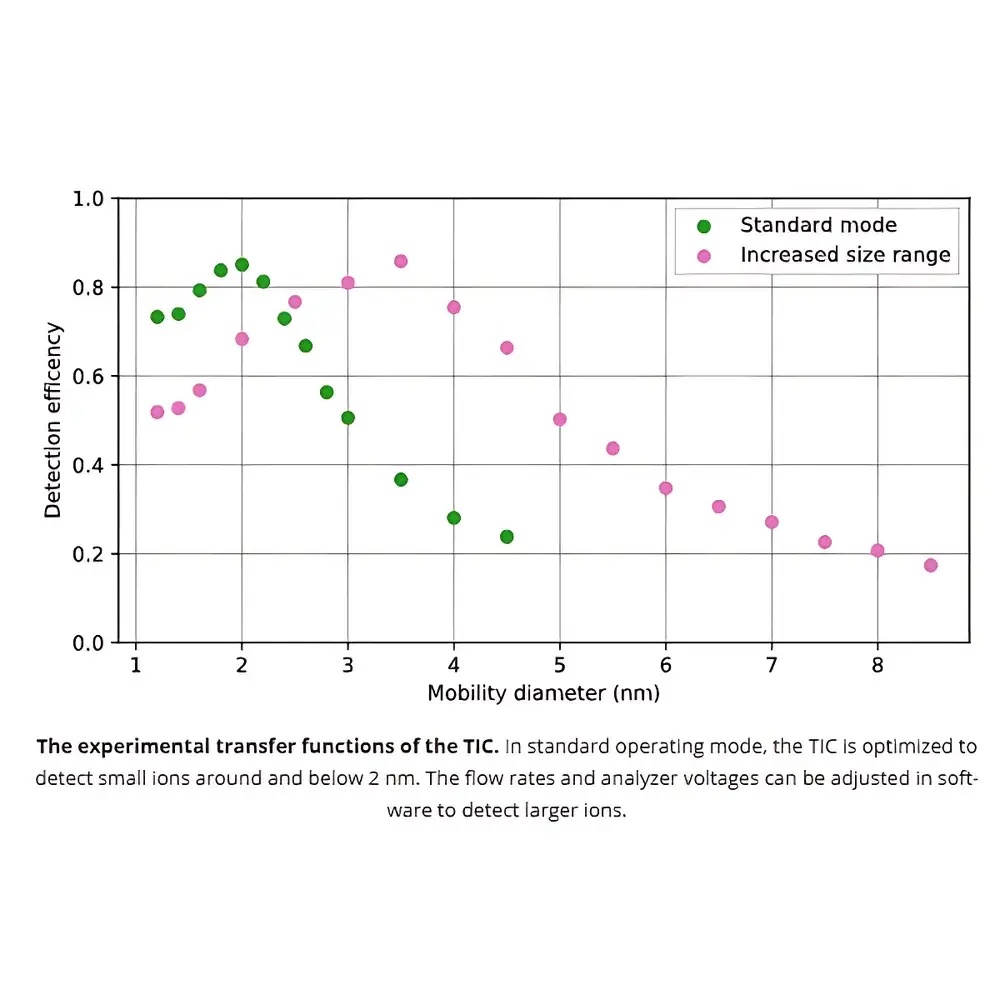
The Airel TIC (TinyIonCounter) is a compact, field-deployable micro-cluster ion counter engineered for continuous, quantitative measurement of total positive and negative atmospheric cluster ion concentrations. Unlike conventional condensation particle counters (CPCs) or aerosol electrometers, the TIC employs parallel-plate electromobility analysis—a principle rooted in the fundamental relationship between ion charge, electric field strength, and gas-phase mobility—to selectively detect and quantify ions with mobility greater than ±0.5 cm²/V/s. This corresponds to molecular clusters ranging from ~0.5 to ~2.0 nm in equivalent spherical diameter—species critical to atmospheric nucleation, indoor air chemistry, and ion-mediated oxidation pathways. Designed for unattended operation in diverse environmental settings—from urban monitoring stations and HVAC-integrated air quality networks to UAV-borne atmospheric profiling—the TIC delivers metrologically traceable ion concentration data without reliance on radioactive or photoionization sources. Its architecture meets core requirements for long-term stability in ambient air monitoring: low drift, self-diagnostic firmware, and immunity to humidity-induced electrostatic artifacts within its specified pressure and temperature envelope.
Key Features
- Compact form factor (50 × 120 × 160 mm) and lightweight design (11 kg) enable integration into mobile platforms—including drones, backpack-mounted sensor arrays, and embedded environmental kiosks.
- Robust electromobility classifier with integrated high-impedance electrometer ensures stable baseline performance across variable pressure (500–1200 hPa) and temperature (−20 to +40 °C) conditions—critical for high-altitude or seasonal deployment.
- Programmable sample flow (2–9 L/min, default 5 L/min unipolar mode) allows optimization for sensitivity (low flow) or temporal resolution (high flow), with real-time flow calibration via internal thermal mass flow sensor.
- Onboard diagnostics continuously monitor electrode voltage stability, electrometer offset, flow consistency, and power rail integrity—logging anomalies with timestamps for GLP-compliant audit trails.
- USB-C virtual serial interface provides deterministic, low-latency data streaming (ASCII-based protocol) compatible with SCADA systems, MQTT brokers, and custom IoT edge gateways—no proprietary drivers required.
Sample Compatibility & Compliance
The TIC is validated for direct sampling of ambient air, conditioned indoor air, and ducted ventilation streams without pre-filtration or dilution. It complies with ISO 16000-32 (indoor air—determination of airborne ions) methodology principles and supports alignment with EPA/NIOSH guidance for ion exposure assessment. The instrument’s electromobility cutoff (Z > ±0.5 cm²/V/s) excludes larger charged aerosols and ensures specificity for thermodynamically stable cluster ions (e.g., H⁺(H₂O)ₙ, NO₃⁻(HNO₃)ₘ, CO₃⁻·(H₂O)ₖ). No radioactive sources are used; all ion generation is passive (ambient ionization only). Firmware supports configurable data logging intervals (1 s to 1 hr), automatic zero-check routines, and timestamp synchronization via NTP over Ethernet-to-USB adapters—enabling compliance with ISO/IEC 17025 data integrity requirements when deployed in accredited laboratories.
Software & Data Management
Airel provides two native software layers: (1) a Windows/Linux GUI application featuring real-time ion concentration plots, mobility distribution histograms (via post-processed inversion), and export to CSV/NetCDF; and (2) a documented Python SDK (pip-installable, no dependencies) supporting automated calibration, batch processing, and integration into Jupyter-based QA/QC workflows. All software implements SHA-256 checksummed firmware updates and stores raw electrometer voltage traces alongside metadata (flow, temperature, pressure, battery voltage). Audit logs record user-initiated actions (e.g., zeroing, range switching) with system timestamps—meeting FDA 21 CFR Part 11 electronic record requirements when used in regulated environments. Raw data files include embedded instrument ID, serial number, and calibration certificate hash for full chain-of-custody traceability.
Applications
- Long-term validation of bipolar ionization devices in commercial HVAC systems—quantifying net ion yield, decay kinetics, and spatial uniformity across zones.
- Atmospheric boundary layer studies: mapping vertical ion gradients using tethered balloon or drone payloads, correlating cluster ion density with nucleation event frequency and VOC oxidation products.
- Indoor environmental quality (IEQ) benchmarking: integrating TIC data with CO₂, PM₂.₅, and VOC sensors to model ion-driven oxidative stress indices relevant to occupant health metrics (e.g., WHO Indoor Air Quality Guidelines).
- Material emission testing: detecting transient ion bursts during off-gassing of adhesives, coatings, or flame retardants—providing early indicators of reactive species generation not captured by static VOC analysis.
- Calibration reference for portable ion spectrometers: serving as a transfer standard in intercomparison campaigns under controlled pressure/temperature conditions per ISO 21507.
FAQ
What ion mobility range does the TIC resolve?
The TIC measures ions with electrical mobility magnitude exceeding ±0.5 cm²/V/s—covering hydrated proton clusters, nitrate-water complexes, and carbonate-based ions typical of ambient and indoor air.
Can the TIC distinguish between positive and negative ions?
Yes—the instrument operates in unipolar or bipolar acquisition modes. In bipolar mode, it alternates polarity of the classification field and reports separate concentration time series for cations and anions.
Is external calibration required before field deployment?
No. The TIC includes factory-applied electromobility calibration traceable to NIST SRM 1985 (electrostatic calibrator) and is shipped with a certificate of conformance. Field verification uses zero-air injection (optional accessory) or ambient background subtraction protocols.
Does the TIC support remote firmware updates?
Yes—firmware updates are delivered as signed binary packages via USB-C. Each update triggers automatic integrity verification and rollback-safe dual-bank flashing.
How is data synchronization handled across distributed sensor networks?
The TIC outputs UTC-synchronized timestamps. When connected to an edge gateway with NTP, it maintains sub-second accuracy across multi-node deployments—essential for cross-instrument correlation in spatial ion mapping studies.
Related Products







