
Airel CIC Cluster Ion Counter
| Brand | Airel |
|---|---|
| Origin | Imported |
| Manufacturer Type | Authorized Distributor |
| Model | CIC |
| Price | Upon Request |
| Measurement Principle | Differential Mobility Analysis (DMA) with Dual Cylindrical DMAs |
| Ion Polarity | Simultaneous Positive & Negative Cluster Ion Detection |
| Mobility Range | >0.25 cm²/V·s |
| Total Ion Concentration Range | ~10⁶ p/cm³ |
| Noise Floor | 20 #/cm³ (at 40 L/min sampling flow) |
| Response Time | ≤100 ms (minimum, signal-dependent) |
| Operating Temperature | −20 to +40 °C |
| Ambient Pressure Range | 300–1200 hPa |
| Sampling Flow Rate | 10–60 L/min per polarity (software-selectable) |
| Power Supply | DC 15 V, 0.5 A |
| Data Interface | USB |
| Software Suite | Spectops (real-time acquisition & online processing) + Retrospect (offline review & re-analysis) |
| Dimensions | H120 × W200 × L380 mm |
| Weight | 5 kg |
Overview
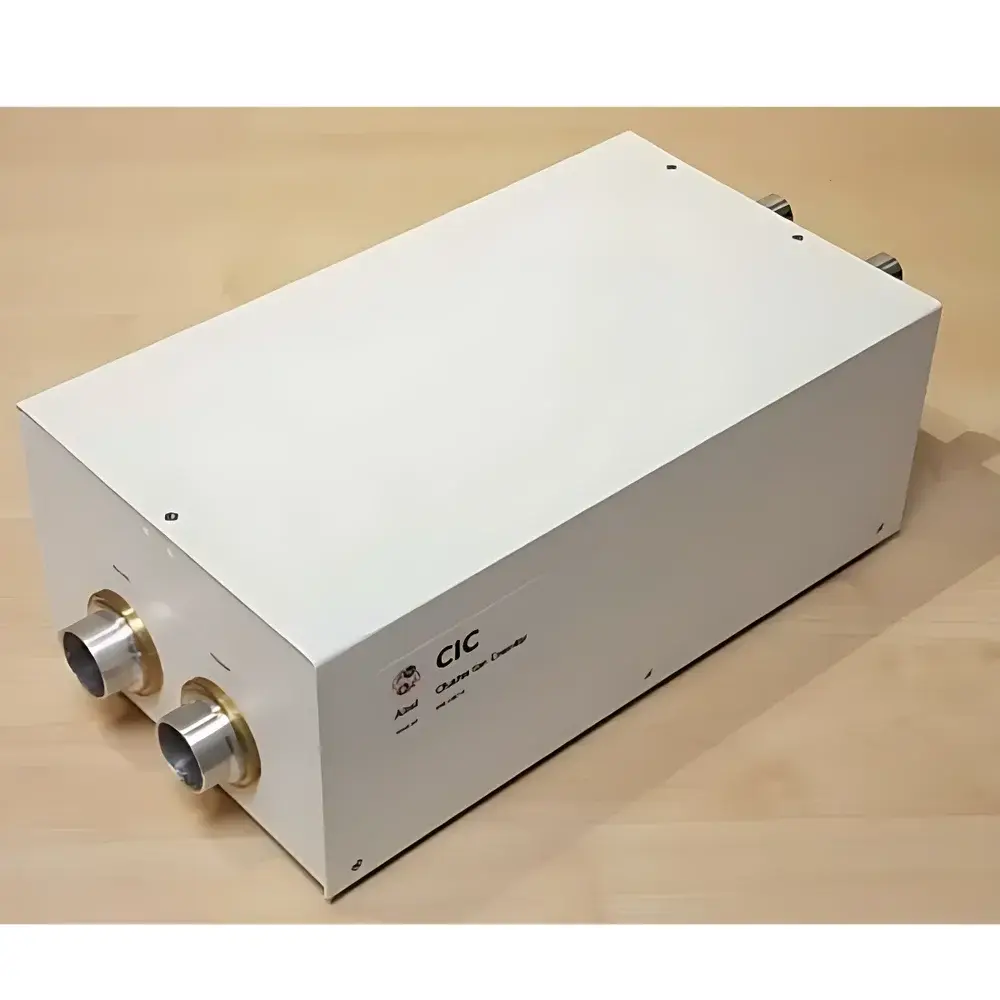
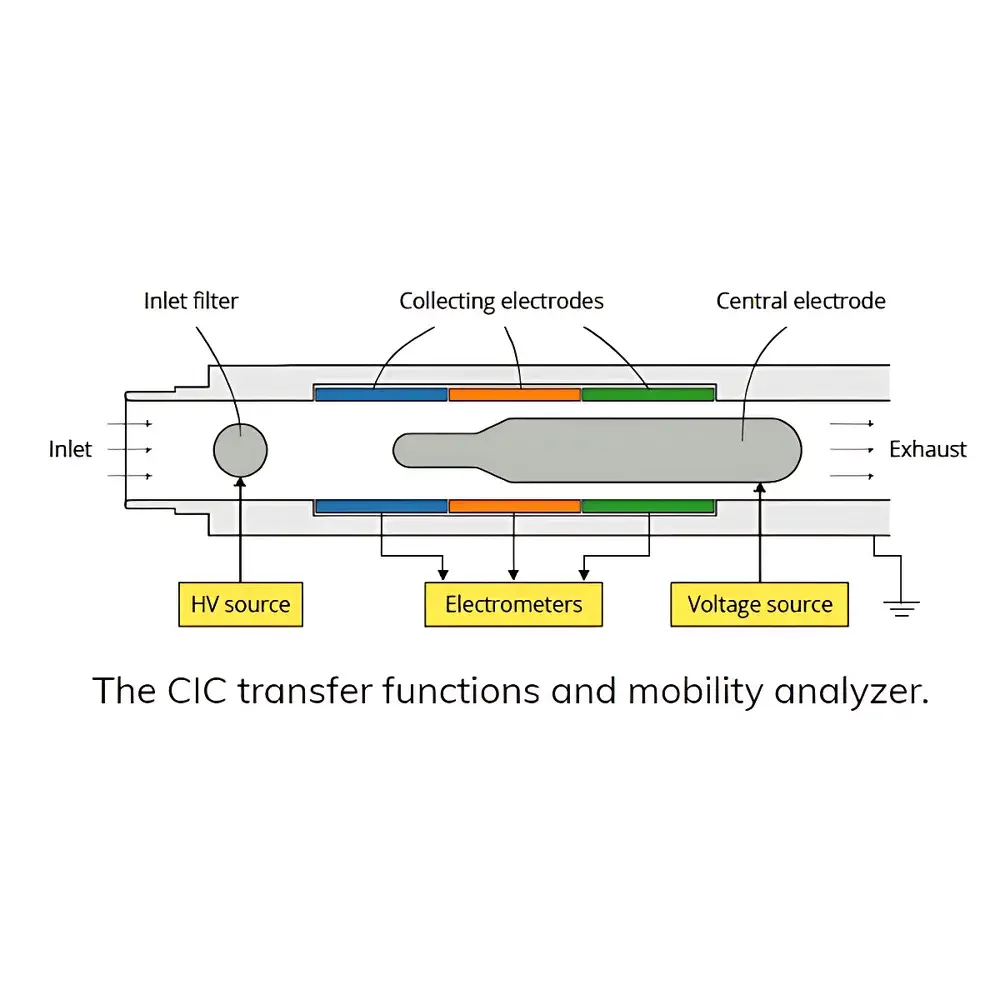
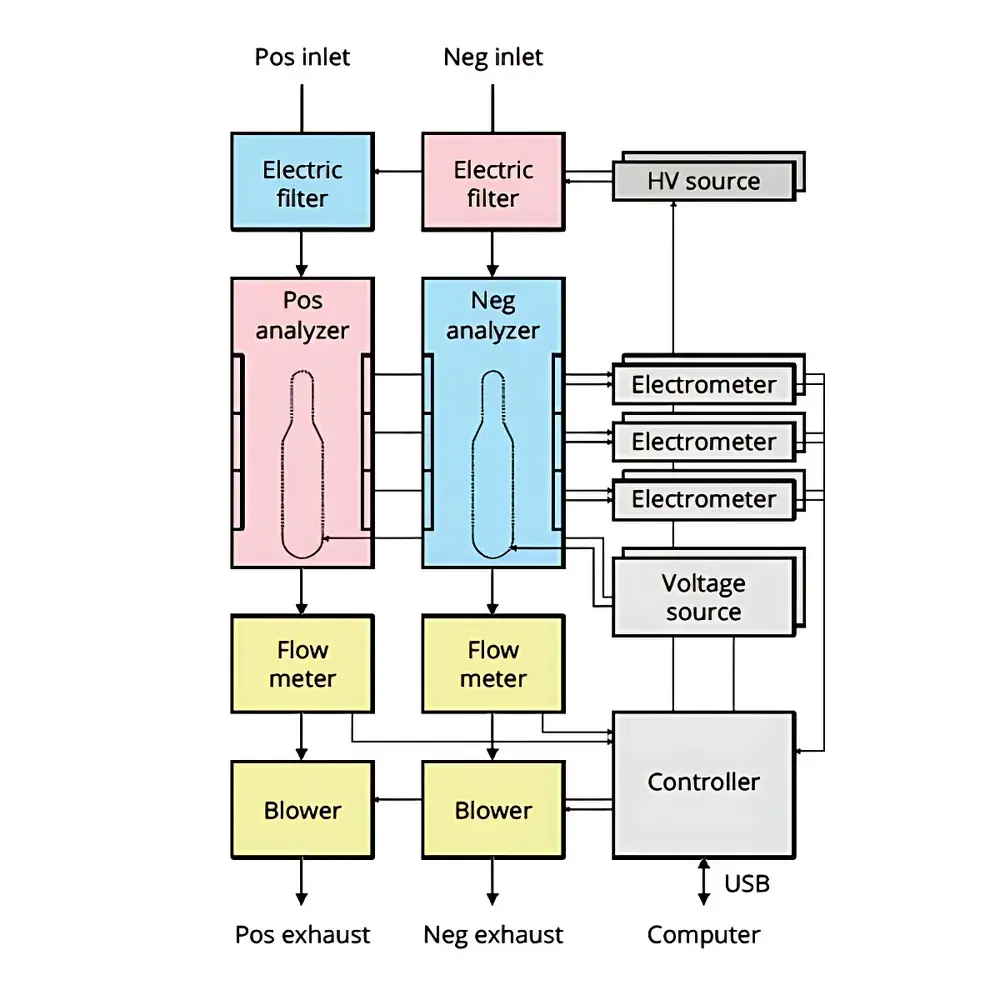
The Airel CIC Cluster Ion Counter is a precision differential mobility spectrometer engineered for quantitative, real-time measurement of atmospheric cluster ions—both positive and negative—with mobility greater than 0.25 cm²/V·s. Unlike conventional particle counters that detect charged aerosols above nanometer scales, the CIC targets the sub-2 nm regime where molecular clusters govern nucleation, ion-induced condensation, and early-stage aerosol formation. Its core architecture employs two independent cylindrical differential mobility analyzers (DMAs), each equipped with three discrete collection electrodes operating at defined voltage gradients. This dual-polarity, multi-electrode design enables simultaneous quantification of total cluster ion concentration and calculation of mean electrical mobility—without requiring assumptions about ion size distribution or charge state. The instrument operates on the fundamental principle that ions migrate through a laminar electric field under controlled sheath gas flow; their trajectory and collection efficiency are governed by the ratio of electrical mobility to diffusion coefficient. By integrating high-sensitivity electrometers (sampling at 30 Hz) and compensating for ambient pressure via an onboard piezoresistive sensor, the CIC maintains metrological stability across variable altitudes—from sea-level laboratories to airborne platforms operating at 10,000 m.
Key Features
- Dual-cylindrical DMA system with fully independent positive and negative ion channels, enabling concurrent polarity-resolved measurements without cross-talk.
- Three-stage electrode array per DMA, permitting both total integrated current detection and mobility-weighted centroid estimation in real time.
- Dynamic voltage control of central electrodes ensures constant mobility resolution bandwidth (ΔZ/Z ≈ 15%) across changing environmental conditions.
- Optimized inlet geometry minimizes diffusional and electrostatic losses, achieving <5% ion transmission loss for mobilities >0.5 cm²/V·s at 40 L/min flow.
- Onboard pressure compensation algorithm adjusts mobility calibration in situ, supporting operation from 300 hPa (high-altitude flight) to 1200 hPa (low-elevation indoor monitoring).
- Low-power DC architecture (15 V, 0.5 A) and compact form factor (120 × 200 × 380 mm, 5 kg) enable deployment in UAV payloads, mobile labs, and permanent ambient monitoring stations.
- Comprehensive self-diagnostic suite monitors electrometer offset drift, DMA voltage stability, flow sensor linearity, and thermal gradient effects—logging fault codes and calibration status for GLP-compliant audit trails.
Sample Compatibility & Compliance
The CIC is designed for direct analysis of ambient air, filtered indoor air, and conditioned sample streams from ion generators or air purification systems. It requires no consumables, chemical reagents, or radioactive sources. Sample introduction occurs via a stainless-steel, electrostatically shielded inlet with minimal residence time (<100 ms), preserving ion integrity during transport. The instrument complies with ISO 29463-3 (high-efficiency filter testing methodology for ultrafine particles), aligns with the measurement principles outlined in IUPAC Technical Report “Atmospheric Cluster Ion Chemistry” (2021), and supports traceable calibration against NIST-traceable mobility standards when used with certified reference ion sources. Its pressure-compensated operation satisfies requirements for airborne atmospheric research per FAA AC 20-138B and ECSS-E-ST-70-08C for environmental sensors on unmanned aerial systems.
Software & Data Management
Data acquisition and real-time processing are handled by Spectops—a lightweight, deterministic software framework optimized for low-latency streaming (≤100 ms end-to-end latency). Spectops implements automatic baseline subtraction, mobility-weighted averaging, and live noise-floor estimation using statistical windowing. Raw electrometer voltages, DMA voltages, pressure, temperature, and flow data are timestamped with microsecond precision and stored in HDF5 format for interoperability. Retrospect provides post-acquisition tools for mobility spectrum deconvolution, inter-channel cross-calibration, and batch-mode reprocessing using updated pressure/temperature models. Both applications support 21 CFR Part 11-compliant user access control, electronic signatures, and immutable audit logs—making them suitable for regulated environments including ISO 17025-accredited laboratories and GMP-aligned indoor air quality validation protocols.
Applications
- Long-term ambient cluster ion monitoring in urban, rural, and polar environments to investigate nucleation event frequency and meteorological drivers.
- Performance evaluation of bipolar ionization-based air purification systems—quantifying net ion yield, polarity balance, and decay kinetics under realistic HVAC airflow conditions.
- Spatial mapping of cluster ion distributions using synchronized multi-instrument networks or drone-mounted CIC units for vertical profiling up to 1,500 m AGL.
- Indoor climate assessment in healthcare facilities, cleanrooms, and educational buildings—correlating cluster ion concentrations with VOC levels, CO₂, and occupant-reported health metrics.
- Process monitoring in semiconductor fabrication cleanrooms, where cluster ion fluctuations may indicate subtle leaks or electrostatic discharge risks prior to particle generation.
FAQ
Does the CIC require radioactive or photoionization sources to generate ions?
No. The CIC is a passive detector only—it measures naturally occurring or externally generated cluster ions without introducing any ionization source.
Can the CIC distinguish between different chemical compositions of cluster ions?
No. It resolves ions solely by electrical mobility, not mass or chemistry. For compositional identification, coupling with a high-resolution mass spectrometer (e.g., CI-APi-TOF) is recommended.
Is the instrument suitable for unattended field operation over extended periods?
Yes. With its robust thermal management, continuous internal diagnostics, and low power draw, the CIC has demonstrated stable 6-month deployments in remote Arctic observatories.
What is the minimum detectable mobility cutoff, and how is it verified?
The lower mobility limit is 0.25 cm²/V·s, validated using monodisperse NH₄⁺–(H₂O)ₙ calibration clusters generated by a nano-DMA and confirmed via tandem mobility–mass analysis.
Does the USB interface support real-time streaming to third-party SCADA or IoT platforms?
Yes. Spectops exposes a documented binary protocol over USB CDC ACM, enabling integration with MQTT brokers, LabVIEW DAQmx, or custom Python-based telemetry stacks via libusb bindings.







