
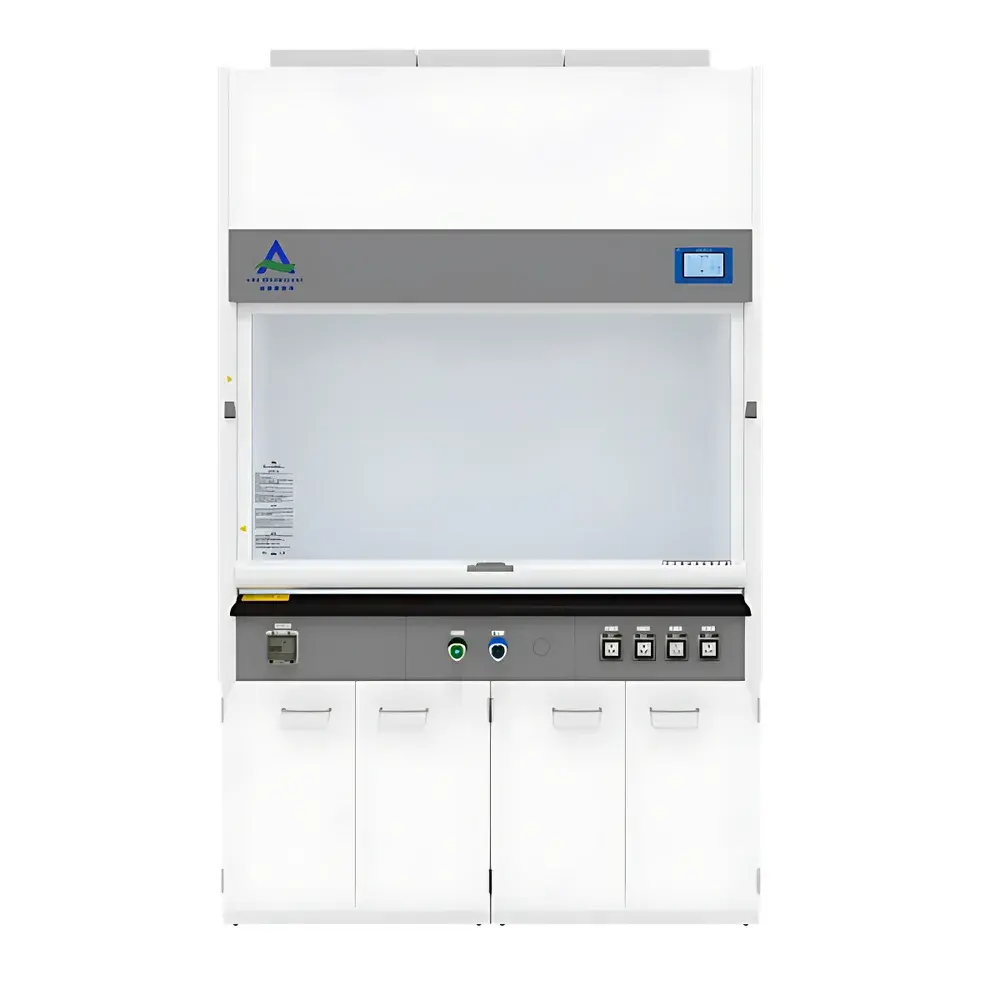
Airs ATH1804 Premium Recirculating Ductless Fume Hood
| Brand | Airs |
|---|---|
| Origin | Shanghai, China |
| Manufacturer Type | Direct Manufacturer |
| Product Origin | Domestic (China) |
| Model | ATH1804 |
| Construction Material | Fully Steel Enclosure |
| Hood Type | Ductless (Recirculating) |
| External Dimensions (W×D×H) | 920 × 1500 × 2700 mm |
| Average Face Velocity | 0.4–0.6 m/s |
| Airflow Capacity | 690–900 m³/h |
| Lighting | Integrated LED |
| Rated Power | 160 W / 1.6 A |
| Noise Level | ≤60 dB(A) |
Overview
The Airs ATH1804 Premium Recirculating Ductless Fume Hood is an engineered safety solution designed for laboratories requiring chemical containment without infrastructure-dependent ductwork. Unlike traditional exhaust hoods that vent air externally via fixed piping, the ATH1804 operates on a closed-loop recirculation principle: ambient laboratory air is drawn through the work surface, passed sequentially through multi-stage filtration media, and returned to the room as purified air. This design eliminates the need for building-integrated exhaust systems while maintaining consistent face velocity control—critical for reliable containment of volatile organic compounds (VOCs), acids, bases, and particulate aerosols generated during routine benchtop chemistry, reagent storage, or instrument operation. Its fully steel construction ensures structural integrity and corrosion resistance under typical laboratory environmental conditions, and its low-profile, frameless aesthetic aligns with modern ergonomic lab design standards.
Key Features
- Intelligent face velocity regulation: Microprocessor-controlled DC blower dynamically adjusts rotational speed in real time based on sash position, sustaining a certified operational range of 0.4–0.6 m/s across the full sash travel path.
- Triple-stage filtration architecture: Pre-filter (HEPA-grade particulate capture), primary molecular filter (activated carbon + impregnated media), and secondary molecular filter (targeted chemisorption layer) provide redundant protection against both airborne particles and gaseous contaminants.
- Integrated LED task lighting: Uniform 500–600 lux illumination at work surface level, compliant with EN 14175-3 photometric requirements for fume hood visual ergonomics.
- Touch-free QR-based interface: Scan-to-control functionality enables remote monitoring of runtime hours, filter saturation status, airflow deviation alerts, and historical event logs via secure web dashboard accessible from iOS/Android devices.
- Modular filter replacement system: Tool-free access panel allows rapid, safe cartridge exchange without disassembly; filter life indicators are calibrated per ISO 16000-23 and ASTM D5212 protocols.
- Acoustic optimization: Vibration-damped motor mount and aerodynamically profiled ducting reduce operational noise to ≤60 dB(A) at 1 m distance—meeting ISO 7730 thermal comfort and noise criteria for occupied lab spaces.
Sample Compatibility & Compliance
The ATH1804 is validated for use with low-to-moderate volatility chemicals including alcohols, ketones, esters, dilute mineral acids (e.g., HCl, HNO₃ <10%), and common solvents such as acetone and ethanol. It is not intended for perchloric acid, hydrogen fluoride, radioactive isotopes, or uncharacterized high-hazard compounds. All filtration media comply with EN 143 and EN 1822 standards for particle retention efficiency (≥99.995% @ 0.3 µm), and molecular filters meet ISO 10121-1 adsorption capacity benchmarks for target VOC families. The unit conforms to EN 14175 Parts 1–7 for ductless fume hood performance, safety, and testing methodology, and supports GLP/GMP documentation workflows via timestamped audit trails and configurable user access levels.
Software & Data Management
Embedded firmware supports local data logging (72-hour buffer) and cloud-synchronized telemetry via TLS 1.2–encrypted MQTT protocol. Logged parameters include real-time face velocity, cumulative filter runtime, motor current draw, ambient temperature/humidity (via optional sensor module), and sash position history. Exportable CSV reports facilitate compliance with internal QA audits and external regulatory inspections (e.g., CAP, CLIA, or ISO/IEC 17025). The system supports FDA 21 CFR Part 11–compliant electronic signatures when integrated with institutional identity management platforms.
Applications
- Routine handling and dispensing of standardized reagents in QC/QA labs
- Long-term storage of volatile chemicals where ventilation redundancy is required
- Operation of analytical instruments emitting low-level solvent vapors (e.g., HPLC autosamplers, GC injectors)
- Educational laboratory environments requiring flexible, relocatable containment
- Pharmaceutical stability chambers and formulation development suites needing localized air purification
- Field-deployable research stations where permanent duct installation is impractical
FAQ
What types of chemicals can be safely used in the ATH1804?
The hood is validated for low- to medium-volatility organic solvents, dilute aqueous acids/bases, and non-reactive particulates. It must not be used with perchloric acid, hydrofluoric acid, mercury compounds, or unknown/uncharacterized mixtures.
How often do the filters require replacement?
Filter service intervals depend on usage intensity and chemical load; typical replacement is every 6–12 months for moderate use. The system provides predictive alerts based on runtime, airflow decay, and VOC breakthrough detection.
Does the ATH1804 require external exhaust ducting?
No—this is a fully self-contained ductless system. All air is filtered and recirculated within the laboratory space, eliminating the need for roof penetrations or HVAC integration.
Can the unit be integrated into a centralized lab monitoring network?
Yes—via optional Ethernet/Wi-Fi module and RESTful API, enabling integration with BMS platforms (e.g., Siemens Desigo, Honeywell Enterprise Buildings Integrator) for facility-wide environmental oversight.
Is third-party certification available for this model?
Yes—certification reports from TÜV Rheinland or SGS are available upon request, covering EN 14175 performance validation, electrical safety (IEC 61010-1), and EMC compliance (EN 61326-1).
Related Products



