
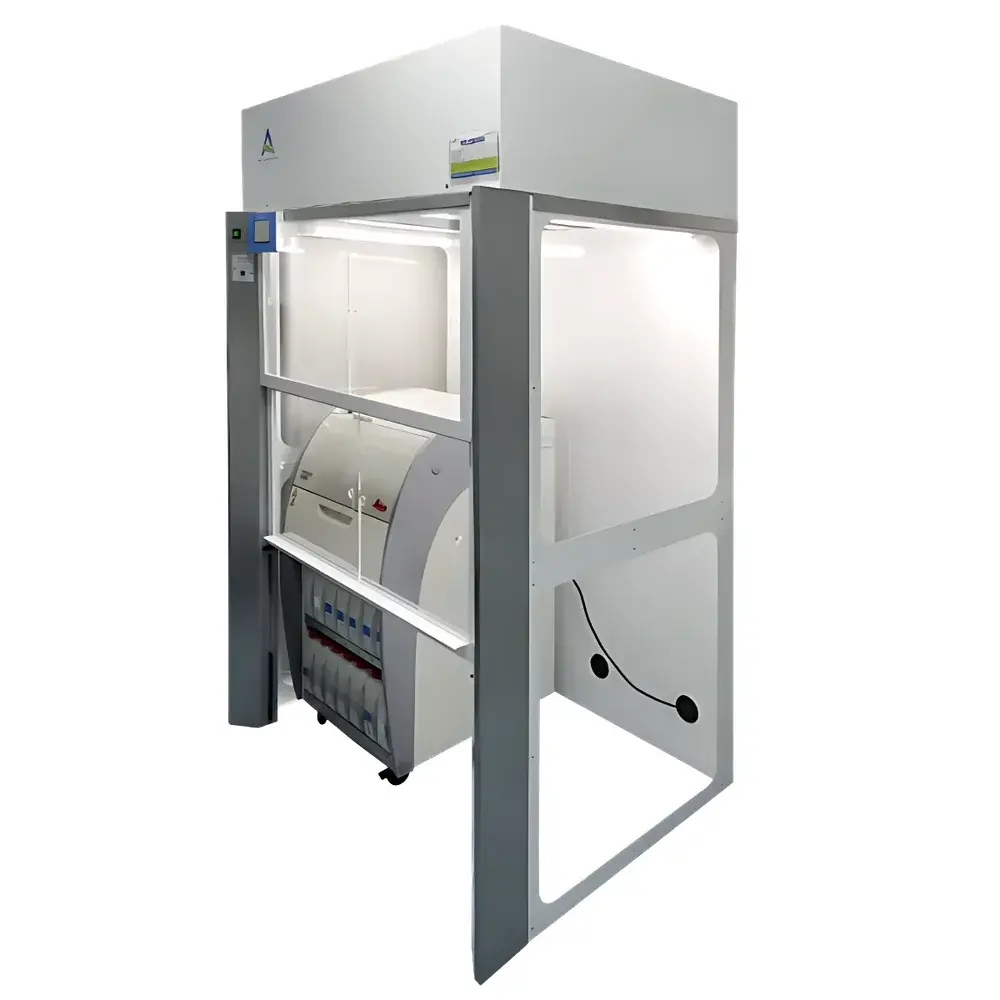
Airs AWIH1502 Walk-In (Floor-Standing) Instrument Safety Enclosure
| Brand | Airs |
|---|---|
| Origin | Shanghai, China |
| Manufacturer Type | Direct Manufacturer |
| Region of Origin | Domestic (China) |
| Model | AWIH1502 |
| Pricing | Upon Request |
Overview
The Airs AWIH1502 Walk-In Instrument Safety Enclosure is an engineered, self-contained containment solution designed specifically for floor-standing analytical instruments, large-scale testing equipment, and benchtop systems that emit volatile organic compounds (VOCs), acidic vapors, or particulate byproducts during operation. Unlike conventional ducted fume hoods requiring extensive HVAC integration, the AWIH1502 operates on a recirculating airflow principle—drawing ambient laboratory air through a dual-stage filtration system (pre-filter + activated carbon + optional HEPA), treating contaminants in situ, and returning conditioned air to the lab environment. This closed-loop architecture eliminates the need for external exhaust ductwork, significantly reducing installation complexity, structural modifications, and long-term energy consumption associated with constant air replacement. The enclosure complies with fundamental occupational hygiene principles outlined in ISO 10873:2020 (Laboratory ventilation — Performance requirements for local exhaust ventilation devices) and supports institutional adherence to OSHA 29 CFR 1910.1200 (Hazard Communication Standard) and ANSI Z9.5–2022 (Laboratory Ventilation).
Key Features
- Walk-in footprint with customizable internal dimensions (standard base configuration: W1500 × D2000 × H2200 mm; fully scalable per instrument footprint and service clearance requirements)
- Vertically bi-directional sash system: top-mounted and bottom-mounted motorized sliding panels enabling simultaneous vertical travel and lateral window translation for unobstructed access to rear-mounted ports, utility connections, and instrument service zones
- Integrated centrifugal blower with variable-frequency drive (VFD), delivering consistent face velocity (0.4–0.6 m/s at sash opening) across operational load conditions
- Dual-stage filtration module: washable aluminum pre-filter (G3 class) + replaceable activated carbon bed (≥3.5 kg capacity, certified for CCl₄ adsorption per ASTM D5228) + optional ULPA-grade final filter (ISO Class 3 @ 0.12 µm)
- Airs-Touch intelligent control panel: 7-inch capacitive touchscreen interface with real-time display of internal temperature (±0.5 °C), relative humidity (±3% RH), filter saturation status, airflow differential pressure, and cumulative runtime
- IoT-enabled remote monitoring via secure HTTPS-based web portal and native iOS/Android application—supports push alerts for filter replacement, airflow deviation (>±10%), or temperature/humidity excursions beyond user-defined thresholds
Sample Compatibility & Compliance
The AWIH1502 accommodates instruments with maximum operational footprints up to 1200 mm (W) × 1800 mm (D) × 2000 mm (H), including but not limited to ICP-MS systems, thermal desorption units, automated titrators, stability chambers, and industrial-scale rheometers. Its modular frame construction—utilizing 1.5 mm cold-rolled steel with epoxy-powder coating—ensures structural integrity under continuous 24/7 operation. All electrical components meet IEC 61000-6-3 (EMC emission limits) and IEC 61000-6-2 (immunity standards). The enclosure’s filtration performance is validated per EN 1822-1:2019 (HEPA/ULPA classification) and ASTM D5228-18 (carbon adsorption capacity), and its control software architecture supports audit-trail functionality aligned with FDA 21 CFR Part 11 Annex 11 requirements for electronic records and signatures.
Software & Data Management
The Airs-Touch OS provides role-based access control (administrator, technician, operator), event logging with timestamped entries (including sash position changes, filter reset actions, alarm triggers), and exportable CSV reports compliant with GLP documentation workflows. Historical environmental data (temperature, humidity, airflow delta-P) is stored locally for ≥12 months and synchronized hourly to encrypted cloud storage. API endpoints enable integration with existing LIMS platforms (e.g., LabWare, Thermo Fisher SampleManager) via RESTful JSON protocols. Firmware updates are delivered over-the-air (OTA) with cryptographic signature verification to ensure system integrity.
Applications
- Containment of VOC emissions from GC-MS, HPLC, and LC-MS instrumentation during method development and routine analysis
- Safe operation of high-temperature sample digestion systems (e.g., microwave-assisted acid digestion) without facility-level exhaust retrofitting
- Isolation of odor-generating stability testing chambers in pharmaceutical QC labs operating under ICH Q1 guidelines
- Protection of sensitive optical components in laser-based analyzers (e.g., Raman spectrometers, LIBS systems) from airborne particulates and solvent vapors
- Compliance support for ISO/IEC 17025-accredited laboratories seeking documented control of environmental interference variables during calibration procedures
FAQ
Does the AWIH1502 require external ducting or roof penetration?
No. It is a ductless, recirculating system designed for plug-and-play deployment in any standard laboratory space with adequate power supply (220 VAC ±10%, 50 Hz, 16 A circuit).
How often must the carbon filter be replaced?
Filter service intervals depend on VOC load profile and usage frequency; typical replacement occurs every 6–12 months. The Airs-Touch system calculates remaining adsorption capacity based on real-time airflow, concentration estimates, and cumulative runtime.
Can the enclosure be integrated into an existing building management system (BMS)?
Yes—via Modbus TCP or BACnet/IP protocol gateways (optional hardware add-on), enabling centralized monitoring of operational status, alarms, and energy consumption metrics.
Is validation documentation provided for GxP environments?
Airs supplies IQ/OQ documentation templates, factory-as-tested performance reports (face velocity mapping, filter efficiency certificates), and traceable calibration records for all embedded sensors—supporting client-led PQ execution per ASTM E2500-13.
Related Products



