
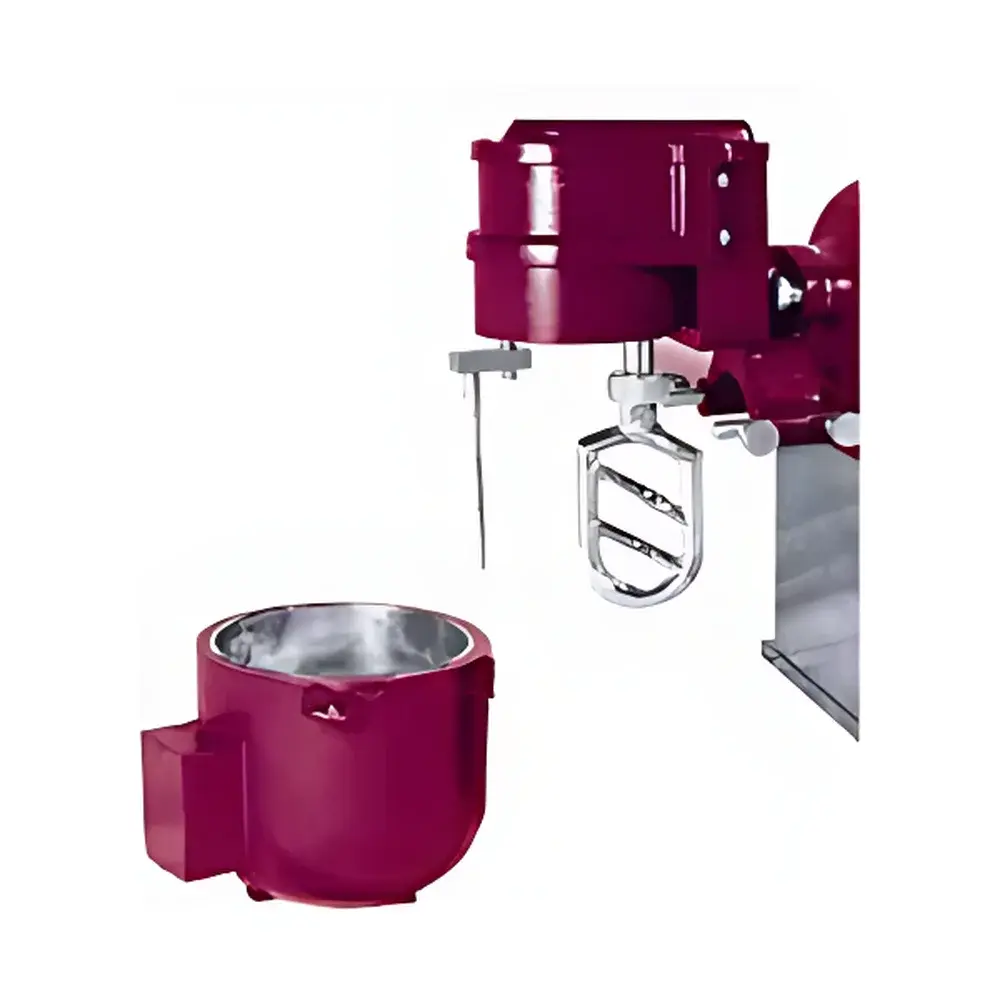
Pharmag Planetary Mixer for Pharmaceutical and Biotech Applications
| Brand | Pharmag |
|---|---|
| Origin | Germany |
| Model | Planetary Mixer |
| Capacity | 5 L total / 3.5 L working volume |
| Construction | Stainless steel vessel and mixing tools, PTFE-coated scraper blades |
| Mixing tool options | Kneading arms, paddle mixers, homogenizing impellers |
| Application scope | Ointments, pastes, gels, suspensions, powders, and low-to-medium viscosity liquids |
| Distribution model | Authorized distributor for EMEA and APAC regions |
| Compliance | Designed to meet ISO 13485-aligned manufacturing practices and supports GMP documentation workflows |
Overview
The Pharmag Planetary Mixer is an engineered solution for high-shear, low-shear, and shear-sensitive mixing tasks in pharmaceutical development, bioprocess formulation, and advanced material synthesis. Operating on the principle of planetary motion—where mixing tools rotate on their own axes while simultaneously revolving around the central axis of the vessel—the system ensures uniform radial and axial material displacement without dead zones. This kinematic architecture enables reproducible homogenization of heterogeneous systems including semi-solid dosage forms (e.g., ointments and creams), viscous suspensions, and dry-powder blends prior to granulation or lyophilization. Unlike orbital shakers or overhead stirrers, the planetary configuration delivers controlled mechanical energy input with minimal air entrapment, making it particularly suitable for oxygen-sensitive formulations and sterile processing environments when integrated into isolator-compatible workflows.
Key Features
- Planetary dual-axis motion: Independent rotation + revolution ensures complete vessel coverage and eliminates stagnant zones.
- Modular tooling system: Interchangeable mixing elements—including kneading arms for plastic deformation, paddle mixers for gentle blending, and high-speed homogenizing impellers for particle size reduction—allow process adaptation across formulation stages.
- Corrosion-resistant construction: 316L stainless steel mixing bowl and tooling; PTFE-coated scraper blades prevent material adhesion and facilitate cleaning validation per FDA and EU GMP Annex 15 requirements.
- Precision volumetric capacity: 5 L total vessel volume with a validated working range of 3.5 L, supporting batch scalability from lab-scale feasibility studies to pilot production.
- Sealed operation capability: Optional lid-integrated ports for nitrogen purging, temperature probe insertion, or vacuum application during mixing—enabling moisture- or oxidation-sensitive processing.
- Variable speed control: Digital motor drive with torque monitoring supports consistent shear rate application across viscosity ranges from 10 mPa·s (aqueous solutions) to >10⁵ mPa·s (anhydrous ointment bases).
Sample Compatibility & Compliance
The Pharmag Planetary Mixer accommodates diverse sample types encountered in preformulation and manufacturing: aqueous gels, hydrophobic ointment bases (e.g., petrolatum, lanolin derivatives), polymer dispersions, ceramic slurries, and pharmaceutical excipient blends. Its design adheres to fundamental principles outlined in USP “Plastic Materials for Packaging and Delivery Systems” and aligns with ISO 20957-2 for laboratory equipment safety. While not certified as Class I medical device under MDR 2017/745, its materials of construction and surface finish (Ra ≤ 0.8 µm) support qualification under ICH Q5A and Q5D for use in cell therapy raw material blending. Cleaning verification protocols can be developed using ATP bioluminescence or rinse sampling per ASTM E3064–17.
Software & Data Management
The mixer operates via an embedded microcontroller with non-volatile parameter storage (up to 99 programmable methods). Each method records timestamped operational data—including speed setpoint, actual RPM, torque %, runtime, and thermal feedback from optional PT100 sensor inputs. All logs are exportable in CSV format for integration into LIMS or electronic batch record (EBR) systems. Audit trail functionality complies with FDA 21 CFR Part 11 requirements when deployed with user authentication and electronic signature modules. Raw data files include checksum validation to ensure integrity during transfer to QA review systems.
Applications
- Development of topical drug products requiring phase homogeneity (e.g., corticosteroid ointments, antifungal creams).
- Preparation of injectable suspensions where particle dispersion stability must be preserved during mixing.
- Blending of lyophilized powder formulations prior to vial filling—minimizing static charge buildup and segregation.
- Biopolymer processing: Hydration and dispersion of cellulose derivatives, hyaluronic acid, or alginate gels under controlled shear.
- Cell culture media component integration, especially for lipid-based supplements or heat-labile growth factors.
- Non-pharma applications include battery electrode slurry mixing and dental composite paste preparation.
FAQ
Is the Pharmag Planetary Mixer suitable for aseptic processing?
Yes—when equipped with a sterilizable lid, SIP-compatible seals, and integrated steam-in-place (SIP) port, it may be qualified for Grade A/B environments under EU GMP Annex 1, subject to full system validation.
Can mixing parameters be exported for regulatory submission?
All method definitions and execution logs are timestamped, user-attributed, and digitally signed; raw data meets ALCOA+ criteria for inclusion in CMC sections of IND/MAA dossiers.
What maintenance intervals are recommended for long-term GMP compliance?
Daily visual inspection of scraper blade wear; quarterly calibration of speed/torque sensors against NIST-traceable references; annual full mechanical audit per manufacturer’s PQ protocol.
Does Pharmag provide IQ/OQ documentation packages?
Yes—validated installation and operational qualification templates are supplied with each unit, customizable to site-specific risk assessments and URS requirements.




