
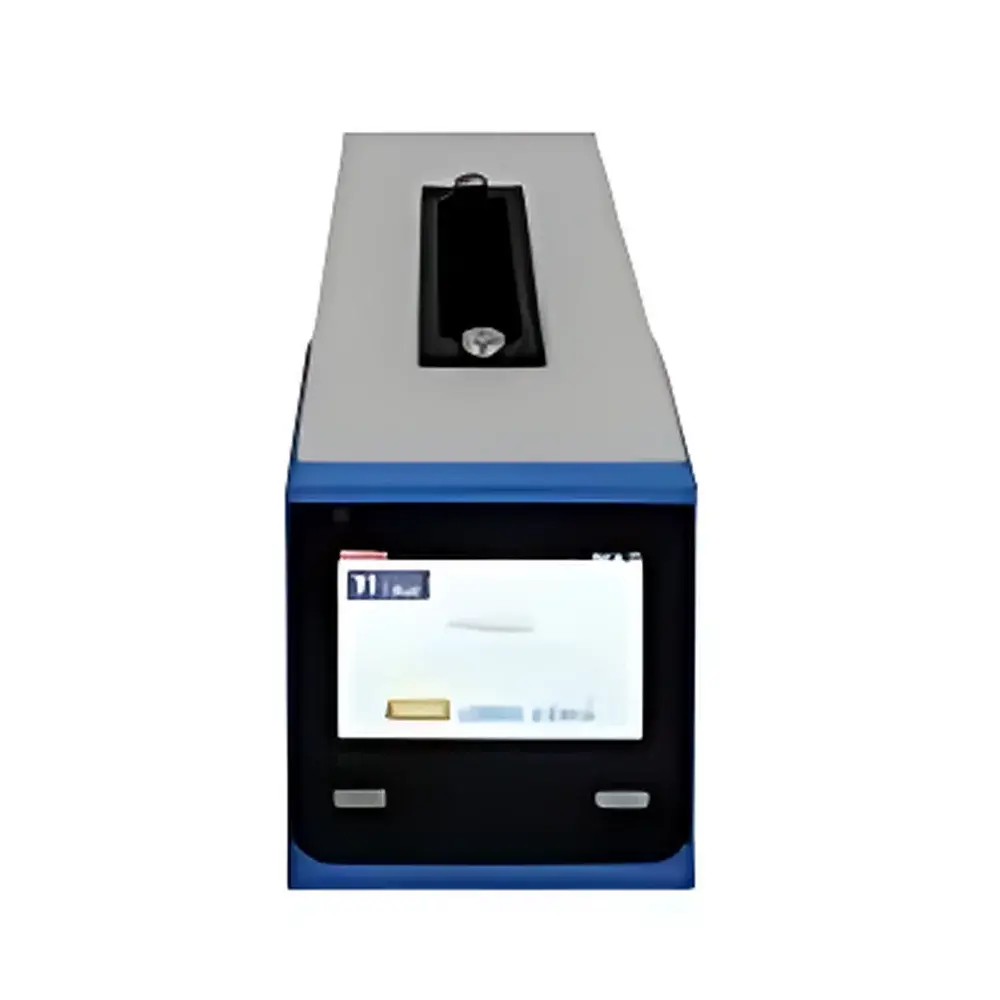
Schmidt+Haensch Coloromat-S Liquid Colorimeter
| Brand | Schmidt+Haensch (S+H) |
|---|---|
| Country of Origin | Germany |
| Model | Coloromat-S |
| Wavelength Range | 340–900 nm |
| Standard Filters | 340 nm, 420 nm, 720 nm |
| Optional Wavelengths | Up to 9 user-selectable wavelengths |
| Wavelength Calibration | Automatic |
| Light Source | 12 V / 20 W halogen lamp |
| Detector | Silicon photodiode |
| Display | Graphical color touchscreen interface |
| Sample Cell Pathlength | Up to 100 mm (flow-through or static cuvette) |
| Measurement Modes | Transmittance, absorbance, extinction, and CIE-based color values (e.g., CIELab, EBC, ICUMSA) |
| Compliance | GLP/GMP-ready with audit trail support (user login, method storage, data timestamping) |
Overview
The Schmidt+Haensch Coloromat-S is a high-precision, benchtop liquid colorimeter engineered for quantitative color assessment of transparent and semi-transparent liquids in quality control and R&D laboratories. Based on single-beam photometric principles with selectable narrowband interference filters, the instrument measures spectral transmittance and absorbance across the near-UV to near-IR range (340–900 nm). Its optical architecture integrates a stabilized 12 V / 20 W halogen light source, precision aperture optics, and a calibrated silicon photodiode detector—ensuring long-term photometric stability and repeatability under routine operation. Designed for industrial compliance environments, the Coloromat-S supports traceable color evaluation according to internationally recognized standards including ICUMSA GS2/3-10 (for sugar solutions), EBC (European Brewery Convention) for wort and beer, and AOAC-defined methods for beverage and food extract analysis.
Key Features
- Graphical color touchscreen interface enabling intuitive method setup, real-time spectral preview, and trend visualization without external software.
- Automatic wavelength calibration with up to nine programmable filter positions—three standard (340 nm, 420 nm, 720 nm) and six optional—enabling method flexibility across diverse colorimetric protocols.
- Dedicated flow-cell compatibility: accommodates continuous-flow measurement using standardized 100 mm pathlength cells, ideal for inline process monitoring of syrup, juice, or fermentation broth streams.
- Open-top sample chamber design minimizes contamination risk and simplifies cleaning—critical for viscous or particulate-prone samples such as beet juice or enzymatic hydrolysates.
- GLP/GMP-aligned firmware: includes user authentication, method versioning, electronic signature support, and time-stamped data logging compliant with FDA 21 CFR Part 11 requirements for regulated industries.
- Integrated photometric validation routines—including dark current compensation and reference blank normalization—to maintain accuracy across extended operational cycles.
Sample Compatibility & Compliance
The Coloromat-S is optimized for aqueous and organic liquid matrices with low-to-moderate turbidity. Validated applications include sucrose syrups (ICUMSA), malt extracts and finished beer (EBC), soft drinks (APHA/Pt-Co), wine must, and enzymatically processed intermediates (e.g., glucose/fructose quantification via coupled oxidation assays). The system meets ISO 7027 for turbidity-related extinction measurements and supports ASTM D1209 (platinum-cobalt scale) and ASTM E308 (CIE tristimulus computation) when configured with appropriate calibration standards. All firmware and data handling modules conform to ICH-GCP and EU Annex 11 expectations for analytical instrument qualification.
Software & Data Management
Instrument control, data acquisition, and report generation are fully embedded within the onboard operating system. Measurement results—including numeric absorbance values, %T, extinction coefficients, and derived color indices (e.g., EBC units, ICUMSA number)—are stored in CSV and PDF formats with embedded metadata (operator ID, timestamp, method name, calibration status). Export is supported via USB port; no proprietary drivers or cloud dependency required. Audit trails record all critical events: parameter changes, calibration executions, user logins/logouts, and result deletions—retained for ≥36 months per configurable retention policy. Optional Ethernet connectivity enables integration into LIMS environments via standard TCP/IP protocols.
Applications
- Quantitative color grading of liquid sugar solutions per ICUMSA Method GS2/3-10, supporting refinery QC and international trade documentation.
- EBC-compliant color determination of wort, beer, and non-alcoholic malt beverages—aligned with European Brewing Convention specifications.
- APHA/Pt-Co index measurement for purified water, pharmaceutical excipients, and cosmetic solvents per USP and EP 2.2.17.
- Enzymatic assay support: monitoring glucose and fructose concentrations in beet juice hydrolysates via NAD(P)H-coupled reactions at 340 nm.
- Process consistency verification for caramelized syrups, invert sugar, and dextran-containing formulations where thermal degradation correlates with spectral shift.
- Turbidimetric extinction analysis of clarified fruit juices and fermented broths where haze contributes measurably to broadband attenuation.
FAQ
Does the Coloromat-S comply with FDA 21 CFR Part 11 for electronic records?
Yes—the instrument implements role-based access control, electronic signatures, and immutable audit trails for all data-critical actions, satisfying core Part 11 requirements for closed systems.
Can it measure CIELab coordinates directly?
Yes—when equipped with ≥3 filter bands spanning the visible spectrum and calibrated against NIST-traceable standards, the device computes CIE 1931 XYZ and derived CIELab values per ISO 11664-4.
Is flow-cell integration plug-and-play?
The 100 mm flow cell mounts mechanically into the standard sample compartment; tubing connections use universal 1/4″-28 UNF ports—no adapter kits required.
How often does wavelength calibration need verification?
Automatic calibration occurs at power-on and before each measurement sequence; annual verification with certified holmium oxide or didymium filters is recommended per ISO/IEC 17025.
What maintenance is required for the halogen lamp?
Lamp lifetime exceeds 2,000 hours; replacement is tool-free and takes <90 seconds—no optical realignment needed due to fixed-source geometry.




