
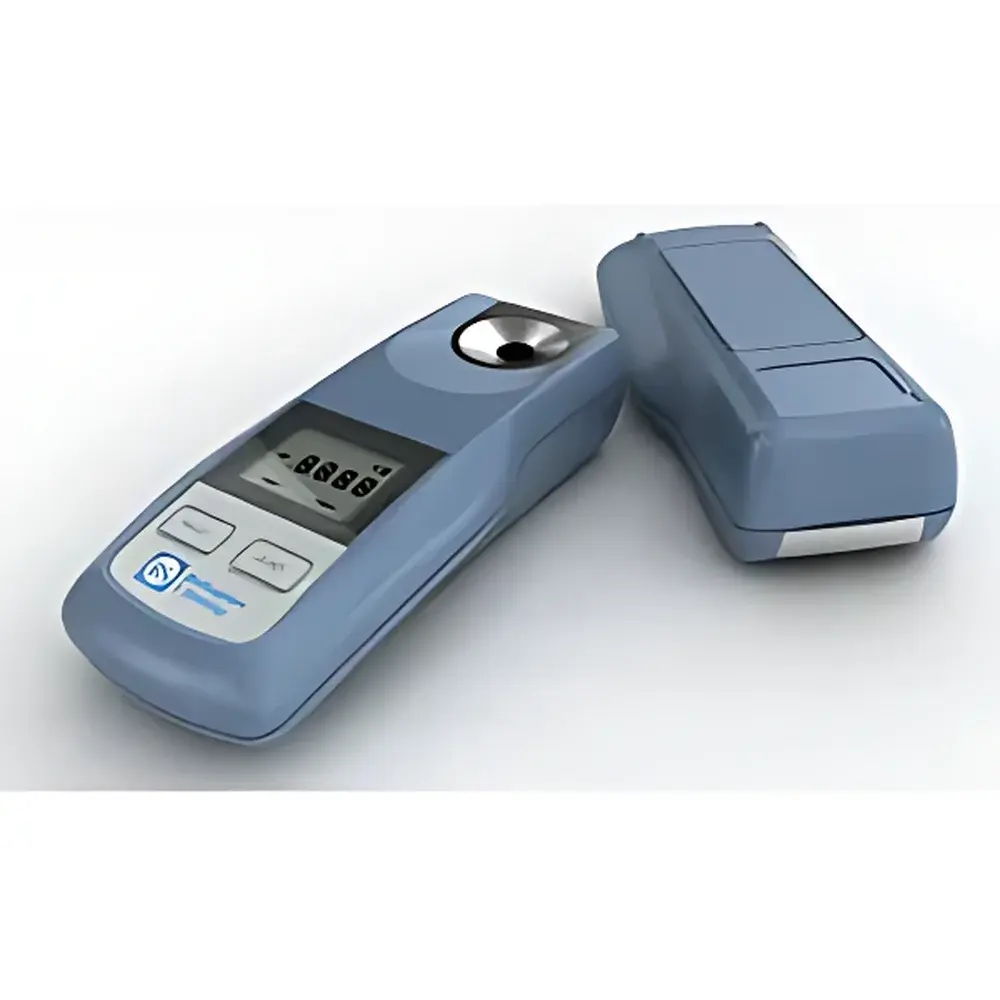
Bellingham + Stanley OPTi Saline 28 Digital Handheld Refractometer
| Brand | Bellingham + Stanley (B+S) |
|---|---|
| Country of Origin | United Kingdom |
| Model | Saline 28 |
| Scale | Salinity (% NaCl) |
| Measurement Range | 0–28% |
| Resolution | 0.1% |
| Accuracy | ±0.2% |
| Calibration | Pure water zero-point calibration |
| Temperature Compensation | Automatic (ATC) |
| Ingress Protection | IP65 |
| Prism Design | Shallow-base, cleanable prism plate |
| Housing | Corrosion-resistant, ergonomic polymer body |
| Compliance | BS EN ISO 9001:2000, UKAS-accredited manufacturing, CE-marked |
Overview
The Bellingham + Stanley OPTi Saline 28 is a precision digital handheld refractometer engineered for rapid, field-deployable measurement of sodium chloride concentration in aqueous solutions. Based on the fundamental optical principle of critical angle refraction—where light transmission through a prism-sample interface shifts predictably with solute concentration—the instrument delivers direct readout of salinity as weight/weight percentage (% w/w NaCl). Its design prioritizes metrological integrity under non-laboratory conditions: the integrated ATC system compensates for sample temperature variations between 5 °C and 40 °C using a high-stability thermistor embedded adjacent to the measuring prism, ensuring traceable results without manual correction. Unlike analog refractometers requiring subjective scale interpretation, the OPTi Saline 28 employs a high-contrast LCD with backlighting and digitized photodiode array detection, eliminating parallax error and enabling unambiguous readings even in low-light or high-humidity environments typical of marine decks, aquaculture pens, or wastewater treatment outposts.
Key Features
- Manufactured in the United Kingdom under Bellingham + Stanley’s ISO 9001:2000–certified quality management system, with full UKAS traceability for calibration procedures
- Ergonomic, one-handed operation with non-slip textured grip and balanced mass distribution for prolonged use in wet or gloved-hand conditions
- Shallow-profile prism plate geometry minimizes residual sample retention and enables complete cleaning with a single lint-free wipe—critical for cross-contamination control across saline gradients
- IP65-rated enclosure provides protection against dust ingress and low-pressure water jets, supporting reliable operation in rain, spray, or high-condensation settings
- Dual-scale configuration option (e.g., % NaCl + ppt or specific gravity) available upon request for multi-standard reporting requirements
- Battery life exceeds 10,000 measurements per set of two AAA alkaline cells, with auto-power-off after 3 minutes of inactivity
Sample Compatibility & Compliance
The OPTi Saline 28 is validated for use with natural seawater, brackish estuarine samples, recirculating aquaculture system (RAS) effluents, and synthetic salt solutions prepared from reagent-grade NaCl. It is not intended for viscous, turbid, or highly colored matrices (e.g., concentrated algal blooms or industrial brines containing suspended solids >50 mg/L), which may scatter incident light and degrade measurement fidelity. All units undergo factory verification against NIST-traceable NaCl reference standards across the full 0–28% range. The device complies with CE marking directives for electromagnetic compatibility (2014/30/EU) and low-voltage safety (2014/35/EU), and its calibration protocol aligns with ASTM D1141-98 (Standard Practice for Preparation of Substitute Ocean Water) for salinity validation workflows.
Software & Data Management
While the OPTi Saline 28 operates as a standalone instrument without onboard data logging, its analog output port (0–5 V DC) permits integration with external dataloggers or SCADA systems for time-stamped batch recording. For laboratories requiring audit-ready documentation, Bellingham + Stanley recommends pairing the unit with their optional OPTiLink PC interface cable and certified software suite—supporting 21 CFR Part 11–compliant electronic signatures, user access tiers, and immutable audit trails for calibration events and measurement histories. Firmware updates are delivered via secure HTTPS portal with SHA-256 hash verification.
Applications
- Real-time salinity monitoring during offshore vessel ballast water exchange to verify compliance with IMO Ballast Water Management Convention D-2 standards
- Routine QC checks in hatchery operations for larval rearing tanks, where deviations >±0.5% NaCl directly impact osmoregulatory stress in crustacean and finfish larvae
- Field validation of conductivity-based salinometers in coastal environmental surveys, serving as a primary reference method per EPA Method 150.1
- Process verification in desalination pre-treatment stages, including intake screening and anti-scalant dosing control loops
- Educational use in university marine science field courses, where ruggedness and intuitive operation support student-led sampling campaigns
FAQ
Does the OPTi Saline 28 require periodic recalibration by an accredited lab?
Yes—Bellingham + Stanley recommends annual recalibration against certified reference materials at a UKAS-accredited facility; certificates include uncertainty budgets per ISO/IEC 17025.
Can the instrument measure salinity in samples containing ethanol or glycerol?
No—its calibration is specific to NaCl–water binary systems; non-ionic solutes alter refractive index non-linearly and invalidate the % NaCl output.
Is the prism surface sapphire-coated?
No—the optical prism uses BK7 borosilicate glass with anti-reflective coating optimized for the 589 nm sodium D-line; hardness rating is 6.5 Mohs, sufficient for routine cleaning with soft cellulose tissue.
What is the minimum sample volume required for measurement?
Approximately 0.05 mL—sufficient to cover the 12 mm × 8 mm prism aperture without overflow; capillary action ensures uniform film formation even on slightly curved surfaces.



