
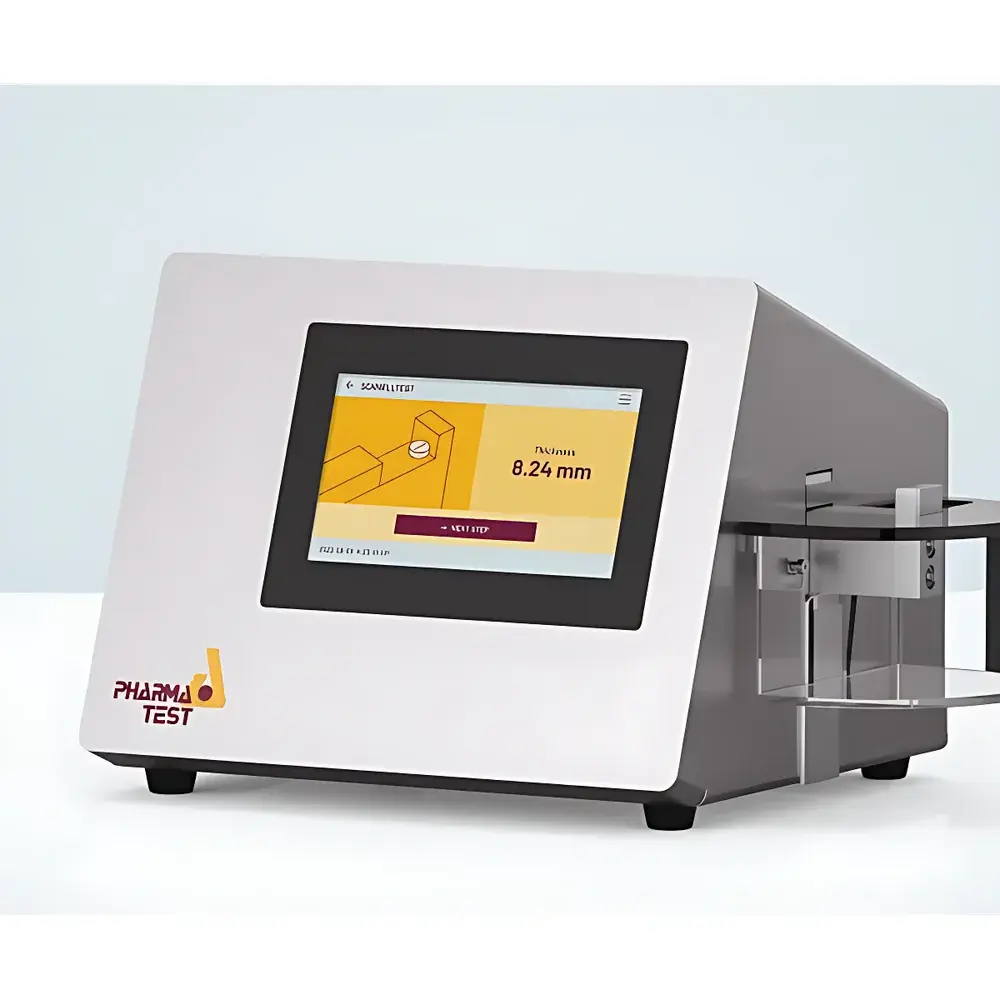
Pharma-Test PTB 330 Quad-Function Tablet Hardness Tester
| Brand | Pharma-Test |
|---|---|
| Origin | Germany |
| Model | PTB 330 |
| Compliance | USP <1217>, Ph. Eur. 2.9.8 |
| Test Modes | Linear Force Ramp & Linear Speed Ramp |
| Output Parameters | Hardness (N), Thickness (mm), Width (mm), Diameter/Length (mm), Mass (g, via external analytical balance) |
| User Authentication | Integrated Fingerprint Sensor |
| Data Management | Onboard Statistics (Mean, SD, RSD, Min/Max), Force-Profile Printing, Multi-Point Validation Protocol |
| Interface | Graphical Touchscreen GUI with Contextual Guidance |
| Connectivity | Optional Ethernet/Wi-Fi Network Integration |
| Mechanical Design | Dual-axis motorized actuator with calibrated load cell and precision linear encoder |
Overview
The Pharma-Test PTB 330 Quad-Function Tablet Hardness Tester is an integrated, regulatory-compliant instrument engineered for comprehensive physical characterization of solid oral dosage forms in pharmaceutical development, QC laboratories, and contract manufacturing organizations (CMOs). Unlike conventional single-parameter hardness testers, the PTB 330 implements a synchronized multi-sensor architecture to acquire five critical dimensional and mechanical attributes—hardness, thickness, width, diameter (or length), and mass—from a single tablet specimen in one automated cycle. Its measurement principle combines high-resolution force transduction (via traceable, temperature-compensated load cell) with optomechanical dimension sensing (using calibrated linear encoders and contact probes), ensuring metrological integrity across all output parameters. Designed and manufactured in Germany under ISO 9001-certified processes, the system adheres strictly to the procedural and performance requirements defined in United States Pharmacopeia Chapter “Tablet Hardness” and European Pharmacopoeia monograph 2.9.8 “Mechanical Strength of Tablets”, making it suitable for use in GLP- and GMP-regulated environments where auditability and method traceability are mandatory.
Key Features
- Dual-force-mode operation: Selectable linear force ramp (constant rate of load application) or linear speed ramp (constant platen displacement velocity), enabling precise differentiation between brittle fracture and plastic deformation behavior.
- Single-specimen, five-parameter acquisition: Simultaneous determination of hardness (N), thickness (mm), width (mm), diameter/length (mm), and mass (g)—the latter via RS232 or USB interface to a certified external analytical balance meeting USP weighing requirements.
- Fingerprint-based user authentication: Eliminates shared credentials and supports role-based access control (RBAC) for operator, supervisor, and administrator privileges—critical for FDA 21 CFR Part 11 compliance when paired with audit-trail-enabled software.
- Built-in multi-point validation protocol: Guided calibration verification at ≥3 force points (e.g., 50 N, 100 N, 150 N) with automatic pass/fail assessment against pre-defined tolerance bands per pharmacopoeial guidelines.
- Graphical touchscreen interface with contextual help: Icon-driven workflow navigation, real-time force–displacement curve visualization, and on-screen prompts aligned with USP/Ph. Eur. test sequence logic.
- Programmable force-profile printing: Direct thermal printout of full load–displacement curves, including peak hardness value, yield point, and inflection thresholds—formatted for inclusion in batch records or stability study reports.
Sample Compatibility & Compliance
The PTB 330 accommodates standard convex, biconvex, capsule-shaped, and oblong tablets within dimensions of 3–25 mm in diameter/length, 2–12 mm in thickness, and up to 1.2 g mass. Its probe geometry and clamping mechanism are configurable for tensile strength testing of cylindrical or elongated tablets (e.g., sustained-release rods) per Ph. Eur. 2.9.8 Annex. All hardware components—including load cell, displacement encoder, and mechanical frame—undergo annual factory recalibration with NIST-traceable standards. The instrument’s firmware and embedded validation routines comply with ICH Q2(R2) definitions of accuracy, repeatability, and intermediate precision, and support qualification documentation (IQ/OQ/PQ) per ASTM E2500-13. It meets electromagnetic compatibility (EMC) requirements per EN 61326-1 and safety standards per EN 61010-1.
Software & Data Management
Data generated by the PTB 330 is stored internally with time-stamped metadata (operator ID, date/time, method ID, environmental conditions if linked to optional hygrothermograph). Statistical calculations—including arithmetic mean, absolute standard deviation (SD), relative standard deviation (RSD), minimum, and maximum values—are computed automatically per test run (n ≥ 6 tablets). Export options include CSV files compatible with LIMS integration, PDF reports with digital signature fields, and encrypted USB transfer. When network-enabled, the device supports remote monitoring via secure HTTPS, centralized method library deployment, and electronic record archiving compliant with 21 CFR Part 11 Subpart B (electronic signatures) and Annex 11 (computerized systems).
Applications
- Formulation development: Correlating binder concentration, granulation moisture, and compression force with tablet mechanical integrity.
- Process validation: Monitoring hardness consistency across compression runs and establishing control limits for real-time release testing (RTRT).
- Stability studies: Tracking hardness drift under accelerated and long-term storage conditions per ICH Q1.
- Supplier qualification: Objective assessment of incoming tablet cores prior to coating or packaging.
- Regulatory submissions: Generating pharmacopoeia-aligned data packages for ANDA, NDA, or MAA dossiers.
FAQ
Does the PTB 330 require external calibration tools for daily verification?
No—the system includes an onboard multi-point validation routine using internal reference weights and displacement references; external calibration is required only annually or after mechanical servicing.
Can hardness data be exported directly to Excel or LIMS without third-party software?
Yes—CSV export is native and requires no additional license; LIMS integration is supported via configurable HL7 or ASTM E1384 message protocols.
Is the fingerprint sensor compliant with GDPR and HIPAA data protection requirements?
Yes—biometric templates are stored locally in encrypted memory, never transmitted over the network, and are irreversibly hashed per ISO/IEC 30134-5.
What tablet geometries does the PTB 330 support beyond round tablets?
Oblong, capsule-shaped, triangular, and rectangular tablets are supported via adjustable probe alignment and custom fixture kits (available as accessories).
How is traceability maintained for audit purposes?
Each test generates a unique audit trail with immutable timestamps, operator biometric ID, method version hash, raw sensor data logs, and digital signature metadata—all retained for ≥30 years per configurable retention policy.





