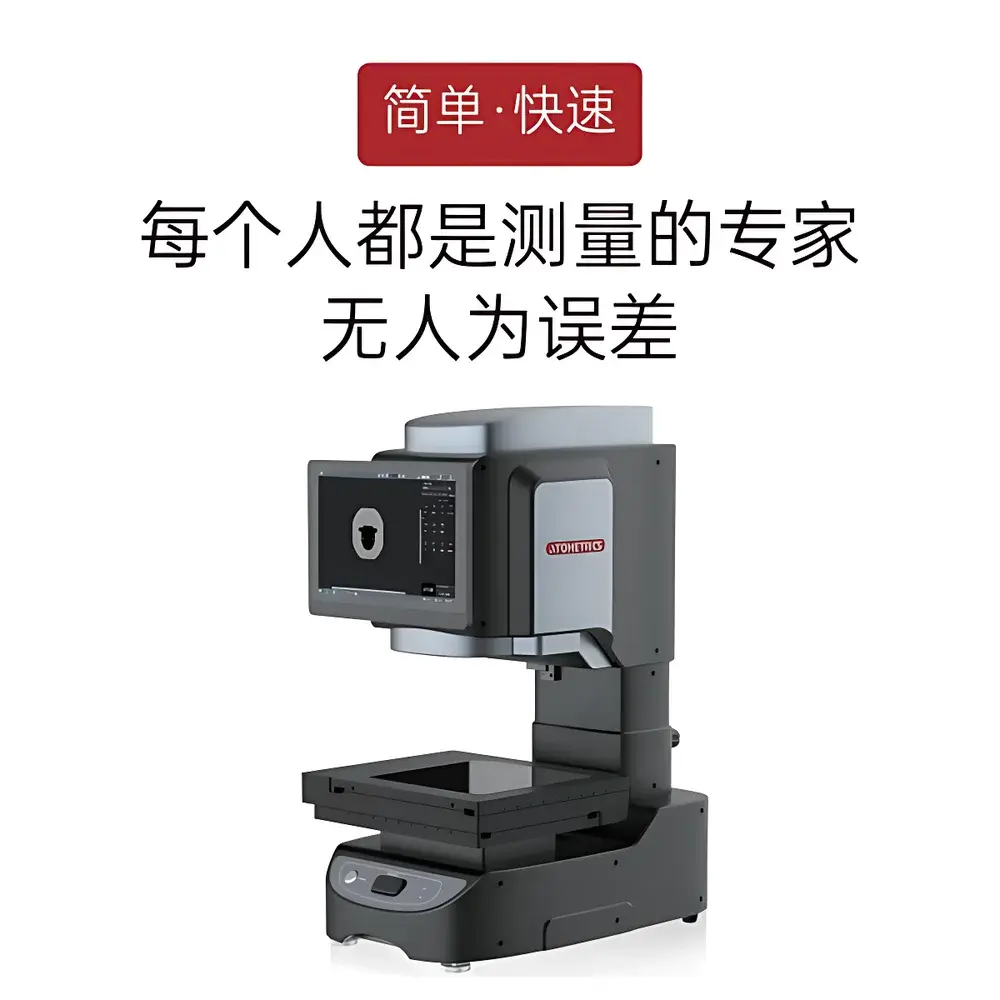
Atometrics FM9000 Series-9005 One-Touch Vision Measuring System
| Brand | Atometrics |
|---|---|
| Origin | Guangdong, China |
| Manufacturer Type | Manufacturer |
| Product Category | Domestic |
| Model | FM9000 Series-9005 |
| Pricing | Upon Request |
| Operation Mode | Fully Automatic |
| Measurement Accuracy | ±1.5 µm |
| Encoder Resolution | 50 nm |
| Camera | 20 MP Monochrome CMOS |
| Illumination | Transmission Light, Ring Light, Movable Profile Light, Slit Ring Light |
Overview
The Atometrics FM9000 Series-9005 is a fully automated, one-touch vision measuring system engineered for high-throughput, high-reproducibility geometric metrology in precision manufacturing environments. Unlike conventional coordinate measuring machines (CMMs), projection systems, or manual stereo microscopes—each requiring extensive operator training, manual focusing, lighting adjustment, and point-by-point feature acquisition—the FM9000-9005 implements a deterministic optical metrology architecture based on dual telecentric optics, sub-pixel edge detection, and synchronized motorized stage control. Its core measurement principle relies on high-fidelity image capture under calibrated illumination conditions, followed by algorithmic extraction of geometric features (e.g., distances, diameters, angles, positions, form deviations) directly from grayscale intensity gradients. The system operates without mechanical probing, eliminating stylus-related uncertainty and enabling non-contact, distortion-free measurement across the full field of view—critical for thin, fragile, or soft-surface components common in stamping, injection molding, and powder metallurgy.
Key Features
- Dual-telecentric optical path with high numerical aperture (NA) and ultra-low distortion (<0.01% TV distortion), ensuring pixel-to-real-world spatial fidelity across the entire imaging field—36% larger than conventional single-telecentric configurations.
- 20-megapixel monochrome CMOS sensor coupled with real-time sub-pixel edge detection algorithm: partitions each pixel into up to 200 subdivisions (0.005-pixel resolution), significantly exceeding native sensor resolution limits and delivering robust contour localization even under low-contrast or noisy surface conditions.
- Intelligent illumination suite including independently controllable transmission backlight, coaxial ring light, programmable profile light, and slit ring light—automatically selected per feature type to maximize edge contrast and minimize shadow artifacts.
- Nanometer-resolution linear stage with 50 nm encoder feedback and 80 mm/s maximum travel speed, supporting seamless multi-field stitching and cross-lens measurement workflows without manual repositioning.
- One-touch workflow engine: automatic focus stacking, adaptive lighting selection, real-time edge fitting, outlier rejection (e.g., burrs, debris), and simultaneous dual-field-of-view display for rapid macro/micro inspection within a single acquisition cycle.
Sample Compatibility & Compliance
The FM9000-9005 accommodates a broad spectrum of industrial parts—including stamped spring contacts, precision-machined shafts, CNC-turned connectors, sintered powder metal gears, injection-molded housings, die-cut elastomers, and threaded fasteners—without requiring dedicated fixtures or datum alignment. Parts are placed arbitrarily on the stage; the system autonomously identifies quantity, orientation, and region-of-interest via global preview scanning. All measurement routines comply with ISO 10360-7 (acceptance and reverification of vision measuring systems), support traceable calibration using NIST-traceable artifact sets, and generate audit-ready reports compliant with ISO 9001, IATF 16949, and FDA 21 CFR Part 11 requirements when integrated with optional secure user authentication and electronic signature modules.
Software & Data Management
The embedded MetroVision OS provides a scriptable, GUI-driven environment for program creation, batch execution, and SPC data export. Measurement programs store full optical configuration metadata (lens ID, exposure time, light channel settings), stage position history, and raw image archives. Data outputs include CSV, XML, PDF (with GD&T annotations), and direct OPC UA integration for MES/SCADA connectivity. Version-controlled program libraries, role-based access permissions, and built-in measurement logbook with timestamped operator IDs ensure GLP/GMP-aligned data integrity. Optional cloud synchronization enables centralized fleet monitoring and remote calibration validation across distributed production sites.
Applications
This system is routinely deployed in Tier-1 automotive supplier QC labs for 100% inline verification of connector pin pitch, terminal coplanarity, and stamper hole position tolerances; in medical device manufacturing for validating microfluidic channel dimensions in polymer substrates; in electronics contract manufacturing for inspecting solder paste volume consistency and BGA ball placement accuracy; and in aerospace component facilities for rapid form assessment of turbine blade root profiles and cooling hole arrays. Its ability to execute repeatable, operator-independent measurements makes it especially suited for high-mix, low-volume production cells where traditional CMM programming overhead is prohibitive.
FAQ
Does the FM9000-9005 require part-specific fixturing or manual alignment?
No—parts may be placed freely on the stage; the system performs autonomous global preview, part count detection, and ROI localization prior to measurement.
Can measurement programs be exported and reused across multiple FM9000 units?
Yes—programs are hardware-agnostic and include embedded calibration offsets; cross-unit deployment requires only stage and lens characterization updates.
Is the sub-pixel edge detection algorithm validated against traceable standards?
Yes—algorithm performance has been verified using ISO 15530-3 compliant step gauges and certified edge artifacts, confirming repeatability ≤ ±0.8 µm at 95% confidence.
What level of illumination control is available for challenging reflective or translucent materials?
All four light sources (transmission, ring, profile, slit ring) are individually intensity-tunable and programmable per measurement step, with dynamic exposure compensation enabled during autofocus sequences.
How does the system handle thermal drift during extended operation?
The granite base and thermally stabilized optical bench maintain positional stability; encoder-based closed-loop stage control compensates for ambient-induced expansion in real time, preserving 50 nm resolution over 8-hour shifts.