
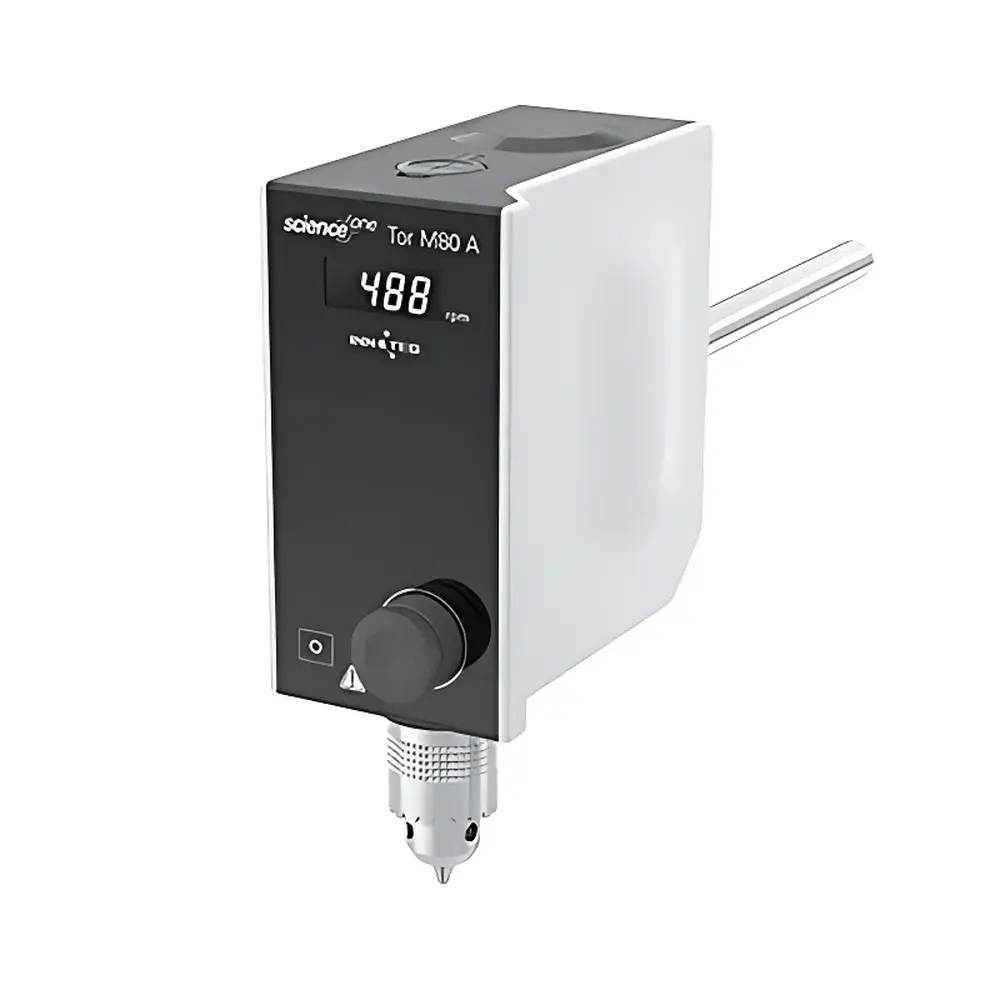
Innoteg ScienceOne Tor M80 A Overhead Stirrer
| Brand | Innoteg |
|---|---|
| Origin | Germany |
| Model | Tor M80 A |
| Stirrer Type | Electric Overhead Stirrer |
| Max. Mixing Volume (Water) | 50 L |
| Speed Range | 50–500 rpm |
| Max. Viscosity | 60,000 mPa·s |
| Max. Torque | 80 N·cm |
| Motor | Brushless DC |
| Display | LED Digital |
| Housing Material | Powder-Coated Cast Aluminum |
| IP Rating | IP54 |
| Dimensions (W×H×D) | 70 × 193 × 147 mm |
| Weight | 1.72 kg |
| Ambient Operating Temperature | 5–40 °C |
| Relative Humidity Limit | ≤80 % RH |
Overview
The Innoteg ScienceOne Tor M80 A Overhead Stirrer is an engineered solution for demanding laboratory mixing and dispersion tasks involving high-viscosity fluids, non-Newtonian suspensions, and shear-sensitive formulations. Designed according to the principles of controlled rotational torque transmission, it employs a brushless DC motor coupled with a precision gear train to deliver stable, low-vibration rotation across its operational speed range. Unlike magnetic stirrers limited by heat generation and coupling efficiency, overhead stirrers like the Tor M80 A provide direct mechanical drive—enabling reproducible agitation in vessels up to 50 L volume and viscosities reaching 60,000 mPa·s. Its compact footprint (70 × 193 × 147 mm) and lightweight construction (1.72 kg) support flexible integration into fume hoods, glove boxes, or modular reactor setups without compromising structural rigidity or thermal stability.
Key Features
- Brushless DC motor ensures maintenance-free operation, consistent torque delivery, and extended service life—eliminating carbon dust contamination and commutator wear common in brushed alternatives.
- Digital LED display provides real-time, high-resolution readout of set and actual rotational speed (50–500 rpm), enabling precise method replication and process documentation.
- Robust powder-coated cast aluminum housing achieves IP54 ingress protection—resisting dust accumulation and water splashes encountered during routine cleaning or humid ambient conditions.
- High-torque output (80 N·cm) sustains stable rotation under load, supporting heavy-duty applications such as polymer dissolution, catalyst slurry homogenization, and viscous emulsion preparation.
- Universal chuck accepts standard ISO 228/1 threaded shafts (diameter range: 0.5–8 mm), facilitating rapid interchange of propeller, anchor, helical ribbon, and dissolver impellers for application-specific optimization.
- Thermally stable design operates continuously within 5–40 °C ambient temperature and ≤80% relative humidity—compliant with standard laboratory environmental specifications per ISO/IEC 17025 calibration environment guidelines.
Sample Compatibility & Compliance
The Tor M80 A is validated for use with aqueous, organic, and semi-aqueous media—including suspensions, pastes, gels, and polymer melts—provided vessel geometry and impeller selection align with fluid rheology. It supports Good Laboratory Practice (GLP) workflows through repeatable speed control and mechanical consistency. While not intrinsically certified for hazardous area use (e.g., ATEX or IECEx), its IP54-rated enclosure meets general-purpose safety requirements outlined in IEC 61000-6-2 (immunity) and IEC 61000-6-3 (emission) standards. No regulatory certification (e.g., FDA 21 CFR Part 11) applies to standalone mechanical stirrers; however, audit-ready operation logs may be generated when integrated with compliant data acquisition systems.
Software & Data Management
As a stand-alone analog/digital hybrid instrument, the Tor M80 A does not include embedded firmware-based data logging or PC connectivity. Speed settings are manually configured via front-panel controls and retained only during active operation. For traceable process documentation, users may pair the unit with external digital tachometers, torque sensors, or programmable logic controllers (PLCs) interfaced via 0–10 V analog output (optional accessory). This architecture prioritizes mechanical reliability over software complexity—aligning with ISO 15197:2013 and ASTM E2500-13 guidance on risk-based validation of laboratory equipment where functional performance outweighs digital feature density.
Applications
- Preparation of high-viscosity pharmaceutical suspensions and ointment bases under controlled shear profiles.
- Homogenization of ceramic slurries and battery electrode pastes prior to coating or casting processes.
- Continuous agitation during enzymatic reactions or microbial fermentations requiring oxygen transfer optimization.
- Dispersion of nanomaterials (e.g., graphene oxide, metal oxides) in polymer matrices for composite development.
- Scale-down mixing studies supporting QbD (Quality by Design) initiatives in API manufacturing per ICH Q5C and Q8(R2).
- Standardized viscosity benchmarking using calibrated reference oils per ASTM D2161 and ISO 3104 protocols.
FAQ
What is the maximum recommended vessel diameter for optimal performance with the Tor M80 A?
For uniform flow field development and minimized vortex formation, use vessels with internal diameters between 80 mm and 300 mm—matching impeller-to-vessel diameter ratios of 0.3–0.5 per AIChE mixing guidelines.
Can the Tor M80 A be used with corrosive solvents such as concentrated acids or halogenated hydrocarbons?
The cast aluminum housing is powder-coated for general chemical resistance, but direct exposure to strong oxidizers or halogenated solvents requires verification of impeller material compatibility (e.g., Hastelloy, PTFE-coated SS) and optional chemical-resistant shaft seals.
Is speed calibration traceable to national metrology institutes?
The LED display reflects internally calibrated encoder feedback; for accredited calibration, third-party verification against NIST-traceable tachometers is recommended per ISO/IEC 17025 Clause 6.5.
Does the unit support continuous duty cycling at maximum torque?
Yes—rated for indefinite operation at 80 N·cm within specified ambient conditions, provided adequate ventilation prevents motor winding temperature rise beyond Class F insulation limits (155 °C).
How does the Tor M80 A compare to gearmotor-driven overhead stirrers in terms of noise and vibration?
Brushless DC architecture eliminates commutation noise and reduces mechanical vibration amplitude by ≥40% versus equivalent AC gearmotor systems—critical for sensitive gravimetric or optical measurements conducted nearby.



