
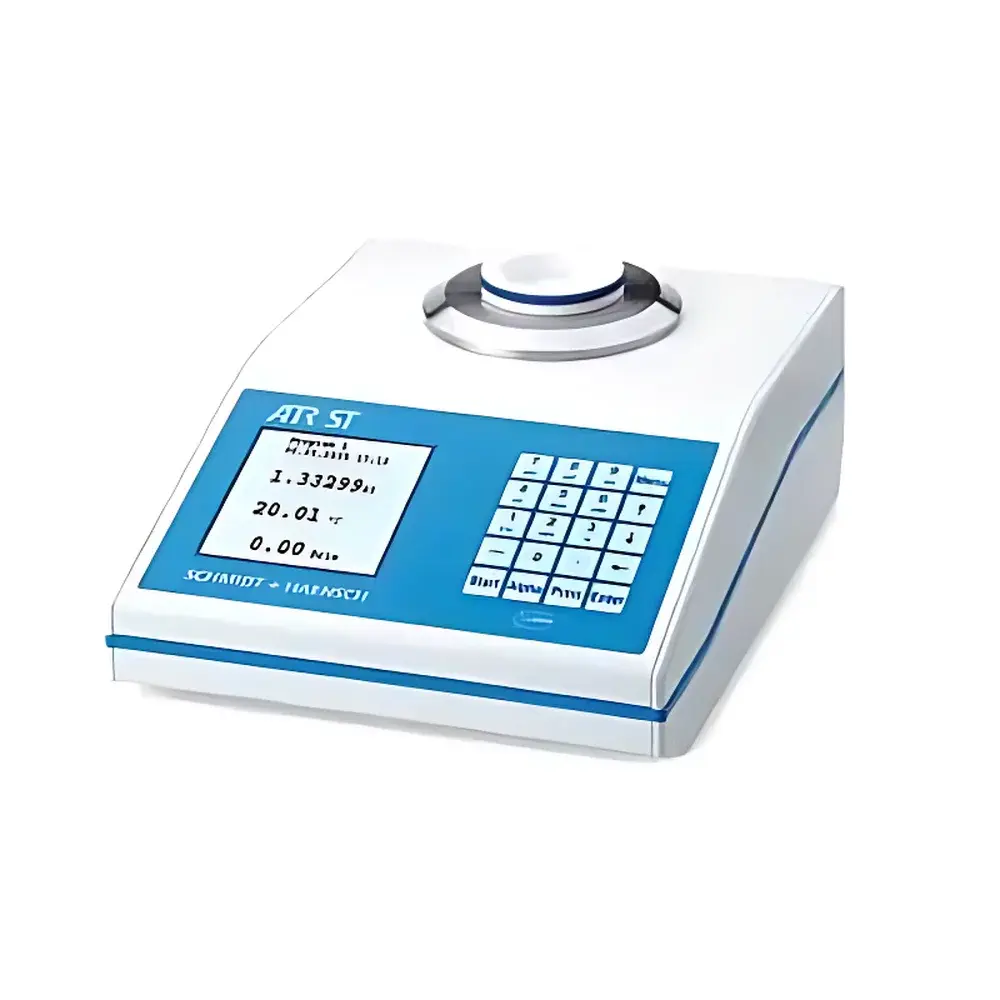
SCHMIDT+HAENSCH ATR ST / ST plus / ST T plus Automatic Digital Refractometer
| Brand | SCHMIDT+HAENSCH (S+H) |
|---|---|
| Country of Origin | Germany |
| Model Series | ATR ST / ST plus / ST T plus |
| Refractive Index Range | 1.3320–1.5320 / 1.30000–1.54000 / 1.28000–1.54000 RI |
| Brix Range | 0–95 / 0–100 / 0–100 % |
| Resolution | RI 0.0001 / 0.00002 / 0.00001 |
| Accuracy | RI ±0.0001 / ±0.00005 / ±0.00003 |
| Temperature Control Range | +5 °C to +50 °C |
| Light Source | 589 nm LED |
| Display | 16×16 character LCD |
| Auto Temperature Compensation | Yes |
Overview
The SCHMIDT+HAENSCH ATR ST, ST plus, and ST T plus series are high-precision automatic digital refractometers engineered for laboratory and quality control environments requiring traceable, repeatable refractive index (RI) and Brix measurements. Based on the principle of total internal reflection at an Attenuated Total Reflection (ATR) prism interface, these instruments eliminate sample preparation variability by enabling direct measurement of liquids, pastes, gels, and semi-solids without dilution or filtration. Each model integrates a thermally stabilized sapphire or BK7 prism, precision temperature-controlled Peltier element, and a monochromatic 589 nm LED light source—mimicking the sodium D-line standard used in classical refractometry. The optical path is calibrated in accordance with ISO 21747, ASTM D1218, and USP , ensuring metrological consistency across global regulatory frameworks.
Key Features
- Three-tiered performance architecture: ST (standard), ST plus (enhanced resolution), and ST T plus (thermostatically optimized for high-stability applications)
- ATR measurement principle enabling rapid, non-destructive analysis of opaque, colored, or particulate-laden samples
- Integrated Peltier temperature control with ±0.1 °C stability over the full operating range (+5 °C to +50 °C)
- Automated temperature compensation compliant with DIN 51757 and ISO 21747 for RI-to-Brix conversion
- High-resolution prism optics manufactured from optically homogenous sapphire (ST T plus) or fused silica (ST/ST plus)
- Self-diagnostic optical alignment system with real-time signal-to-noise monitoring
- IP54-rated enclosure suitable for controlled laboratory and pilot-plant environments
Sample Compatibility & Compliance
These refractometers accommodate a broad spectrum of industrial matrices—including aqueous sugar solutions, pharmaceutical syrups, dairy concentrates, essential oils, polymer emulsions, and hydrocarbon-based coolants—without requiring solvent extraction or dilution. All models support GLP-compliant operation through audit-trail-enabled user authentication, electronic signature capability, and timestamped measurement logging. Data integrity meets FDA 21 CFR Part 11 requirements when paired with SCHMIDT+HAENSCH’s optional LabSoft Suite. Calibration verification follows traceable NIST- or PTB-certified reference standards (e.g., certified sucrose solutions, synthetic calibration fluids with certified RI values). Instrument validation documentation supports IQ/OQ/PQ protocols per GMP Annex 15 and ISO/IEC 17025.
Software & Data Management
The embedded firmware supports standalone operation via the front-panel LCD interface, while optional USB or RS-232 connectivity enables integration into LIMS or MES platforms. The LabSoft Suite provides advanced data handling features including multi-curve overlay, statistical process control (SPC) charting, automated report generation (PDF/CSV/XLSX), and configurable alarm thresholds for out-of-specification results. Measurement metadata—including ambient temperature, prism temperature, RI drift rate, and signal intensity—is stored alongside each result to support root-cause analysis during investigations. All software modules undergo annual cybersecurity review per IEC 62443-3-3.
Applications
- Food & Beverage: Real-time Brix monitoring in juice concentration, syrup blending, dairy evaporation, and confectionery QC; detection of adulteration in honey and olive oil
- Pharmaceuticals: Assay of active pharmaceutical ingredient (API) solutions; osmolality estimation in parenteral formulations; residual solvent quantification in lyophilized products
- Cosmetics & Fragrances: Refractive index profiling of essential oil batches; fatty acid composition estimation in surfactant systems; viscosity proxy correlation in emulsion development
- Chemical Manufacturing: In-process control of polymerization reactions; purity assessment of solvents and monomers; concentration tracking in acid/base neutralization processes
- Academic Research: Thermodynamic characterization of binary and ternary liquid mixtures; solvent–solute interaction studies using RI-derived molar refraction
FAQ
What distinguishes the ST, ST plus, and ST T plus models?
The ST offers foundational ATR performance with 0.0001 RI resolution; ST plus doubles resolution to 0.00002 RI and improves Brix repeatability; ST T plus adds dual-zone Peltier control and sapphire prism for long-term thermal drift <0.00001 RI/hour.
Can these refractometers measure viscous or suspended samples?
Yes—ATR geometry eliminates dependence on optical clarity. Samples up to 10,000 mPa·s (e.g., molasses, glycerol, cream) and suspensions with particles <50 µm are routinely analyzed.
Is external calibration required between measurements?
No. Built-in auto-zero and reference-check routines use internal optical references; manual calibration with certified standards is recommended every 72 operational hours or per SOP-defined intervals.
How is temperature uniformity maintained across the prism surface?
A micro-machined copper heat spreader coupled with closed-loop PID control ensures <±0.05 °C spatial gradient across the 12 mm² ATR contact zone.
Do these instruments support 21 CFR Part 11 compliance?
Yes—when operated with LabSoft Suite v4.2+, all electronic records include immutable audit trails, role-based access control, and electronic signatures meeting ALCOA+ principles.






