
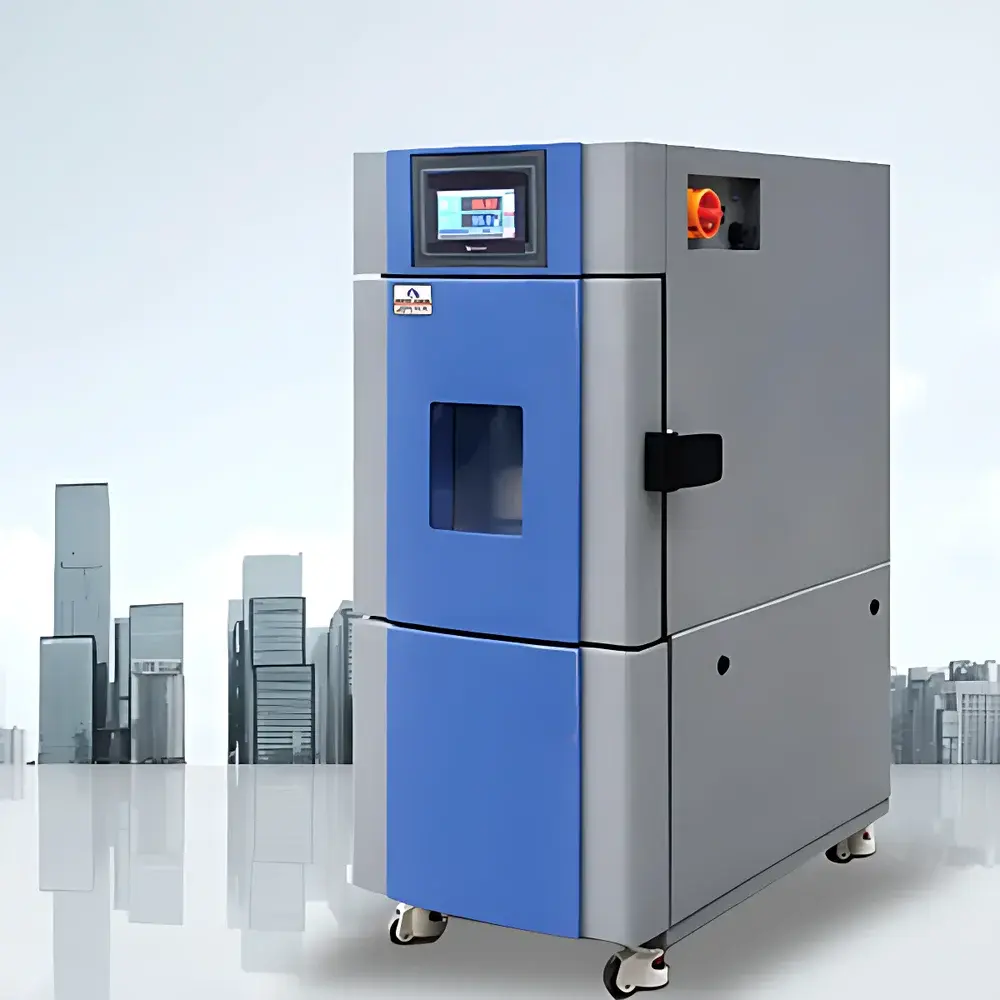
Haiyin Equipment HW-100L Electronic Components Optical Communication Environmental Test Chamber
| Brand | Haiyin Equipment |
|---|---|
| Origin | Guangdong, China |
| Manufacturer Type | Direct Manufacturer |
| Country of Origin | China |
| Model | HW-100L |
| Temperature Range | −70 °C to +150 °C |
| Cooling Method | Compressor-Based Refrigeration |
| Explosion-Proof Design | Standard (Non-Explosion-Proof) |
| Temperature Fluctuation | ±2.0 °C |
| Temperature Deviation | ±1.5 °C |
| Temperature Uniformity | 2.0 °C |
| Heating Rate | 3–5 °C/min |
| Cooling Rate | 1.0–1.2 °C/min |
| Internal Chamber Dimensions | 30 × 25 × 30 cm (L × W × H) |
Overview
The Haiyin Equipment HW-100L Environmental Test Chamber is a precision-engineered thermal stress testing system specifically designed for reliability validation of optoelectronic components and high-speed communication devices under controlled temperature extremes. It operates on a dual-stage compressor refrigeration architecture with PID-controlled heating and cooling circuits, enabling stable thermal cycling across a broad operational envelope—from cryogenic −70 °C to elevated +150 °C. Unlike general-purpose climate chambers, the HW-100L integrates structural optimizations critical for optical and semiconductor applications: water-electricity separation, multi-layer thermal insulation, and a uniformity-focused chamber geometry that minimizes vertical thermal gradients—ensuring consistent thermal exposure across mounted transceivers, laser diodes, photodetectors, and passive optical components during qualification per Telcordia GR-468-CORE, IEC 61373, and JEDEC JESD22-A104 (Temperature Cycling) standards.
Key Features
- Compact 100 L internal volume (30 × 25 × 30 cm) optimized for benchtop integration in R&D labs and QC environments handling small-form-factor optical modules (e.g., SFP+, QSFP28, OSFP).
- Thermal performance validated to ±1.5 °C deviation and ≤2.0 °C uniformity across the working zone—critical for detecting latent defects in solder joints, epoxy adhesion, and thermo-mechanical mismatch in photonic integrated circuits (PICs).
- Programmable ramp rates (3–5 °C/min heating; 1.0–1.2 °C/min cooling) support both steady-state soak tests and accelerated thermal cycling (ATC) profiles compliant with IPC-9701A.
- Integrated condensate management system with sloped ceiling and drip-free “isothermal layer” design prevents moisture accumulation and cold-side condensation—eliminating risk of water ingress into sensitive optical interfaces during low-temperature operation.
- Real-time monitoring via front-panel LCD with event logging, alarm history storage, and fault-code diagnostics—including over-temperature, refrigerant pressure anomaly, and door-open alerts.
Sample Compatibility & Compliance
The HW-100L accommodates standard optical component carriers (e.g., JEDEC trays, custom PCB fixtures), fiber array holders, and bare-die test boards up to 25 cm wide. Its non-explosion-proof configuration meets Class I, Division 2 electrical safety requirements per UL 61010-1 and IEC 61010-1. All thermal test protocols—including temperature cycling, storage, and operational life testing—are fully traceable and audit-ready for ISO/IEC 17025-accredited laboratories. Data export supports GLP-compliant documentation: time-stamped CSV and Excel-compatible files generated without proprietary software dependencies—enabling direct import into LIMS or statistical process control (SPC) platforms.
Software & Data Management
No external software installation is required for data retrieval or analysis. Test logs—including temperature setpoints, actual chamber readings, timestamps, and alarm events—are stored internally and exported via USB flash drive in native .CSV or .XLSX format. Each file includes embedded metadata (test ID, operator, start/stop times, firmware version) and conforms to FDA 21 CFR Part 11 principles through immutable timestamping and user-accessible audit trails. Optional RS-485 or Ethernet interface enables remote monitoring and integration with centralized environmental test management systems (ETMS) using Modbus RTU or TCP protocols.
Applications
- Qualification testing of optical transceivers (10G/25G/100G/400G) per IEEE 802.3 and OIF CEI specifications.
- Thermal shock evaluation of VCSEL arrays, silicon photonics modulators, and hybrid III-V/Si packaging assemblies.
- Reliability screening of passive components—including WDM filters, isolators, and PLC splitters—under repeated thermal excursions.
- Process validation for conformal coating, underfill dispensing, and reflow soldering in optoelectronic assembly lines.
- Failure analysis correlation between thermal stress exposure and post-test parameter drift (e.g., insertion loss, extinction ratio, eye diagram degradation).
FAQ
What standards does the HW-100L support for optical component qualification?
It facilitates testing aligned with Telcordia GR-468-CORE (optoelectronic reliability), JEDEC JESD22-A104 (temperature cycling), and IEC 60068-2-14 (thermal shock), with configurable profiles for both steady-state and dynamic thermal stress.
Can the chamber be used for humidity-enabled testing?
No—the HW-100L is a dry-thermal-only chamber. For combined temperature/humidity testing, refer to Haiyin’s HW-H series environmental chambers with integrated steam humidification and dew-point control.
Is the temperature uniformity verified at multiple load conditions?
Yes—uniformity is certified at empty, 50% loaded (with standard aluminum test racks), and full-load configurations per IEC 60068-3-5, with all results documented in the factory calibration report shipped with each unit.
How is data integrity ensured during long-duration tests (e.g., 1000+ hour thermal aging)?
Internal non-volatile memory retains continuous 1-second interval logging even during power interruption; upon recovery, logging resumes seamlessly without data gap or timestamp corruption.
Does the chamber comply with electromagnetic compatibility (EMC) requirements for lab environments?
Yes—it meets EN 61326-1 (industrial EMC) and EN 61000-6-3 (emission limits) for operation in shared laboratory spaces adjacent to sensitive optical measurement equipment such as OTDRs and bit error rate testers (BERTs).



