
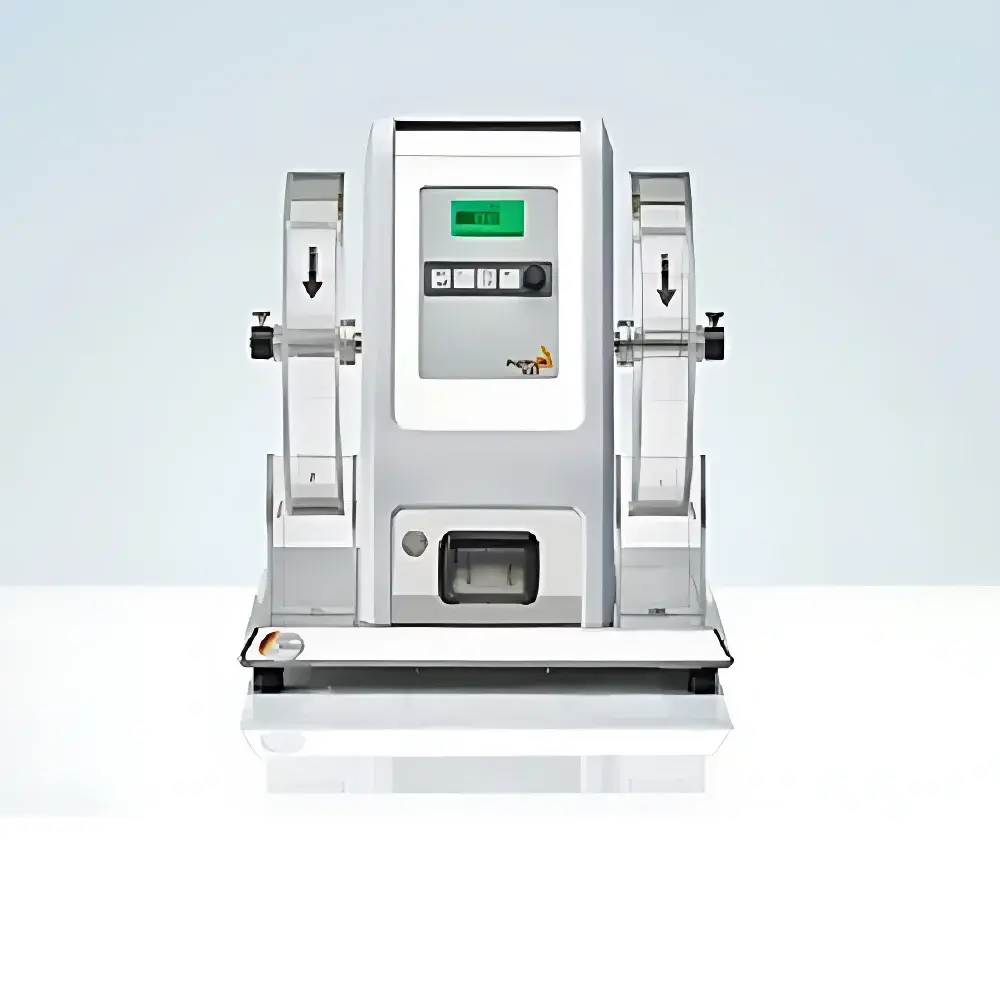
Pharma-test PTF 200 Dual-Drum Friability Tester
| Brand | Pharma-test |
|---|---|
| Origin | Germany |
| Model | PTF 200 |
| Drum Configuration | Dual-drum |
| Speed Range | 15–100 rpm |
| Operating Modes | Fixed revolutions or fixed time |
| Calibration Reminder | Programmable interval timer |
| Data Export | USB flash drive support |
| Sample Discharge | Automatic |
| Balance Interface | RS-232/USB for analytical balance integration |
| Compliance | USP <1216>, Ph. Eur. <2.9.7>, JP <14> |
| Optional | Built-in thermal printer |
Overview
The Pharma-test PTF 200 Dual-Drum Friability Tester is an engineered solution for quantitative assessment of tablet mechanical integrity under controlled tumbling stress. It operates on the principle of rotational abrasion—where tablets are subjected to repeated impacts and frictional forces inside two horizontally mounted, rotating drums lined with smooth, non-reactive acrylic surfaces. This simulates mechanical stresses encountered during packaging, shipping, and handling in pharmaceutical manufacturing and distribution. Designed in accordance with the pharmacopoeial standards of the United States Pharmacopeia (USP <1216>), European Pharmacopoeia (Ph. Eur. <2.9.7>), and Japanese Pharmacopoeia (JP <14>), the PTF 200 delivers reproducible, auditable friability data essential for batch release, formulation development, and stability protocol execution.
Key Features
- Dual-drum architecture enables parallel or comparative testing—supporting method optimization, cross-batch evaluation, or reference-standard verification within a single run.
- Adjustable rotational speed from 15 to 100 rpm ensures precise control over mechanical energy input, facilitating compliance with variable pharmacopoeial requirements or internal SOPs.
- Two operational modes—fixed revolution count (e.g., 100 rotations) or fixed duration (e.g., 4 minutes)—allow flexibility in test design without manual intervention.
- Programmable calibration reminder interval ensures traceable instrument performance verification in alignment with GLP and GMP documentation practices.
- Automatic sample discharge mechanism eliminates manual drum opening, reducing operator exposure, contamination risk, and inter-run variability.
- Integrated balance interface (RS-232 and USB) enables direct mass measurement transfer post-test, minimizing transcription errors and supporting 21 CFR Part 11–compliant electronic records when paired with validated software.
- USB port supports export of test methods, raw weight data, and summary reports to external storage—facilitating audit-ready documentation and long-term data archiving.
Sample Compatibility & Compliance
The PTF 200 accommodates standard tablet sizes up to Ø 25 mm and thicknesses up to 8 mm per drum, with total loading capacity of up to 6.5 g per drum (per USP guidelines). Its drum geometry, surface finish, and rotational dynamics have been validated to meet the dimensional and kinetic specifications defined in USP <1216>. The system is routinely deployed in QC laboratories supporting FDA-regulated submissions, EU MRP dossiers, and PMDA filings. All firmware and user-accessible functions comply with ICH Q7 and Annex 11 principles for computerized system validation, and its operation supports ALCOA+ data integrity criteria—including attributable, legible, contemporaneous, original, and accurate recordkeeping.
Software & Data Management
While the PTF 200 operates as a standalone instrument with intuitive front-panel controls, its digital infrastructure supports seamless integration into enterprise quality management systems. Test parameters—including speed, duration/revolutions, start time, and operator ID—are logged automatically. When connected to an analytical balance, pre- and post-test masses are timestamped and stored alongside calculated % weight loss. Reports generated via USB export include full metadata: instrument serial number, firmware version, calibration status, environmental conditions (if externally logged), and digital signatures where enabled. Optional firmware upgrades provide enhanced audit trail functionality, including user-level access control and change history for critical parameters—aligning with FDA 21 CFR Part 11 requirements for electronic signatures and record retention.
Applications
- Batch release testing per pharmacopoeial monographs for immediate-release and film-coated tablets.
- Formulation screening during preformulation studies—evaluating binder efficacy, granulation method impact, or coating durability.
- Stability program support—monitoring physical degradation trends across accelerated and long-term storage conditions.
- Process validation activities, including compression parameter optimization and scale-up assessment.
- Supplier qualification—verifying consistency of incoming tablet cores or coated products against agreed-upon friability thresholds.
- Investigations into root causes of coating defects, capping, or chipping observed in packaging line trials.
FAQ
Does the PTF 200 require external PC software to operate?
No—the instrument functions independently with embedded firmware; PC connectivity is optional and used only for advanced reporting or centralized data aggregation.
Can the PTF 200 be validated for GMP environments?
Yes—its design supports IQ/OQ/PQ protocols; Pharma-test provides documented evidence packages, including factory calibration certificates, traceable standards, and test templates aligned with ASTM E2500 and Annex 15.
Is the drum material compliant with USP <1216> requirements?
Yes—the drums are constructed from optically clear, static-dissipative acrylic meeting USP’s specification for non-reactive, low-abrasion internal surfaces.
How is calibration verified on the PTF 200?
Calibration includes rotational speed verification using certified tachometry, drum dimension metrology, and timer accuracy assessment; the programmable reminder prompts scheduled checks per internal SOP or regulatory schedule.
What balance compatibility does the PTF 200 support?
It interfaces with most major analytical balances via RS-232 or USB virtual COM port, supporting automatic weight capture upon command—no proprietary drivers required.




