
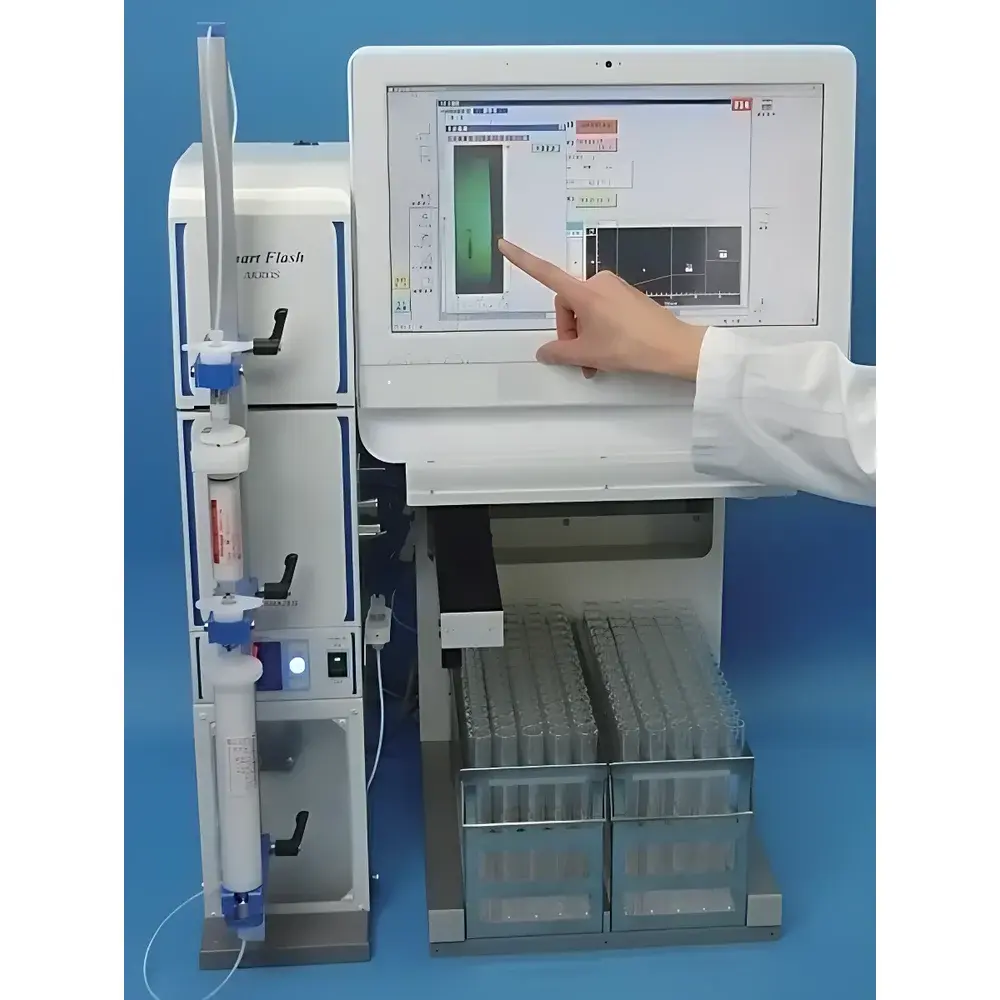
Yamazen AKROS Intelligent Medium-Pressure Preparative Liquid Chromatography System
| Brand | Yamazen |
|---|---|
| Origin | Japan |
| Model | AKROS |
| Application Level | Laboratory Grade |
| Instrument Type | Medium-Low Pressure Preparative LC |
| Flow Rate Range | 0–80 mL/min |
| Flow Accuracy | RSD₆ ≤ 1% |
| Flow Precision (Repeatability) | RSD₆ ≤ 1% |
| Maximum Operating Pressure | 1.0 MPa |
| Wavelength Range | ±1 nm |
| Wavelength Repeatability | ≤0.1 nm |
| Baseline Noise | ≤1 × 10⁻⁵ AU |
| Data Acquisition Rate | 20 Hz |
Overview
The Yamazen AKROS Intelligent Medium-Pressure Preparative Liquid Chromatography System is a purpose-engineered platform for scalable, reproducible compound isolation and purification in research and development laboratories. Built upon Yamazen Corporation’s four-decade legacy in preparative chromatography, the AKROS implements medium-pressure liquid chromatography (MPLC) principles—operating at pressures up to 1.0 MPa—to deliver robust separation performance across milligram-to-multi-gram sample loads. Unlike high-pressure systems requiring ultra-high-purity solvents and sub-2-µm particles, the AKROS leverages conventional silica- or polymer-based stationary phases (e.g., Hi-flash®, Ultra Pack®, Cartridge columns), enabling cost-effective, rapid method development without compromising resolution or recovery yield. Its architecture integrates fluidic control, real-time UV/Vis detection, and intelligent software-driven decision logic—making it especially suitable for natural product isolation, synthetic intermediate purification, pharmaceutical impurity profiling, and early-stage lead compound enrichment.
Key Features
- Programmable dual-piston reciprocating pump delivering precise flow rates from 0 to 80 mL/min with ≤1% RSD₆ accuracy and repeatability—ensuring consistent gradient formation and retention time stability across repeated runs.
- Modular detector configuration supporting interchangeable optical modules: fixed-wavelength UV (254 nm), variable-wavelength UV/Vis (190–380 nm or 190–600 nm), refractive index (RI), evaporative light scattering (ELSD), and mass spectrometry (MS) interfaces—enabling universal detection of chromophoric, non-chromophoric, and semi-volatile analytes.
- Integrated TLC scanning module (compatible with AI-580S interface) that digitizes thin-layer chromatograms, calculates Rf values in real time, and correlates elution profiles with mobile phase composition—accelerating method scouting and solvent system optimization.
- Intelligent chromatographic software (amazen™) grounded in fundamental retention modeling; automatically proposes gradient programs, predicts elution windows, and highlights target compound elution zones using dynamic yellow arrow indicators—reducing method development time by up to 60% compared to manual approaches.
- Rugged stainless-steel fluid path with chemically resistant seals and low-dead-volume fittings; compliant with common organic solvents (acetonitrile, methanol, THF, dichloromethane) and aqueous buffers (pH 2–8).
Sample Compatibility & Compliance
The AKROS accommodates a broad range of sample matrices—including crude extracts, reaction mixtures, fermentation broths, and synthetic crude products—with minimal pretreatment. Column compatibility spans standard glass and stainless-steel cartridges (4–80 mm i.d.), packed with C18, silica, amino, cyano, diol, or specialized chiral media. All hardware and software components conform to ISO 9001 manufacturing standards. The system supports audit-trail-enabled operation under GLP environments and is compatible with 21 CFR Part 11-compliant electronic signature modules when deployed with validated software configurations. Method parameters, instrument logs, and raw chromatograms are timestamped and digitally signed to meet regulatory submission requirements for preclinical and process R&D documentation.
Software & Data Management
The amazen™ software suite provides a unified interface for instrument control, method building, data acquisition, and post-run analysis. It features embedded retention modeling algorithms that correlate solvent strength (ε⁰), polarity index, and column geometry to predict retention behavior—allowing users to simulate gradient outcomes prior to injection. Raw data is stored in vendor-neutral .cdf format (compatible with OpenChrom and Chromeleon), while processed reports export as PDF or Excel with customizable templates. All user actions—including parameter changes, fraction collection triggers, and detector wavelength switches—are logged with operator ID, timestamp, and reason-for-change fields. Optional network deployment enables centralized instrument monitoring and remote method validation across multi-site laboratories.
Applications
- Purification of natural product isolates (alkaloids, flavonoids, terpenes) from plant or microbial sources using step-gradient or linear-gradient MPLC protocols.
- Isolation of synthetic intermediates and final APIs following Suzuki, Heck, or amidation reactions—where rapid removal of palladium residues, excess reagents, or regioisomers is critical.
- Preparative-scale separation of enantiomers on chiral stationary phases (e.g., Chiralpak® AD-H, AS-H) under isocratic or gradient conditions.
- Fractionation of peptide libraries and oligonucleotide conjugates prior to MALDI-TOF or LC-MS characterization.
- Method transfer from analytical HPLC to preparative scale via retention time normalization and linear velocity scaling—validated per ICH Q5A and USP .
FAQ
What pressure range does the AKROS operate within, and how does this affect column selection?
The AKROS operates at up to 1.0 MPa (10 bar), making it ideal for standard-packed silica and polymer columns with particle sizes ≥15 µm. This eliminates the need for expensive UHPLC-grade hardware while maintaining sufficient backpressure for efficient mass transfer.
Can the AKROS be used for GMP-regulated purification steps?
While primarily designed for R&D and lab-scale purification, the system supports 21 CFR Part 11 compliance when configured with electronic signatures, audit trails, and validated software—enabling use in non-final GMP stages such as reference standard preparation or impurity isolation.
Is method transfer from analytical HPLC to AKROS supported?
Yes—the amazen™ software includes a scale-up calculator that converts analytical gradient methods to preparative equivalents based on column volume, flow rate scaling, and linear velocity preservation—aligned with USP guidance.
Does the system support automated fraction collection?
Yes—integrated fraction collectors with UV-triggered or time-based collection modes are available as optional modules, with position tracking synchronized to chromatographic data streams.
What maintenance intervals are recommended for pump seals and detector lamps?
Pump seals require inspection every 500 hours of operation; UV lamp lifetime is rated at ≥2,000 hours under typical 254 nm usage, with automatic intensity monitoring and replacement alerts built into the software.




