
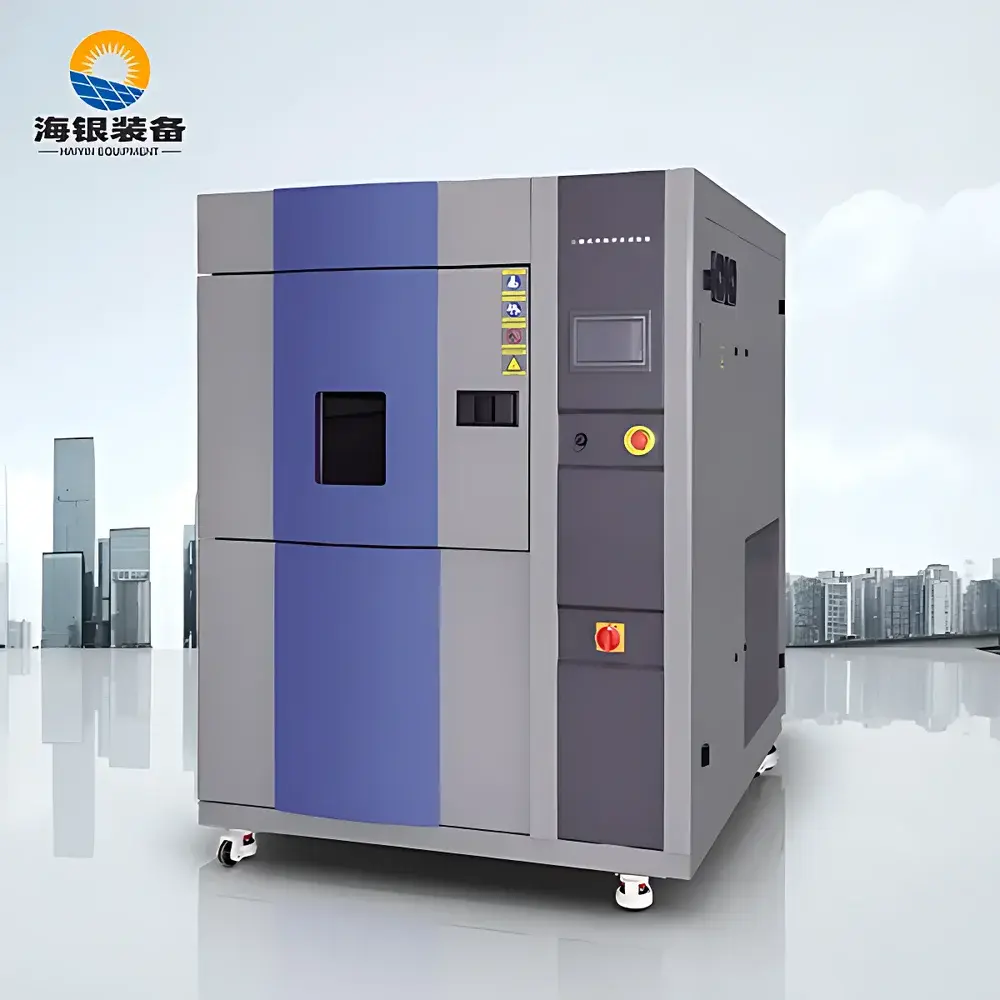
Haiyin Equipment COK7193 Three-Zone Thermal Shock Test Chamber with Chip-Sensing Temperature Monitoring
| Brand | Haiyin Equipment |
|---|---|
| Origin | Guangdong, China |
| Manufacturer Type | Direct Manufacturer |
| Country of Origin | China |
| Model | COK7193 |
| Price Range | USD 12,000 – 39,500 (FOB) |
| High-Temperature Range | +180 °C |
| Low-Temperature Range | −70 °C |
| Thermal Shock Range | −55 °C to +150 °C |
| Temperature Stability | ±2 °C |
| Temperature Transition Time | ≤5–15 s (−55 °C ↔ +150 °C) |
Overview
The Haiyin Equipment COK7193 Three-Zone Thermal Shock Test Chamber is an engineered solution for accelerated environmental stress screening (ESS) and reliability validation of electronic components, semiconductor packages, PCB assemblies, and advanced materials. Designed around a true three-chamber architecture—comprising independent high-temperature, low-temperature, and test zones—the system enables rapid, repeatable thermal transitions without subjecting samples to ambient air exposure or mechanical transfer. This configuration eliminates thermal lag associated with single- or dual-chamber designs and ensures precise control over dwell time, transition rate, and thermal gradient exposure—critical parameters defined in industry standards such as JEDEC JESD22-A104 (Temperature Cycling), MIL-STD-810H Method 503.6 (Temperature Shock), and IEC 60068-2-14. The integrated chip-sensing temperature monitoring system provides real-time, localized thermal feedback directly at the sample interface, enabling closed-loop verification of actual device-under-test (DUT) surface temperature during shock events—distinct from conventional chamber air-sensor-based control.
Key Features
- Three-zone segregated architecture: Independent high-temperature (+180 °C), low-temperature (−70 °C), and insulated test chambers eliminate cross-contamination and ensure thermal integrity during rapid transitions.
- Ultra-fast thermal transition: Achieves full-range switching between −55 °C and +150 °C in ≤15 seconds, validated per ASTM E1545-20 Annex A1 protocols for transition time measurement.
- Chip-level temperature sensing: Embedded micro-sensor array mounted on sample carrier enables direct DUT surface temperature acquisition with ±0.3 °C accuracy, supporting ISO/IEC 17025-compliant uncertainty budgets.
- Dual-stage cascade refrigeration: Uses R404A (low-stage) and R23 (high-stage) refrigerants in a Copeland semi-hermetic compressor system, meeting EPA SNAP and EU F-Gas Regulation (EU) No 517/2014 requirements.
- Balanced temperature control (BTC): PID-driven dynamic modulation of electric heating and staged refrigerant expansion maintains test zone stability at ±0.5 °C under static conditions and ±2 °C during cycling.
- Structural integrity: Inner chamber constructed from SUS304 stainless steel; insulation via 120 mm thick ultra-fine glass fiber; external casing finished with electrostatic polyester coating (RAL 7035).
Sample Compatibility & Compliance
The COK7193 accommodates standard JEDEC trays (up to 30 kg load capacity), wafer carriers, and custom fixtures via adjustable stainless-steel sliding rails actuated by Festo pneumatic cylinders. Its 350 × 250 mm heated, anti-fog observation window (indium-tin-oxide coated) permits optical inspection without thermal interruption. Cable feedthroughs support up to eight 3-mm-diameter signal lines with silicone-sealed grommets. The system complies with electromagnetic compatibility (EMC) per EN 61326-1, safety per IEC 61010-1, and is designed to meet audit requirements for GLP/GMP environments—including traceable calibration records, alarm logging, and hardware-enforced door interlocks. Optional configurations support US FDA 21 CFR Part 11 compliance through encrypted audit trails and electronic signature modules.
Software & Data Management
Control is managed via a 10.1-inch capacitive touchscreen HMI running embedded Linux OS, supporting programmable profiles with up to 99 segments, 999 cycles, and conditional branching (e.g., “hold at −40 °C until sensor T < −38 °C”). All temperature data—including chamber air, DUT surface, and refrigerant line readings—is timestamped and stored locally on industrial-grade SD card (≥32 GB) with automatic rollover. Export formats include CSV and XML; optional Ethernet/IP or Modbus TCP interfaces enable integration into MES/SCADA systems. Firmware supports firmware-over-the-air (FOTA) updates and includes built-in diagnostics for compressor performance, refrigerant pressure differentials, and sensor drift compensation.
Applications
- Qualification testing of automotive-grade ICs per AEC-Q200 Rev D, including solder joint fatigue assessment under repeated thermal stress.
- Failure analysis labs performing accelerated life testing (ALT) on MEMS sensors, power modules, and GaN/SiC devices.
- Materials science research evaluating coefficient of thermal expansion (CTE) mismatch in heterogeneous packaging stacks.
- Quality assurance workflows in contract manufacturing (EMS) for IPC-A-610 Class 3 product release.
- Government and defense laboratories conducting MIL-STD-883 Method 1010.8 (Thermal Shock) and NATO STANAG 4370 environmental qualification.
FAQ
What standards does the COK7193 comply with for thermal shock testing?
It is engineered to meet the operational requirements of JEDEC JESD22-A104, IEC 60068-2-14, MIL-STD-810H Method 503.6, and ASTM E1545-20.
Can the chip-sensing system be calibrated independently from chamber air sensors?
Yes—each micro-sensor channel supports individual NIST-traceable calibration via front-panel adjustment or external software utility.
Is remote monitoring supported out-of-the-box?
Standard Ethernet connectivity enables web-based status viewing; optional VPN gateway and TLS 1.2 encryption are available for secure off-site access.
What maintenance intervals are recommended for the cascade refrigeration system?
Compressor oil analysis every 2,000 operating hours; refrigerant leak check annually; filter-drier replacement every 18 months or after any refrigerant service.
Does the system support automated reporting for ISO/IEC 17025 accreditation?
Yes—integrated report generator produces PDF/CSV test certificates with metadata (operator ID, calibration due date, environmental conditions) and digital signatures.



