
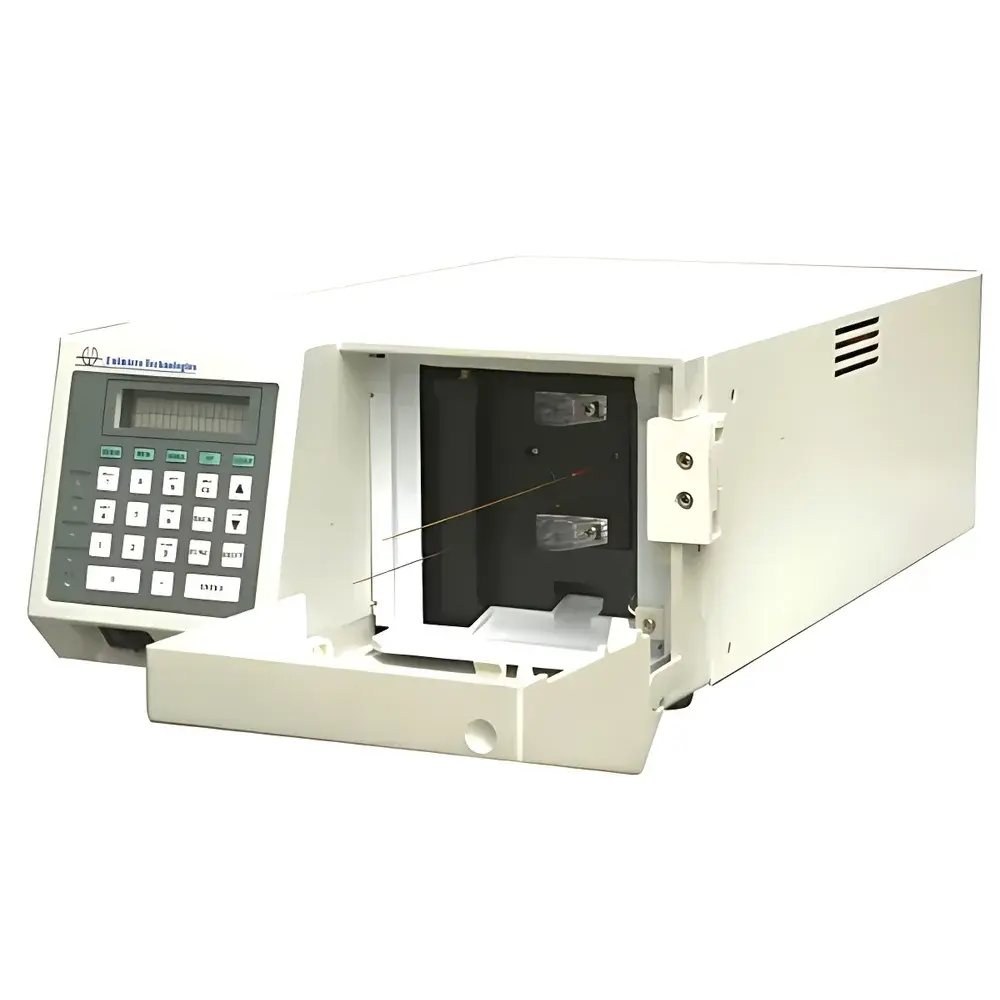
Unimicro Trisep®-2100 UV/Vis On-Column Detector
| Brand | Unimicro Technologies |
|---|---|
| Origin | Shanghai, China |
| Manufacturer Type | Original Equipment Manufacturer (OEM) |
| Instrument Type | UV-Vis Absorbance Detector |
| Model | Trisep®-2100 |
| Light Sources | Deuterium Lamp & Tungsten-Halogen Lamp |
| Wavelength Range | 190–600 nm |
| Spectral Bandwidth | 8 nm |
| Wavelength Accuracy | ±1 nm |
| Wavelength Repeatability | ±0.1 nm |
| Baseline Drift | ≤5 × 10⁻⁴ AU/h |
| Baseline Noise | ≤6 × 10⁻⁶ AU (RMS, 1 s time constant) |
| Absorbance Range | 0.0001–2.56 AU Full Scale (AUFS) |
| D₂ Lamp Lifetime | ≥2000 h |
| Operating Temperature | 4–35 °C |
| Dimensions (W×H×D) | 260 × 140 × 430 mm |
Overview
The Unimicro Trisep®-2100 UV/Vis On-Column Detector is an engineered solution for real-time, high-sensitivity absorbance detection directly at the column outlet—specifically optimized for microbore and capillary-scale separation systems. Unlike conventional flow-cell detectors requiring post-column tubing and volumetric dilution, the Trisep®-2100 employs a compact, low-dead-volume optical interface that couples directly to capillary or fused-silica columns (ID ≤ 100 µm), minimizing band broadening and preserving chromatographic resolution. Its dual-lamp architecture—integrating a deuterium lamp for deep-UV coverage (190–370 nm) and a tungsten-halogen lamp for visible-range stability (350–600 nm)—enables seamless spectral continuity across the full 190–600 nm range. Detection is based on Beer-Lambert law-compliant absorbance measurement, with photometric linearity validated over 4 orders of magnitude (0.0001–2.56 AUFS), making it suitable for both trace-level quantification and high-concentration screening in low-flow environments (typically 0.1–10 µL/min).
Key Features
- True on-column detection architecture with sub-20 nL optical path dead volume, eliminating post-column dispersion artifacts
- Dual-source illumination system: independently switchable or synchronized D₂ and W lamp operation ensures optimal SNR across UV and visible bands
- Three operational modes: single-wavelength (fixed λ), dual-wavelength (ratiometric or differential), and fixed-wavelength scanning (full spectrum acquisition at user-defined intervals)
- High photometric stability: baseline drift <5 × 10⁻⁴ AU/h and noise ≤6 × 10⁻⁶ AU (RMS) support long-duration method validation and unattended overnight runs
- Wavelength accuracy ±1 nm and repeatability ±0.1 nm—certified per ISO 17025-accredited calibration protocols
- Robust thermal management enabling stable performance within ambient lab conditions (4–35 °C), without active cooling or external chillers
- Compact footprint (260 × 140 × 430 mm) designed for integration into confined instrument bays or modular CE/LC platforms
Sample Compatibility & Compliance
The Trisep®-2100 is compatible with capillary electrophoresis (CE), capillary electrochromatography (CEC), and micro-LC systems operating at flow rates from 0.05 to 15 µL/min. It interfaces seamlessly with standard 360-µm OD fused-silica capillaries via proprietary low-torque, zero-leakage optical couplers. The detector complies with IEC 61010-1 for electrical safety and meets electromagnetic compatibility (EMC) requirements per EN 61326-1. Its firmware supports audit-trail-enabled operation in accordance with FDA 21 CFR Part 11 when integrated with compliant data systems, and its wavelength calibration traceability aligns with NIST-traceable reference standards. For regulated QC/QA labs, the device supports GLP/GMP workflows through configurable user access levels and electronic signature-capable software integration.
Software & Data Management
The Trisep®-2100 communicates via USB 2.0 or RS-232 to host acquisition software (e.g., Unimicro ChromaLink™ Suite or third-party CE/LC control platforms). Real-time absorbance data are streamed at up to 20 Hz with 24-bit ADC resolution. Software features include automated lamp switching logic, wavelength calibration verification reports, baseline correction algorithms (rolling average, polynomial fit), and export of raw .csv or .dx files compatible with ASTM E1319-compliant data analysis tools. All parameter changes—including wavelength selection, gain adjustment, and mode switching—are logged with timestamp, operator ID, and reason-for-change fields to satisfy ALCOA+ data integrity principles.
Applications
- High-efficiency peptide mapping in biopharmaceutical development using capillary LC-UV
- Trace-level impurity profiling of small-molecule APIs under ICH Q2(R2) guidelines
- On-line monitoring of CEC separations for chiral compound resolution
- Method transfer from analytical- to capillary-scale HPLC with preserved peak fidelity
- Multi-wavelength ratio analysis for co-eluting analytes (e.g., oxidation products in lipidomics)
- Stability-indicating assays where photodiode array (PDA) detectors are impractical due to flow-rate or volume constraints
FAQ
What is the minimum detectable absorbance for the Trisep®-2100 under standard operating conditions?
Under typical 1-s time constant and 5 µL/min flow, the limit of detection (LOD) is ~0.3 ng injected for compounds with ε > 10⁴ L·mol⁻¹·cm⁻¹ (e.g., aromatic amines).
Can the Trisep®-2100 be used with non-aqueous mobile phases such as THF or chloroform?
Yes—optical path materials are chemically resistant to common organic solvents; however, extended exposure to halogenated solvents requires periodic quartz window inspection per maintenance schedule.
Is firmware upgrade capability supported remotely?
Firmware updates are delivered via signed .hex packages and require local USB connection; remote update is not enabled to preserve regulatory compliance and system integrity.
Does the detector support GMP-compliant electronic signatures?
Electronic signature functionality is available only when deployed with validated ChromaLink™ Suite v4.2+, including role-based permissions, biometric or token-based authentication, and immutable audit trails.
How is wavelength calibration verified during routine use?
Users may execute internal holmium oxide or didymium glass reference checks; calibration certificates include uncertainty budgets per ISO/IEC 17025:2017 Annex A.3.




