
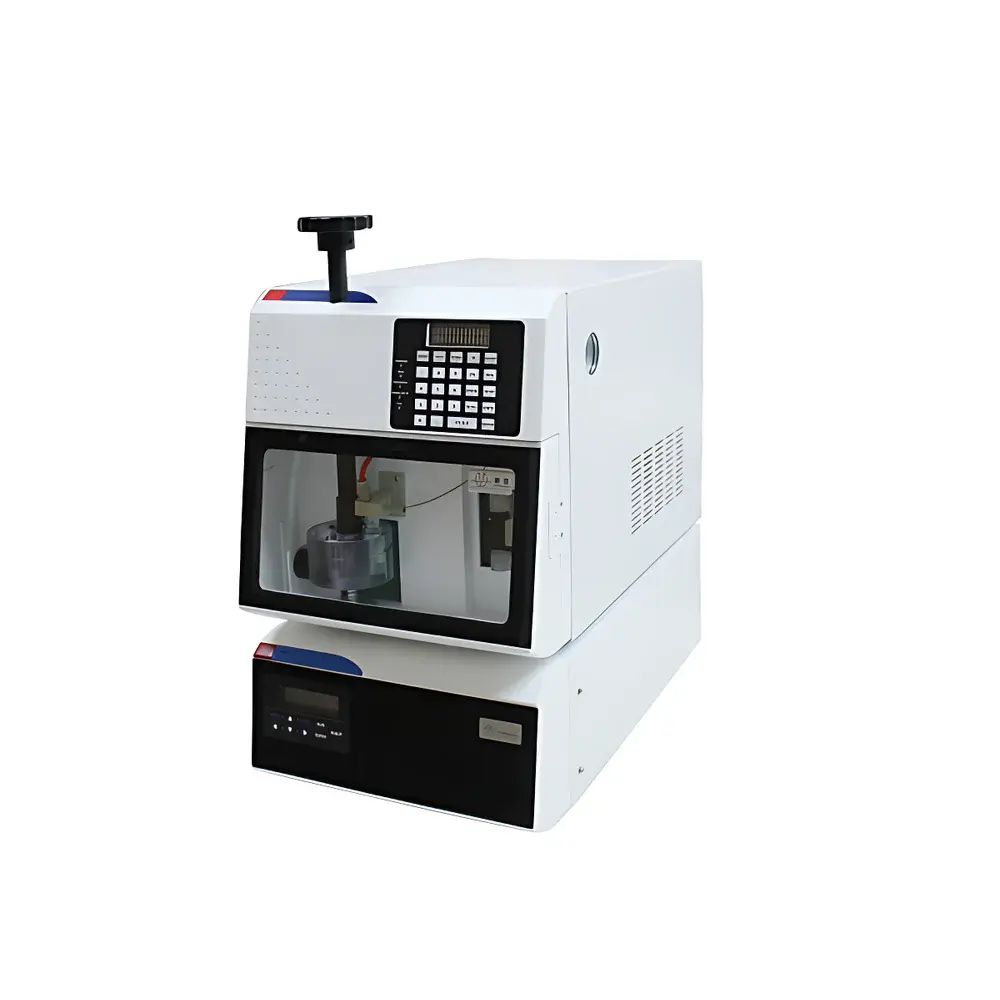
Unimicro Technologies CE-1000 Semi-Automatic Capillary Electrophoresis System
| Brand | Unimicro Technologies |
|---|---|
| Origin | Shanghai, China |
| Manufacturer Type | Direct Manufacturer |
| Instrument Type | Capillary Electrophoresis (CE) |
| Sample Application | Organic Analysis |
| Voltage Range | 0–30 kV |
| Cooling Method | Liquid Cooling |
| Capillary Temperature Control | Liquid-Cooled Thermostatic Module |
| Detector | UV-Vis Absorbance Detector |
| Injection Mode | Manual Pressure/Voltage-Assisted |
| Pressure Range | ±30 kV Equivalent Driving Force |
| Thermal Stability | ±0.1 °C (Typical under Steady-State Liquid Cooling) |
Overview
The Unimicro Technologies CE-1000 Semi-Automatic Capillary Electrophoresis System is a precision-engineered platform designed for high-resolution separation and quantitative analysis of charged analytes in organic matrices. Based on the fundamental principle of capillary electrophoresis—electrokinetic migration of ions under a controlled electric field within fused-silica capillaries—the CE-1000 delivers reproducible mobility-based separations with minimal sample consumption and rapid run times. Its architecture integrates a stabilized high-voltage power supply (0–30 kV), a liquid-cooled thermostatic capillary cartridge holder, and a fixed-wavelength UV-Vis absorbance detector optimized for 200–220 nm detection (standard configuration). Unlike fully automated systems, the CE-1000 retains manual injection control to support method development, low-throughput validation studies, and educational applications where operator intervention is required for precise volume or pressure calibration. The system is engineered for robustness in routine QC/QA laboratories and academic research settings where regulatory traceability, thermal stability, and operational transparency are critical.
Key Features
- Liquid-Cooled Capillary Thermostat: Integrated recirculating liquid cooling maintains capillary temperature within ±0.1 °C during extended runs, minimizing Joule heating-induced band broadening and ensuring retention time reproducibility across replicate analyses.
- High-Voltage Power Supply with Dual Polarity: Programmable ±30 kV output supports both cathodic and anodic injection modes, enabling flexible method optimization for cations, anions, and zwitterionic species.
- UV-Vis Absorbance Detection Module: Fixed-wavelength detector (200–220 nm range) provides stable baseline performance for small-molecule organics, pharmaceuticals, and derivatized compounds with native chromophores.
- Visual Injection Monitoring: Transparent capillary mounting interface allows real-time observation of meniscus movement during pressure- or voltage-assisted sample introduction, supporting accurate volume estimation and troubleshooting.
- One-Touch Pressure Flush Function: Integrated pneumatic pressure module enables rapid capillary rinsing between runs using buffer or cleaning solvents, reducing carryover and improving inter-run consistency.
- Safety-Interlocked Enclosure: Motorized lid sensor automatically interrupts high-voltage output upon opening, complying with IEC 61010-1 safety requirements for laboratory electrical equipment.
Sample Compatibility & Compliance
The CE-1000 is validated for aqueous and mixed-aqueous organic samples including pharmaceutical actives, amino acids, organic acids, nucleotides, and synthetic polymers. It supports standard 50–100 µm ID fused-silica capillaries (up to 100 cm total length) and accommodates common background electrolytes (e.g., phosphate, borate, acetate buffers). While not pre-certified for GMP environments, the system’s hardware design—including non-volatile parameter storage, audit-ready operation logs, and deterministic high-voltage sequencing—facilitates compliance with GLP and FDA 21 CFR Part 11 when deployed with validated SOPs and third-party electronic lab notebook (ELN) integration. It meets ISO/IEC 17025 general requirements for testing laboratories as a measurement instrument when operated within its specified environmental and calibration conditions.
Software & Data Management
The CE-1000 operates via Windows-based acquisition software that records voltage, current, UV signal, and temperature synchronously at 10 Hz sampling rate. Raw data is saved in vendor-neutral .csv format with embedded metadata (date/time, method name, capillary ID, operator ID). Software supports peak integration using tangent skim and Gaussian deconvolution algorithms, migration time alignment via internal standards, and export of calibrated concentration reports compliant with ASTM D8194 (Standard Guide for Capillary Electrophoresis Data Reporting). Audit trails log all parameter modifications, run initiations, and detector gain adjustments—enabling full traceability for internal quality audits. No cloud connectivity or remote access functionality is included; all data remains local unless exported manually per institutional IT policy.
Applications
- Quality control of active pharmaceutical ingredients (APIs) per USP and EP 2.2.47 guidelines
- Chiral separation of enantiomeric drugs using cyclodextrin-modified electrolytes
- Impurity profiling in synthetic organic intermediates
- Charge heterogeneity assessment of monoclonal antibody fragments
- Teaching electrophoretic theory and method development in analytical chemistry curricula
- Environmental analysis of herbicides and phenolic contaminants in water extracts
FAQ
Is the CE-1000 compatible with coated capillaries for reduced electroosmotic flow?
Yes—capillary cartridges are mechanically agnostic and support polyacrylamide-, polyvinyl alcohol-, or silane-based coatings when installed per manufacturer instructions.
Can detection wavelength be customized beyond 200–220 nm?
No—the standard UV-Vis module uses a fixed LED source; optional upgrade to a tunable diode array (DAD) detector is available separately under part number CE-DAD-250.
What maintenance intervals are recommended for the liquid cooling system?
Coolant level and pump function should be verified weekly; full coolant replacement and filter cleaning are required every 6 months under continuous operation.
Does the system support internal standard calibration for quantitative work?
Yes—software includes dedicated fields for IS name, concentration, and response factor input, with automatic normalization of analyte peak areas relative to IS area.
Is method transfer possible from other CE platforms?
Retention time and resolution are transferable within ±5% when using identical capillary dimensions, buffer composition, temperature, and field strength—subject to empirical revalidation per ICH Q5A.




