
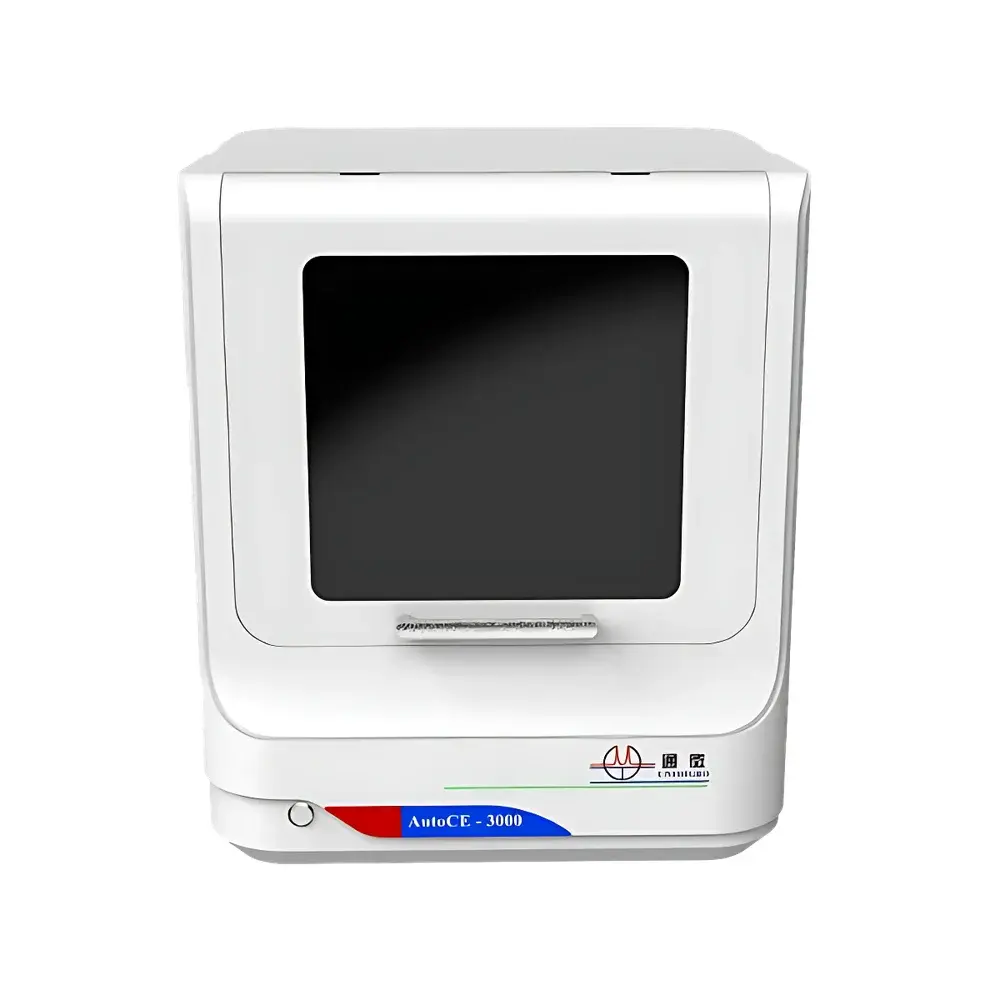
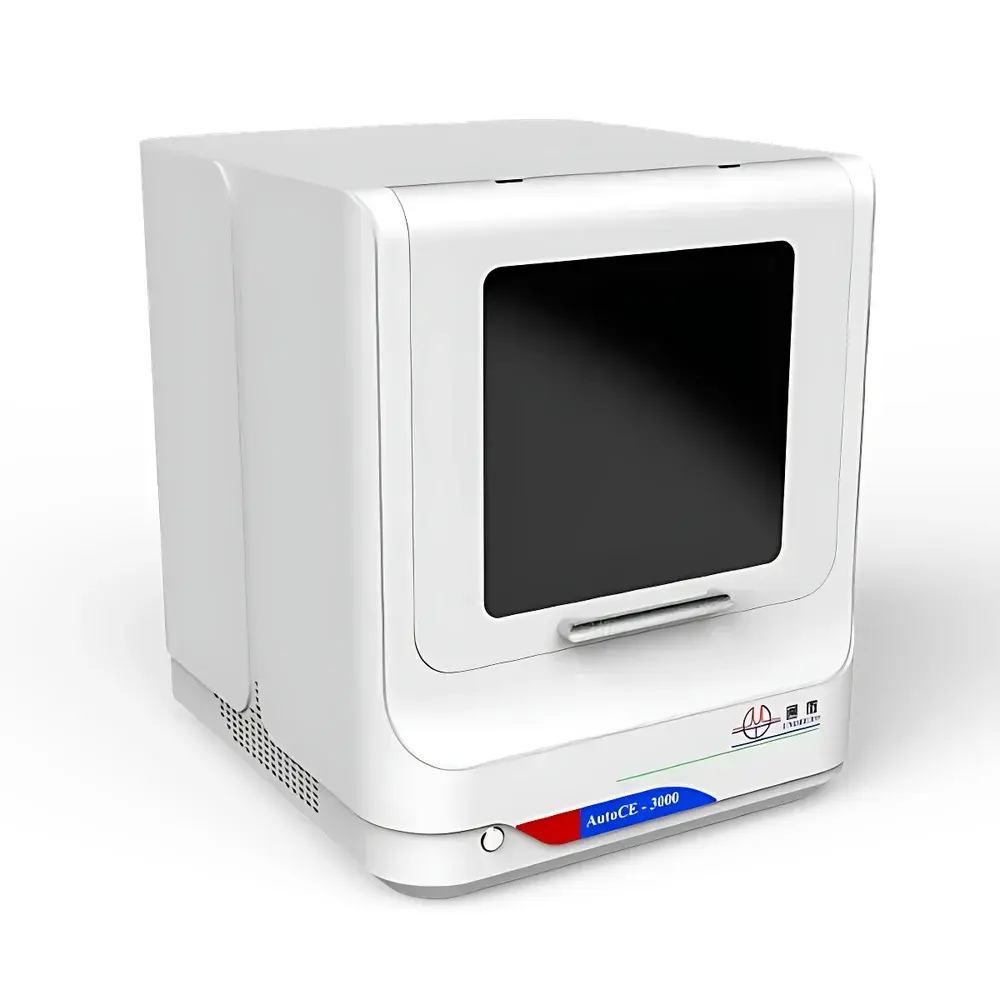
Unimicro AutoCE-3000 Fully Automated Capillary Electrophoresis System
| Brand | Unimicro Technologies |
|---|---|
| Origin | Shanghai, China |
| Manufacturer Type | Original Equipment Manufacturer (OEM) |
| Product Category | Domestic |
| Model | AutoCE-3000 |
| Instrument Type | Capillary Electrophoresis (CE) System |
| Sample Application | Organic Analysis |
| Voltage Range | 0 to ±30 kV (adjustable) |
| Cooling Method | Liquid-based Cooling |
| Sample Temperature Control | Water-cooled Thermostatic Module |
| Detector | UV-Vis Photodiode Array Detector (190–600 nm, adjustable wavelength) |
| Operation Modes | Constant Voltage, Constant Current, or Constant Power |
| Injection Mode | Electrokinetic Injection |
| Pressure Range | 0–95 psi |
| Thermal Management System | Closed-loop Liquid Cooling Circuit |
Overview
The Unimicro AutoCE-3000 Fully Automated Capillary Electrophoresis System is an engineered solution for high-fidelity, regulatory-compliant separation and analysis of charged biomolecules—including monoclonal antibodies (mAbs), bispecific antibodies, antibody-drug conjugates (ADCs), adeno-associated viruses (AAVs), mRNA constructs, and small-molecule pharmaceuticals. Based on the fundamental principle of capillary electrophoresis—where analytes migrate under an applied electric field through a fused-silica capillary filled with electrolyte buffer—the AutoCE-3000 delivers reproducible, high-resolution separations governed by charge-to-size ratio. Its architecture integrates precision high-voltage control (±30 kV), liquid-cooled thermal stabilization, and real-time pressure monitoring to mitigate Joule heating effects and electroosmotic flow (EOF) variability—critical factors affecting peak shape, migration time reproducibility, and quantitative accuracy in regulated environments.
Key Features
- Fully automated workflow: Integrated sample loading, capillary conditioning, electrophoretic separation, UV detection, capillary rinsing, and data processing—enabling unattended overnight operation with minimal manual intervention.
- Multi-mode electrophoretic capability: Supports capillary zone electrophoresis (CZE), capillary gel electrophoresis (CGE), capillary isoelectric focusing (cIEF), and laser-induced fluorescence (LIF) detection via optional module integration—addressing diverse analytical needs from charge variant profiling to nucleic acid purity assessment.
- Dual-pressure balanced pneumatic system: Simultaneous pressure control at both capillary ends ensures stable hydrodynamic flow during injection and rinsing, minimizing band broadening and migration time drift across runs.
- Liquid-cooled thermostatic module: Closed-loop water circulation maintains capillary temperature within ±0.2 °C over extended run times, significantly reducing thermal gradient-induced resolution loss compared to air-cooled alternatives.
- Intelligent buffer management: Automatic solvent switching between run cycles prevents cross-contamination and supports method flexibility without manual valve reconfiguration.
- High-voltage safety architecture: Built-in self-locking power supply with real-time arc detection, leakage current monitoring, and automatic shutdown upon overvoltage, overcurrent, or insulation failure—ensuring operator safety and instrument integrity.
Sample Compatibility & Compliance
The AutoCE-3000 is validated for use with biological macromolecules (e.g., proteins, peptides, oligonucleotides) and small organic molecules requiring high-efficiency charge-based separation. Its design adheres to international regulatory expectations for analytical instrumentation used in GxP environments. The system fully supports ALCOA+ data integrity principles and implements 21 CFR Part 11-compliant functionality—including role-based electronic signatures, immutable audit trails with timestamped user actions, version-controlled method and sequence files, and secure data archiving. All firmware and software components are qualified per ICH Q2(R2) and aligned with FDA/EMA guidance on analytical procedure lifecycle management (ICH Q14). Routine IQ/OQ/PQ documentation packages are available to support laboratory validation workflows.
Software & Data Management
Control and data acquisition are managed through Unimicro CE-Studio v4.x—a Windows-based application developed for scientific rigor and operational traceability. The interface includes guided method setup wizards, preconfigured application templates (e.g., mAb charge variant analysis per USP , cIEF for pI determination), and customizable reporting modules compliant with LIMS export standards (CSV, PDF/A-2, XML). All raw electropherograms, processed chromatograms, integration parameters, and system logs are stored in encrypted, tamper-evident containers. Audit trail records capture every parameter change, sequence modification, and user login event—retained for minimum 15 years as defined by internal SOPs and regional regulatory requirements.
Applications
- Charge heterogeneity profiling of therapeutic proteins (e.g., deamidation, oxidation, C-terminal lysine clipping)
- Impurity analysis of plasmid DNA and mRNA drug substances
- Quality control of synthetic peptides and oligonucleotides
- Stability-indicating assays under forced degradation conditions (acid/base/thermal/oxidative)
- Comparability studies across manufacturing scales and process changes
- Supporting regulatory submissions under ICH Q5, Q6, and Q7 guidelines
FAQ
What electrophoretic modes does the AutoCE-3000 support out-of-the-box?
CZE and CGE are natively supported; cIEF and LIF require optional hardware modules and corresponding software licenses.
Is the system compatible with third-party capillaries and buffers?
Yes—standard 365 µm OD fused-silica capillaries (50–100 µm ID) and commercially available electrophoresis-grade buffers are fully interoperable.
How is temperature uniformity verified across the capillary length?
The liquid-cooled cartridge incorporates distributed thermal sensors and PID-controlled recirculation; temperature homogeneity is confirmed during OQ using NIST-traceable thermocouples at inlet, midpoint, and detection window locations.
Can audit trail data be exported for external review?
Yes—audit logs are exportable in CSV format with digital signature verification and may be ingested into enterprise document management systems.
What maintenance intervals are recommended for routine operation?
Capillary replacement every 200–300 runs; UV lamp calibration annually; cooling fluid exchange every 12 months; full system PQ recommended biannually or after major hardware/software updates.



