
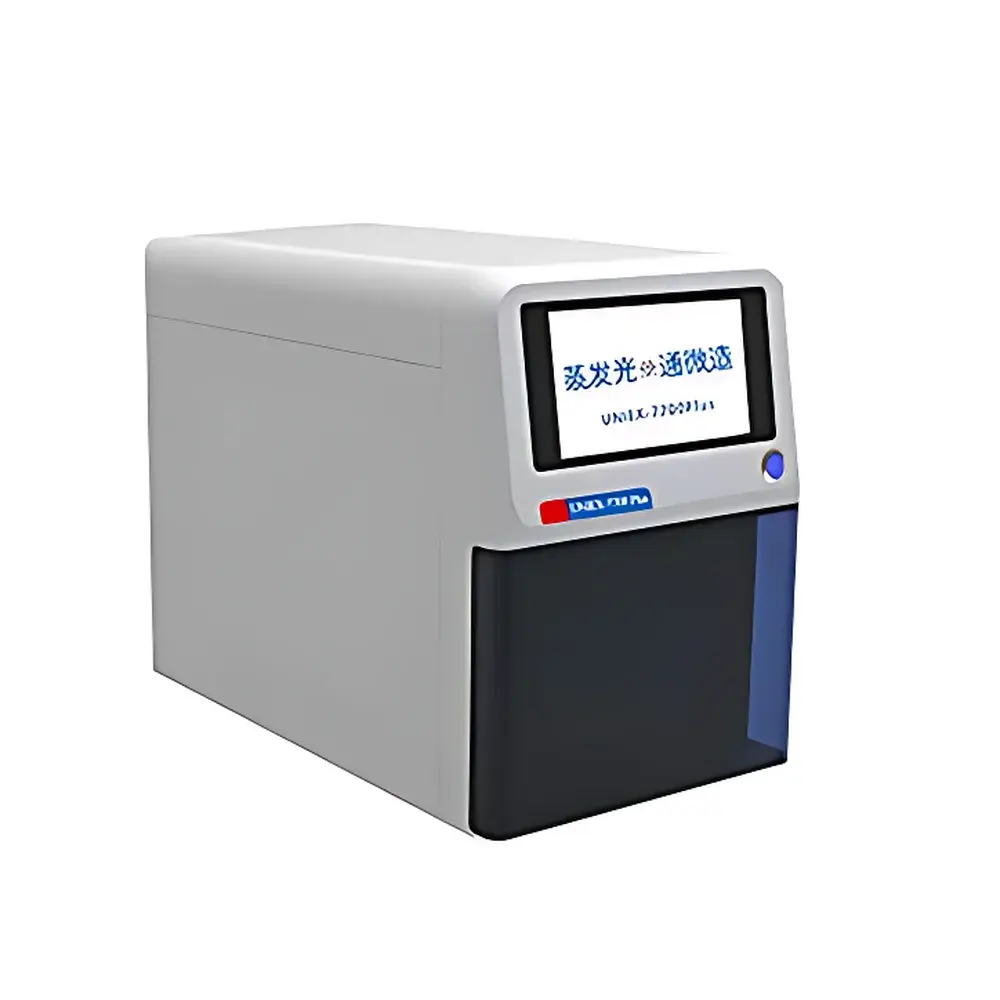
UNIEX-7700PLUS Evaporative Light Scattering Detector
| Brand | Unimicro Technologies |
|---|---|
| Origin | Jiangsu, China |
| Manufacturer Type | Direct Manufacturer |
| Product Origin | Domestic (China) |
| Model | UNIEX-7700PLUS |
| Pricing | Upon Request |
Overview
The UNIEX-7700PLUS Evaporative Light Scattering Detector (ELSD) is a high-performance, benchtop analytical detector engineered for universal, non-destructive detection of non-volatile and semi-volatile analytes in liquid chromatography workflows. Unlike UV-Vis or fluorescence detectors, the UNIEX-7700PLUS operates on the principle of nebulization, solvent evaporation, and light scattering—making it inherently mass-sensitive and independent of chromophore presence or molecular absorbance characteristics. This enables consistent quantitative response across diverse compound classes including lipids, carbohydrates, polymers, surfactants, and natural product extracts where conventional optical detection fails. Designed for integration with HPLC, UHPLC, and preparative LC systems, the detector delivers stable baseline performance, low carryover, and robust signal reproducibility under variable mobile phase gradients—including high-water-content or volatile organic solvent eluents.
Key Features
- Optimized nebulization chamber with temperature-controlled evaporation zone to ensure complete solvent removal while preserving analyte integrity and minimizing thermal degradation.
- High-sensitivity photodetector assembly with low-noise amplification circuitry and adjustable gain settings to accommodate wide dynamic concentration ranges (typically 1–2 orders of magnitude above instrument noise floor).
- Intelligent pneumatic control system with real-time pressure feedback, enabling precise and repeatable nebulizer gas flow regulation across varying solvent viscosities and flow rates (0.2–5.0 mL/min).
- Modular design supporting hot-swappable components—including nebulizer tip, drift tube, and light source—reducing maintenance downtime and simplifying routine calibration procedures.
- Embedded microprocessor with onboard diagnostics, self-calibration routines, and automatic fault logging compliant with GLP documentation requirements.
- Eco-conscious operation: reduced solvent consumption via optimized nebulizer geometry and energy-efficient heating elements aligned with ISO 14001 environmental management principles.
Sample Compatibility & Compliance
The UNIEX-7700PLUS accommodates a broad spectrum of sample matrices, including reversed-phase, normal-phase, and hydrophilic interaction liquid chromatography (HILIC) eluents. It is compatible with common volatile mobile phases such as acetonitrile, methanol, ethanol, and aqueous buffers containing ammonium acetate or formic acid—provided total non-volatile content remains below 0.1% w/v to prevent drift tube fouling. The detector conforms to key international standards for analytical instrumentation, including ISO/IEC 17025:2017 (general requirements for competence of testing and calibration laboratories), and supports audit-ready data integrity features required under FDA 21 CFR Part 11 when paired with validated chromatography data systems (CDS). Its mechanical construction meets IEC 61010-1 safety specifications for laboratory electrical equipment.
Software & Data Management
The UNIEX-7700PLUS communicates via standard RS-232 or USB virtual COM port protocols, ensuring seamless interoperability with third-party CDS platforms (e.g., Chromeleon, Empower, OpenLab CDS). Optional Unimicro ELSD Control Suite provides native acquisition, real-time signal visualization, peak integration, and method parameter archiving. All raw detector signals are timestamped and stored in vendor-neutral ASCII formats (.txt, .csv), facilitating traceable post-processing and statistical validation per ICH Q2(R2) guidelines. Audit trail functionality records user actions, parameter changes, and calibration events with immutable timestamps—supporting GMP-compliant environments and regulatory submissions.
Applications
- Quantitative analysis of triglycerides, phospholipids, and sterols in food and nutraceutical extracts.
- Method development and QC release testing of polysaccharide-based therapeutics (e.g., heparin, hyaluronic acid) under USP & EP monographs.
- Characterization of synthetic polymers (e.g., PEG, PLGA) in pharmaceutical formulation studies.
- Detection of non-UV-absorbing surfactants in cleaning agent formulations and environmental water samples.
- Stability-indicating assays for degradation products lacking chromophores in forced degradation studies.
FAQ
What types of mobile phases are compatible with the UNIEX-7700PLUS?
Aqueous-organic mixtures containing volatile solvents (e.g., methanol, acetonitrile, tetrahydrofuran) and volatile buffers (e.g., ammonium acetate, ammonium formate) are fully supported. Non-volatile salts, ion-pair reagents, or high concentrations of phosphoric acid must be avoided.
Does the detector require routine lamp replacement?
No—this model utilizes a solid-state LED light source with an operational lifetime exceeding 10,000 hours, eliminating scheduled lamp maintenance.
Can the UNIEX-7700PLUS be used with gradient elution methods?
Yes. Its adaptive evaporation temperature and gas flow control algorithms maintain signal stability throughout steep solvent composition changes, provided gradient dwell volume and system dispersion are properly characterized.
Is 21 CFR Part 11 compliance built-in?
The hardware supports electronic signatures and audit trails when operated with validated CDS software; full compliance requires site-specific validation of the integrated system per organizational SOPs.
What is the typical detection limit for sucrose under standard HPLC conditions?
At 1.0 mL/min flow rate with 70% acetonitrile mobile phase, the limit of detection (LOD, S/N = 3) is approximately 100 ng on-column for sucrose using standard 4.6 mm × 150 mm C18 columns.




