
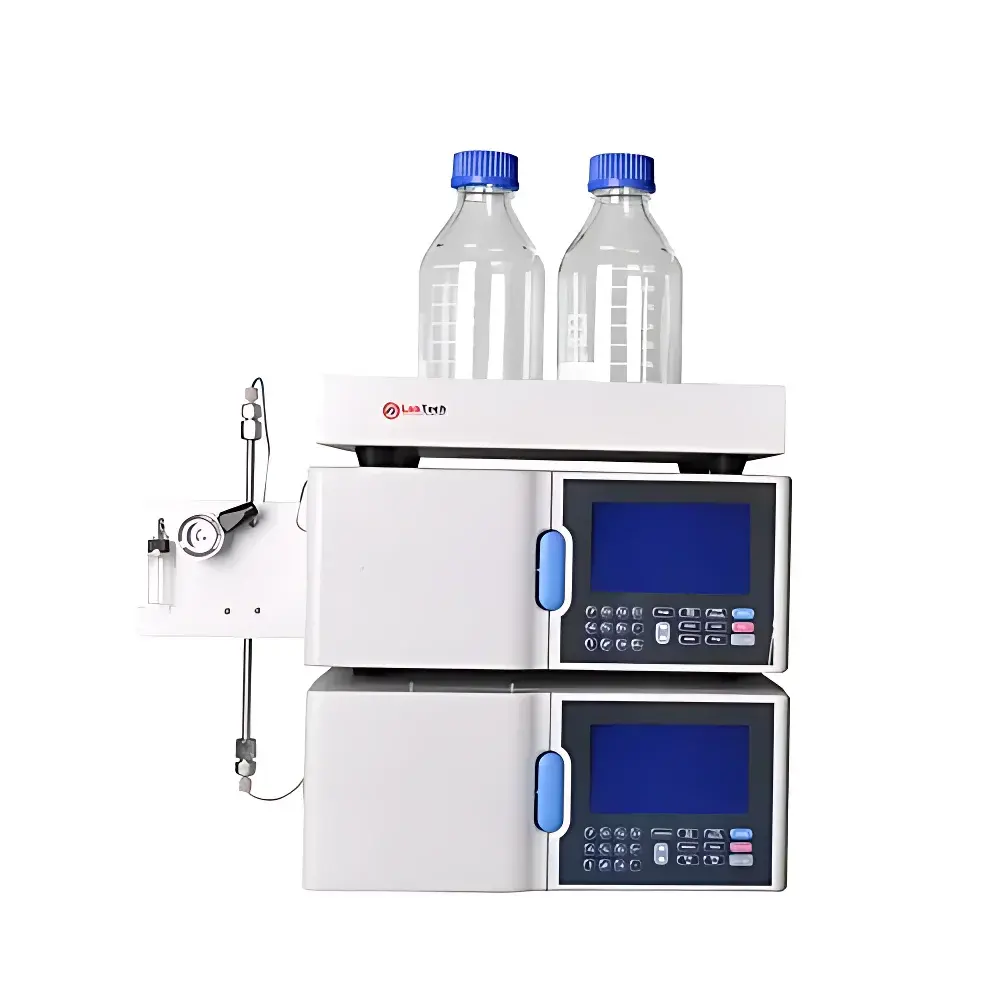
LabTech LC600 Isocratic Liquid Chromatography System
| Brand | LabTech |
|---|---|
| Origin | Beijing, China |
| Manufacturer Type | Original Equipment Manufacturer (OEM) |
| Product Category | Domestic |
| Model | LC600 |
| Instrument Type | Conventional High-Performance Liquid Chromatograph (HPLC) |
| Flow Rate Range | 0.001–9.999 mL/min |
| Maximum Operating Pressure | 42 MPa |
| Sample Loop Capacity | 2 mL (120-position tray) |
| Injection Volume Range | 1–250 µL |
| Column Oven Temperature Range | Ambient to 120 °C |
| UV-Vis Wavelength Range | 190–600 nm |
| Data Acquisition Frequency | 10 Hz |
Overview
The LabTech LC600 Isocratic Liquid Chromatography System is a robust, benchtop HPLC platform engineered for routine separation, identification, and quantification of organic and small-molecule analytes in complex matrices. Based on classical reversed-phase liquid chromatography principles, the system operates under isocratic elution conditions—maintaining constant mobile phase composition throughout the run—making it especially suitable for targeted analysis of well-characterized compound classes where gradient optimization is unnecessary. Its architecture integrates a high-precision dual-piston reciprocating pump, a thermostatically controlled column compartment, a programmable UV-Vis absorbance detector with spectral flexibility, and an automated fraction collector—all synchronized via embedded firmware and PC-based control software. Designed for reliability in regulated and non-regulated laboratory environments, the LC600 meets fundamental performance expectations for method transfer, stability testing, assay validation, and quality control workflows across pharmaceutical, chemical, food safety, agricultural, and feed analysis applications.
Key Features
- Dual-Piston Parallel Pump Architecture: Utilizes cam-driven, suspended piston rod alignment with digital pulse dampening to achieve <0.1% flow ripple at all operating pressures up to 42 MPa; stepper motor microstepping ensures smooth, low-vibration delivery across the full 0.001–9.999 mL/min range.
- Column Compartment with Precise Thermal Control: Maintains temperature stability within ±0.3 °C over a 20–120 °C operating range, supporting method reproducibility for retention time-critical assays and thermally sensitive separations.
- UV-Vis Detector with Wavelength Programming: Equipped with a holographic flat-field grating, quartz-coated optical path, and sine-bar wavelength drive mechanism; supports time-resolved wavelength switching (e.g., 214 nm for peptides, 254 nm for aromatics, 365 nm for fluorescing compounds) to maximize signal-to-noise ratio per analyte without hardware reconfiguration.
- Automated Fraction Collector: Two-dimensional XYZ motion stage enables precise vial positioning; accepts six trigger modes—time-based, voltage threshold, peak apex, peak width, UV absorbance threshold, and external TTL input—facilitating seamless integration with preparative-scale purification workflows.
- Integrated Online Solvent Purge Function: Automatically flushes pump head internals with wash solvent after each injection sequence to prevent crystallization of buffer salts on sapphire piston seals, extending seal lifetime and reducing maintenance frequency.
- High-Integrity Fluidic Pathway: All wetted components—including check valves, tubing, and injector rotor seals—are chemically resistant (e.g., PEEK, sapphire, stainless steel 316L) and rated for aqueous/organic mobile phases containing up to 100% acetonitrile or methanol.
Sample Compatibility & Compliance
The LC600 accommodates standard 3.9–4.6 mm ID analytical columns (up to 250 mm length) and is compatible with C18, C8, phenyl-hexyl, HILIC, and ion-exchange stationary phases. It supports sample introduction via 2 mL vials (120-position autosampler tray) with programmable injection volumes from 1 to 250 µL. The system adheres to core instrumentation requirements outlined in ISO 9001-certified manufacturing practices and aligns with general laboratory compliance frameworks including GLP (Good Laboratory Practice) and GMP (Good Manufacturing Practice) for QC release testing. While not pre-certified for FDA 21 CFR Part 11, its software architecture supports audit trail logging, user access levels, and electronic signature configuration when deployed with validated third-party LIMS or ELN integrations.
Software & Data Management
Control and data acquisition are managed through LabTech ChromaVision™ software (v3.x), a Windows-based application offering real-time chromatogram display, peak integration with customizable baseline algorithms (tangent skim, valley-to-valley, perpendicular drop), calibration curve generation (linear, quadratic, weighted), and report export in PDF, CSV, and XML formats. Raw data files (.lcd) are stored with metadata embedding (instrument ID, method parameters, operator ID, timestamp). The software supports method validation templates compliant with ICH Q2(R2) guidelines and includes built-in system suitability test (SST) calculation modules (resolution, tailing factor, plate count, RSD of retention time). All data modifications are logged with timestamps and user identifiers, forming a traceable record for internal QA review.
Applications
- Pharmaceutical QC: Assay of active pharmaceutical ingredients (APIs), related substances testing, dissolution profile analysis.
- Food & Beverage: Quantification of preservatives (sorbic acid, benzoic acid), sweeteners (aspartame, sucralose), mycotoxins (aflatoxin B1), and pesticide residues.
- Agricultural Chemistry: Analysis of veterinary drug residues (tetracyclines, sulfonamides) in animal tissues and milk; herbicide metabolite profiling in soil extracts.
- Chemical Industry: Purity assessment of synthetic intermediates, polymer additive quantification, and catalyst residue screening.
- Academic Research: Teaching chromatography fundamentals, method development for novel stationary phases, and stability-indicating assay design.
FAQ
Is the LC600 compatible with gradient elution methods?
No—the LC600 is designed exclusively for isocratic operation. Gradient capability requires a binary or quaternary pump system with solvent proportioning valves, which are not included in this model.
What column oven temperature accuracy is guaranteed across the full range?
The column compartment maintains ±0.3 °C stability at any setpoint between 20 °C and 120 °C, verified per internal calibration protocol using NIST-traceable PT100 sensors.
Can the UV-Vis detector perform spectral scanning or generate full UV spectra?
No—it is a fixed-wavelength or time-programmed single-wavelength detector; spectral acquisition requires a diode array detector (DAD), which is not part of the LC600 base configuration.
Does the system support 21 CFR Part 11-compliant electronic records out of the box?
The hardware and firmware provide foundational elements (audit trail buffer, user authentication), but full Part 11 compliance requires additional validation documentation, role-based access configuration, and third-party electronic signature implementation.
What maintenance intervals are recommended for the pump seals and check valves?
Under typical usage (≤20 injections/day, aqueous/organic mobile phases without aggressive buffers), pump seals require replacement every 6–12 months; check valves should be inspected quarterly and replaced if backpressure exceeds 10% of nominal maximum or if baseline noise increases significantly.
Related Products





