
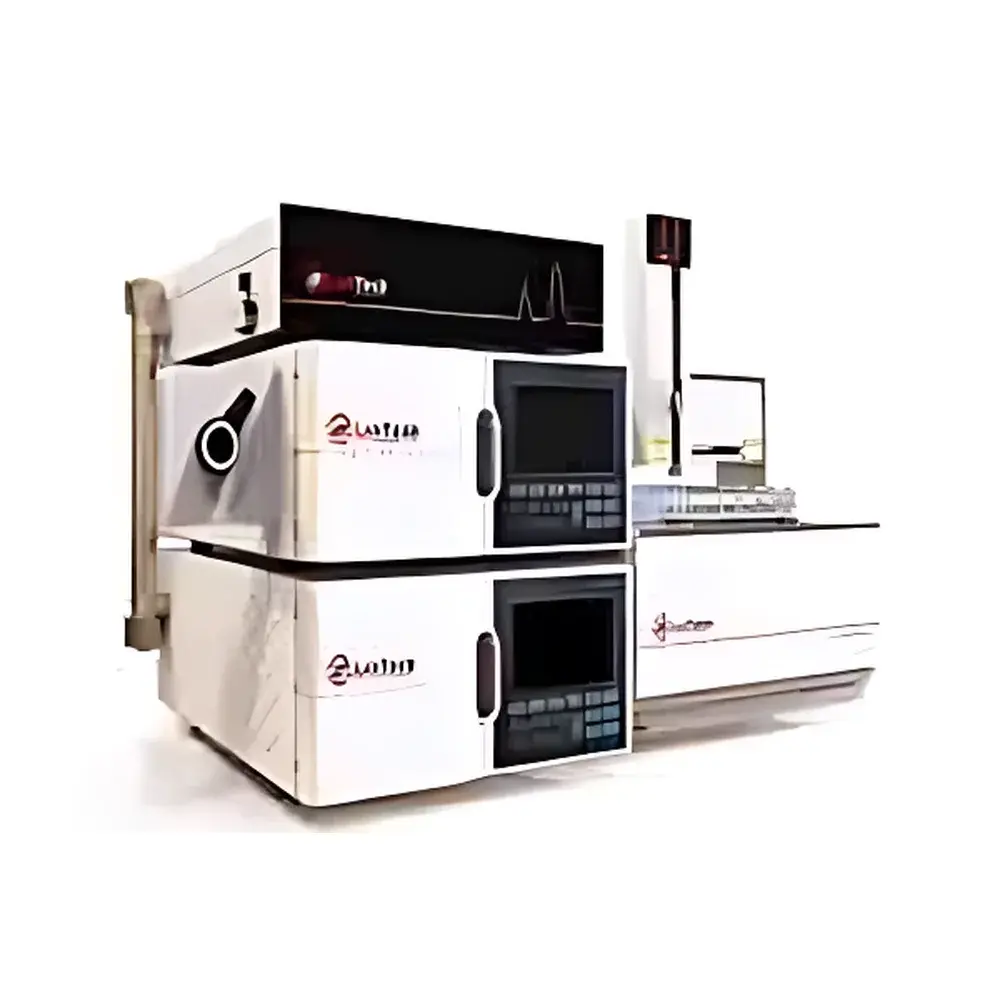
LabTech GPC 600 UP Semi-Automatic Gel Permeation Chromatography Purification System
| Brand | LabTech |
|---|---|
| Origin | Beijing, China |
| Manufacturer Type | Direct Manufacturer |
| Country of Origin | China |
| Model | GPC 600 UP |
| Flow Rate | 0–50 mL/min |
| Maximum Pressure | 42 psi |
| Flow Stability | ±0.1% RSD |
| Auto-Sampling Volume Range | 0–10 mL |
| Auto-Sampling Capacity | 1 position |
| Detection | Variable-Wavelength UV Detector |
| Collection Platform | Precision 3-Axis Robotic Arm with Septum-Piercing Sealed Vial Access |
| Pump Type | High-Accuracy Dual-Piston Solvent Delivery Pump |
| Column | Pre-packed Stainless-Steel GPC Column (No Packing Required) |
| Software | Graphical User Interface with Role-Based Access Control, Audit Trail, and Data Traceability |
| Compliance Support | Designed for GLP-compliant workflows |
Overview
The LabTech GPC 600 UP Semi-Automatic Gel Permeation Chromatography Purification System is an engineered solution for molecular-weight-based fractionation of complex matrices in environmental, food, agricultural, and regulatory laboratories. Based on the fundamental principle of size-exclusion chromatography (SEC), the system separates analytes from interfering macromolecules (e.g., lipids, proteins, polymers) and low-molecular-weight contaminants (e.g., pigments, residual solvents) by differential elution through a porous gel matrix. Unlike conventional open-column methods, this system utilizes pre-packed, high-stability stainless-steel GPC columns—eliminating column packing variability, reducing method development time, and ensuring inter-laboratory reproducibility. The GPC 600 UP operates in semi-automated mode: samples are manually injected via a precision six-port injection valve, after which all downstream steps—including gradient-compatible solvent delivery, real-time UV monitoring at user-selectable wavelengths (190–400 nm), fraction collection, needle wash cycles, and vial sealing—are executed under programmable control. Its architecture balances operational simplicity with analytical rigor—making it ideal for labs transitioning from manual cleanup to standardized, traceable purification protocols.
Key Features
- Pre-packed stainless-steel GPC column—no user packing required; ensures consistent pore structure, extended column lifetime, and minimal batch-to-batch variation.
- High-accuracy dual-piston solvent delivery pump delivering flow stability of ±0.1% RSD across the full 0–50 mL/min range, with maximum backpressure tolerance of 42 psi—sufficient for robust operation with standard cross-linked polystyrene-divinylbenzene (PS-DVB) media.
- Three-axis robotic collection platform with septum-piercing capability enables sealed, vapor-tight fraction collection into standard 10–60 mL glass or amber vials—minimizing solvent evaporation, preventing cross-contamination, and supporting subsequent direct coupling to parallel evaporators or rotary evaporators without sample transfer.
- Integrated variable-wavelength UV detector (190–400 nm) provides real-time chromatographic monitoring and threshold-based fraction triggering—enhancing selectivity for target analyte windows.
- Automated internal/external needle washing between injections eliminates carryover; wash solvent selection and cycle duration are fully programmable.
- Modular hardware design allows seamless future upgrade path to the fully automated LabTech GPC 1000 platform—preserving capital investment while accommodating increasing throughput demands.
Sample Compatibility & Compliance
The GPC 600 UP accommodates a broad range of extract matrices, including but not limited to: pesticide residues in fruit/vegetable homogenates, PCBs and PAHs in soil/sediment extracts, mycotoxins in cereal extracts, and lipid-rich animal tissue homogenates. It supports common GPC-compatible solvents (e.g., hexane, cyclohexane, ethyl acetate, dichloromethane, and their mixtures) and is compatible with ASTM D6986, EPA Method 3640A, and EN 15662 extraction workflows. The system’s firmware and optional software package support audit trail generation, electronic signatures, and role-based access control—enabling alignment with GLP (Good Laboratory Practice) documentation requirements and providing foundational infrastructure for FDA 21 CFR Part 11 compliance when deployed within a validated IT environment.
Software & Data Management
The embedded graphical user interface (GUI) features intuitive workflow-driven operation: method setup, sequence definition, real-time chromatogram display, and fraction logic programming (time-based, peak-triggered, or UV-threshold modes). All system events—including valve actuations, pump status, UV absorbance values, collection coordinates, and wash cycles—are timestamped and logged with operator ID attribution. Data files adhere to vendor-neutral formats (e.g., CSV, XML) for third-party LIMS integration. Optional software validation packages include IQ/OQ documentation templates and electronic record integrity verification tools—facilitating laboratory accreditation audits per ISO/IEC 17025.
Applications
- Environmental analysis: Cleanup of soil, sediment, and water extracts prior to GC-MS or LC-MS/MS determination of persistent organic pollutants (POPs).
- Food safety testing: Removal of triglycerides and sterols from olive oil, fish oil, or meat extracts to improve detection limits for veterinary drug residues.
- Agricultural residue labs: Isolation of pesticide parent compounds and metabolites from complex plant tissue matrices.
- Regulatory compliance: Preparation of reference standards and certified reference materials requiring matrix-free calibration solutions.
- Method development support: Rapid screening of GPC fractionation parameters (flow rate, solvent composition, column temperature) prior to full automation deployment.
FAQ
What types of sample matrices are compatible with the GPC 600 UP?
It is validated for lipid-rich, pigment-laden, and polymer-containing extracts—commonly encountered in environmental, food, and biological sample preparation.
Can the system be integrated with existing parallel concentration workstations?
Yes—the collection vials conform to ANSI/SLAS footprint standards and align directly with LabTech’s AutoVap series and other industry-standard parallel evaporators.
Is column regeneration or cleaning supported?
The pre-packed stainless-steel column is designed for >500 injections under typical operating conditions; column cleaning protocols using strong solvents (e.g., THF, chloroform) are documented in the operator manual.
Does the UV detector support quantitative analysis?
While primarily used for fraction triggering, the detector provides linear response (R² > 0.999) over a 0.01–2.0 AU range—enabling semi-quantitative assessment when calibrated with appropriate standards.
How is data integrity ensured during long unattended runs?
All critical parameters are continuously logged to non-volatile memory; power-fail recovery preserves method state and collection position—preventing loss of fractions or method corruption.



