
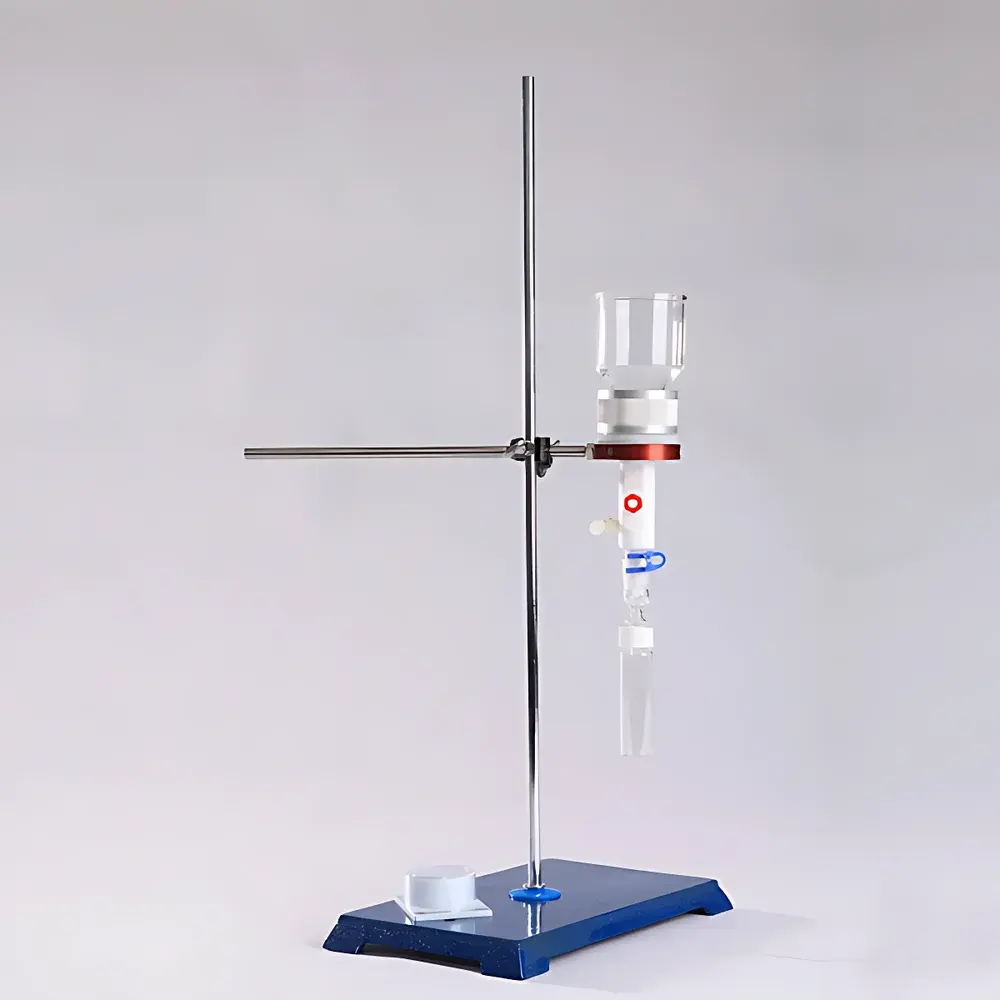
LabTech IFAD Hydrophobic Membrane-Based Solvent Drying and Dehydration Unit
| Brand | LabTech |
|---|---|
| Model | IFAD |
| Origin | Beijing, China |
| Manufacturer | LabTech (Producer) |
| Country of Origin | China |
| Pricing | Upon Request |
| Maximum Flow Rate | 300 mL/min per channel |
| Channel Capacity | Up to 8 independent channels |
| Membrane Material | PTFE hydrophobic membrane |
| Primary Function | Aqueous-phase retention with organic solvent permeation under vacuum |
| Reusability | Membranes are cleanable and reusable |
| Application Scope | Sample preparation for GC, HPLC, LC-MS, and environmental residue analysis |
Overview
The LabTech IFAD Hydrophobic Membrane-Based Solvent Drying and Dehydration Unit is an engineered sample preparation system designed for rapid, selective phase separation of water-immiscible organic extracts. It operates on the principle of vacuum-driven membrane filtration using chemically inert, hydrophobic polytetrafluoroethylene (PTFE) membranes. Under controlled vacuum conditions (typically –0.08 to –0.1 MPa), organic solvents—such as hexane, dichloromethane, ethyl acetate, acetone, and acetonitrile—permeate the membrane pores due to their low surface tension and affinity for the fluorinated polymer matrix. In contrast, aqueous phases—including residual moisture, saline solutions, or polar extractants—are retained in the filtration cup by capillary rejection and surface energy mismatch. This physical separation mechanism eliminates the need for traditional desiccants such as anhydrous sodium sulfate, thereby avoiding adsorptive losses of polar analytes, metal ion contamination, filter clogging, and manual handling variability. The IFAD unit is purpose-built for laboratories performing high-throughput sample cleanup prior to chromatographic analysis, especially in environmental monitoring (e.g., EPA Method 505, 525.3), food safety testing (AOAC 2007.01), and pesticide residue workflows.
Key Features
- Vacuum-assisted PTFE membrane separation enables simultaneous dehydration and solvent filtration without chemical additives
- Independent channel architecture supports up to eight parallel sample processing paths—each with dedicated vacuum control and flow monitoring capability
- Consistent flow rates up to 300 mL/min per channel ensure sub-10-second processing time for standard 10–50 mL extracts
- Reusable PTFE membranes withstand repeated cleaning via solvent rinsing (e.g., methanol, acetone, or isopropanol) and thermal drying; validated for ≥50 cycles without performance degradation
- Modular cup-and-bottle design accommodates standard 15 mL, 50 mL, and 100 mL conical centrifuge tubes and glass collection vials (25–250 mL)
- Chemically resistant housing (PP and PTFE-lined components) ensures compatibility with aggressive solvents and prevents leaching during extended use
Sample Compatibility & Compliance
The IFAD system is compatible with a broad range of liquid-phase extraction matrices, including QuEChERS extracts, SPE eluates, liquid–liquid partitioned samples, and homogenized tissue supernatants. It maintains integrity across pH 1–14 and temperatures from 4 °C to 40 °C. Membrane pore size (0.45 µm nominal) provides particulate retention while permitting unrestricted solvent passage. The device meets structural and material requirements outlined in ISO/IEC 17025:2017 for accredited testing laboratories and supports GLP-compliant documentation when integrated with LabTech’s optional electronic logbook module. While not a regulated medical device, its design aligns with principles referenced in USP , ASTM D4057, and FDA guidance for sample preparation traceability in residue analysis.
Software & Data Management
The IFAD unit operates as a standalone hardware platform with no embedded firmware or proprietary software. However, it integrates seamlessly into LIMS- and ELN-managed workflows through standardized lab equipment interfaces. Optional vacuum pressure logging modules (sold separately) provide analog 4–20 mA or digital RS-485 outputs for real-time vacuum level recording and alarm triggering. All operational parameters—including channel activation status, cumulative runtime, and membrane usage count—can be manually logged in accordance with 21 CFR Part 11–compliant audit trail practices when paired with validated electronic notebooks. No cloud connectivity or remote diagnostics are implemented, preserving data sovereignty and network security in regulated environments.
Applications
- Routine dehydration of pesticide extracts prior to GC-ECD or GC-MS/MS analysis
- Cleanup of veterinary drug residues in milk, honey, and muscle tissue following QuEChERS protocols
- Removal of water traces from lipid-rich extracts before LC-MS injection to prevent column fouling and ion suppression
- Pre-concentration support for trace-level PFAS analysis in wastewater effluents (per EPA Method 1633)
- High-volume screening of pharmaceutical impurities in organic reaction mixtures
- On-site field laboratory deployment where desiccant logistics and waste disposal are constrained
FAQ
Can the PTFE membrane be used with chlorinated solvents such as chloroform or carbon tetrachloride?
Yes—the membrane exhibits full chemical resistance to halogenated hydrocarbons at ambient temperature and under vacuum.
What is the maximum allowable total suspended solids (TSS) concentration in the feed sample?
For optimal membrane longevity and flow consistency, TSS should remain below 0.5% w/v; pre-filtration through a 1.0 µm glass fiber syringe filter is recommended for turbid extracts.
Is the IFAD unit suitable for acidic or basic aqueous phases?
Yes—membrane stability has been verified across pH 1–14; however, prolonged exposure (>2 hours) to strong oxidizers (e.g., >5% HNO₃ or H₂O₂) is not advised.
How is channel cross-contamination prevented during multi-sample operation?
Each channel features isolated fluid pathways, dedicated membrane mounts, and non-interconnected vacuum manifolds—validated via dye-tracing studies per ISO 8573-1 Annex B.
Does LabTech provide validation documentation for IQ/OQ protocols?
Yes—factory-issued Installation Qualification (IQ) templates and Operational Qualification (OQ) test procedures are available upon request for GMP-regulated users.



