
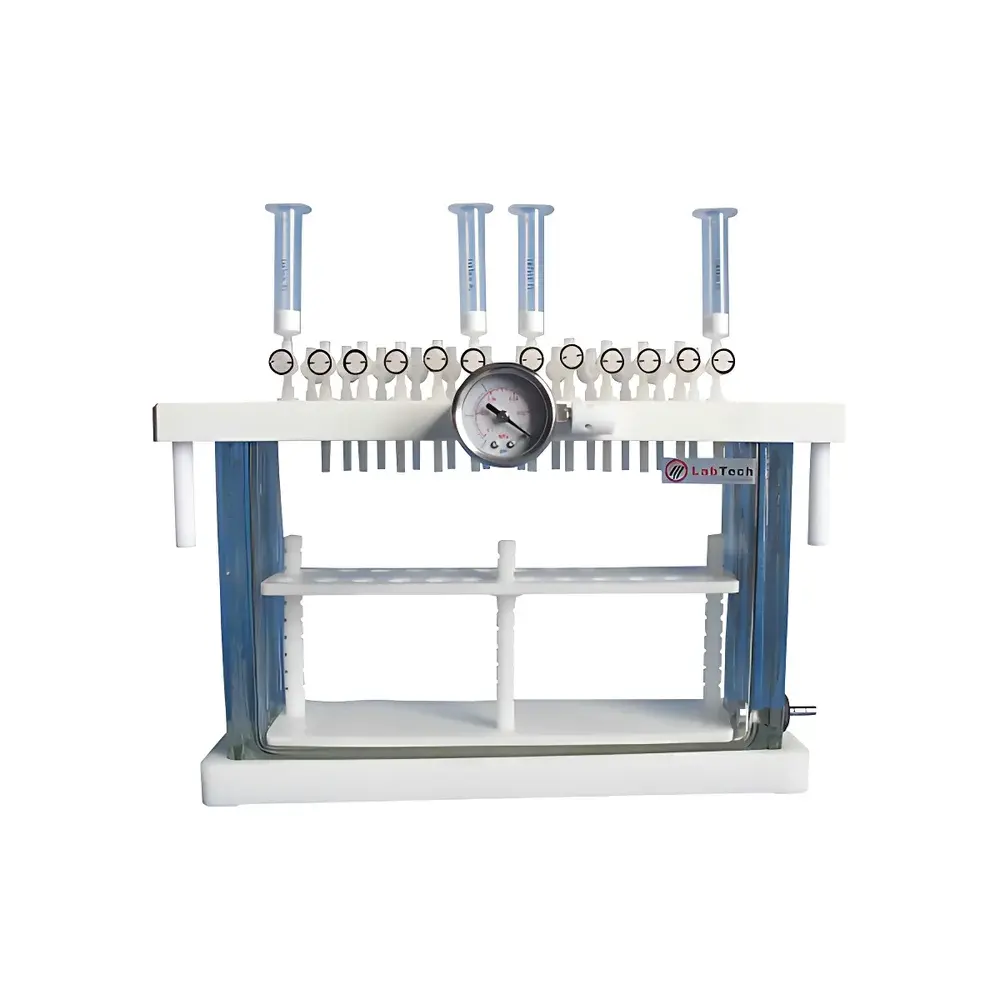
LabTech W-SPE12 & W-SPE24 Manual Solid Phase Extraction Manifolds
| Brand | LabTech |
|---|---|
| Origin | Beijing, China |
| Manufacturer Type | Direct Manufacturer |
| Instrument Type | Manual SPE Manifold |
| Model | W-SPE12 (12-Channel), W-SPE24 (24-Channel) |
| Flow Rate Control | 0–20 mL/min |
| Solvent Compatibility | Universal (all common organic/aqueous solvents) |
| Sample Capacity | 12 or 24 positions |
| Sample Loading Volume | Unlimited (gravity-fed or vacuum-assisted) |
| Wetted Materials | PTFE, Borosilicate Glass |
| Vacuum Chamber Rating | ≤ −80 kPa |
| Column Compatibility | Standard 1 mL, 3 mL, 6 mL, and 10 mL SPE cartridges |
| Valve Type | Individual PTFE-coated stainless steel shut-off valves |
| Rack Material | Corrosion-resistant polymer with adjustable height and tube-positioning flexibility |
| Compliance | Designed to support GLP-compliant workflows |
Overview
The LabTech W-SPE12 and W-SPE24 are manually operated, modular solid phase extraction (SPE) manifolds engineered for precision, reproducibility, and long-term reliability in analytical sample preparation laboratories. These instruments implement vacuum-assisted SPE using a gravity- and pressure-balanced manifold architecture, enabling controlled elution and washing of analytes adsorbed onto reversed-phase, ion-exchange, or mixed-mode sorbent cartridges. Unlike automated systems, the W-SPE series prioritizes operator control over flow dynamics—critical when handling viscous, particulate-laden, or pH-sensitive samples where programmable flow rates may induce channeling or breakthrough. The system operates on fundamental fluidic principles: vacuum applied to the receiver manifold draws solvent sequentially through conditioned SPE columns, while independent valve actuation ensures strict isolation between channels—eliminating carryover risk during multi-sample processing.
Key Features
- Modular dual-platform design: W-SPE12 supports up to 12 parallel extractions; W-SPE24 scales to 24 positions—both allow physical stacking or side-by-side configuration for expanded throughput without sacrificing ergonomic access.
- Individual high-integrity PTFE-coated stainless steel valves per channel: Each valve provides tactile feedback, full shutoff capability, and >100,000-cycle mechanical durability—ensuring consistent vacuum integrity across extended use cycles.
- Reinforced borosilicate glass vacuum chamber: Manufactured to ASTM E438 Type I, Class A specifications; rated for continuous operation at −80 kPa (−600 mmHg), with wall thickness ≥8 mm to prevent implosion under prolonged vacuum stress.
- Chemically inert wetted path: All solvent-contact surfaces consist exclusively of virgin PTFE gaskets, PTFE-lined valve seats, and Class A borosilicate glass—fully compatible with acetonitrile, methanol, dichloromethane, ethyl acetate, and strong acids/bases (pH 0–14).
- Adjustable-height polymer tube rack: Precision-machined with 12/24-position indexing; accommodates 13 × 100 mm, 16 × 150 mm, and 18 × 180 mm collection tubes; rack height fine-tuned via dual-threaded lift mechanism for optimal meniscus alignment during fraction collection.
- No external power requirement: Fully manual operation eliminates dependency on compressed air, electrical controllers, or software interfaces—reducing failure points and simplifying qualification in regulated environments.
Sample Compatibility & Compliance
The W-SPE platforms accept all commercially available SPE cartridges conforming to ANSI/SLAS dimensional standards (e.g., 1 mL, 3 mL, 6 mL, and 10 mL formats), including bonded silica, polymeric resins (e.g., Strata™-X, Oasis® HLB), and carbon-based sorbents. Each channel functions as an isolated fluidic circuit—preventing cross-contamination even when processing heterogeneous matrices (e.g., wastewater, plasma, soil extracts). The system supports method development per EPA Method 508.1, 525.3, and 8270D; is routinely deployed in laboratories maintaining ISO/IEC 17025 accreditation; and aligns with USP chromatographic sample prep requirements. While not electronically audit-trail enabled, its mechanical simplicity facilitates straightforward validation documentation per FDA 21 CFR Part 11 Annex A (for non-electronic records) and EU GMP Annex 15.
Software & Data Management
The W-SPE12 and W-SPE24 operate without embedded firmware or digital interfaces. All operational parameters—including vacuum level (monitored externally via analog vacuum gauge), flow rate (adjusted manually via needle valve or vacuum regulator), and timing—are recorded directly in laboratory notebooks or LIMS-integrated electronic lab notebooks (ELNs). This analog-first architecture eliminates cybersecurity vulnerabilities, reduces IQ/OQ/PQ validation scope, and enables seamless integration into legacy QC workflows where paper-based SOPs remain standard. Optional accessories include calibrated vacuum gauges (±1.5% FS), PTFE-reinforced vacuum tubing sets, and SPE column conditioning trays—all traceable to NIST-certified reference standards.
Applications
These manifolds are routinely employed in environmental analysis (pesticide residue screening in surface water per EN 15662), clinical toxicology (opioid metabolite enrichment from urine prior to LC-MS/MS), food safety testing (mycotoxin cleanup in cereal extracts), and pharmaceutical stability studies (degradant isolation from forced-degradation solutions). Their unrestricted loading volume capability makes them ideal for large-volume environmental sampling (e.g., 1 L groundwater extracts processed via 6 mL C18 cartridges), while independent valve control permits staggered elution—essential when recovering thermally labile compounds requiring cold solvent delivery.
FAQ
Can the W-SPE system be used with 10 mL SPE cartridges?
Yes—the manifold’s universal column adapter plate accepts 1 mL through 10 mL standard-format cartridges without modification.
Is vacuum level adjustable per channel?
No—vacuum is applied uniformly to the entire chamber; however, individual flow rate is precisely controlled via each channel’s dedicated valve.
What maintenance is required?
Annual inspection of PTFE valve seals and visual verification of glass chamber integrity; no lubrication or calibration required.
Does LabTech provide method transfer support?
Yes—application scientists supply validated SOPs for EPA, AOAC, and pharmacopeial methods, including column selection guides and solvent optimization matrices.
Are replacement parts available globally?
All components—including valves, glass chambers, and tube racks—are stocked in LabTech’s EU distribution center (Rotterdam) and US logistics hub (Chicago), with lead times ≤5 business days.



