
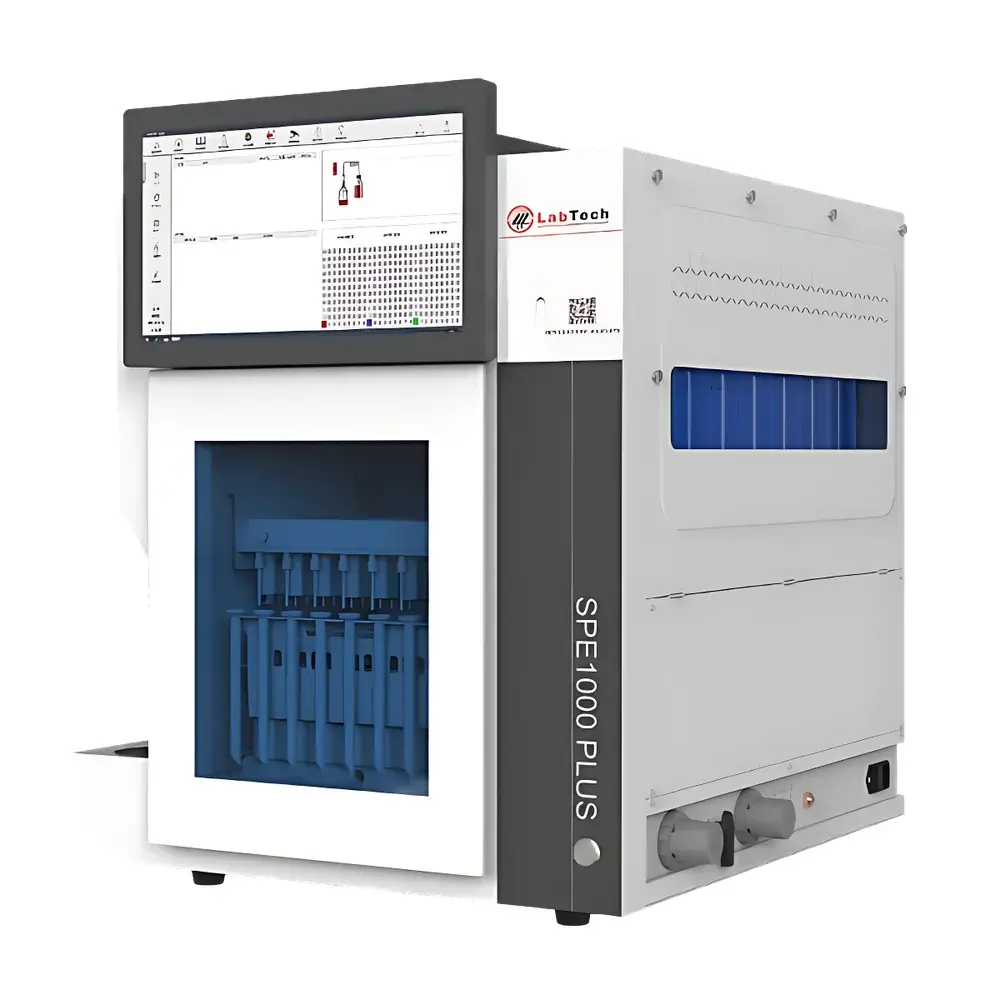
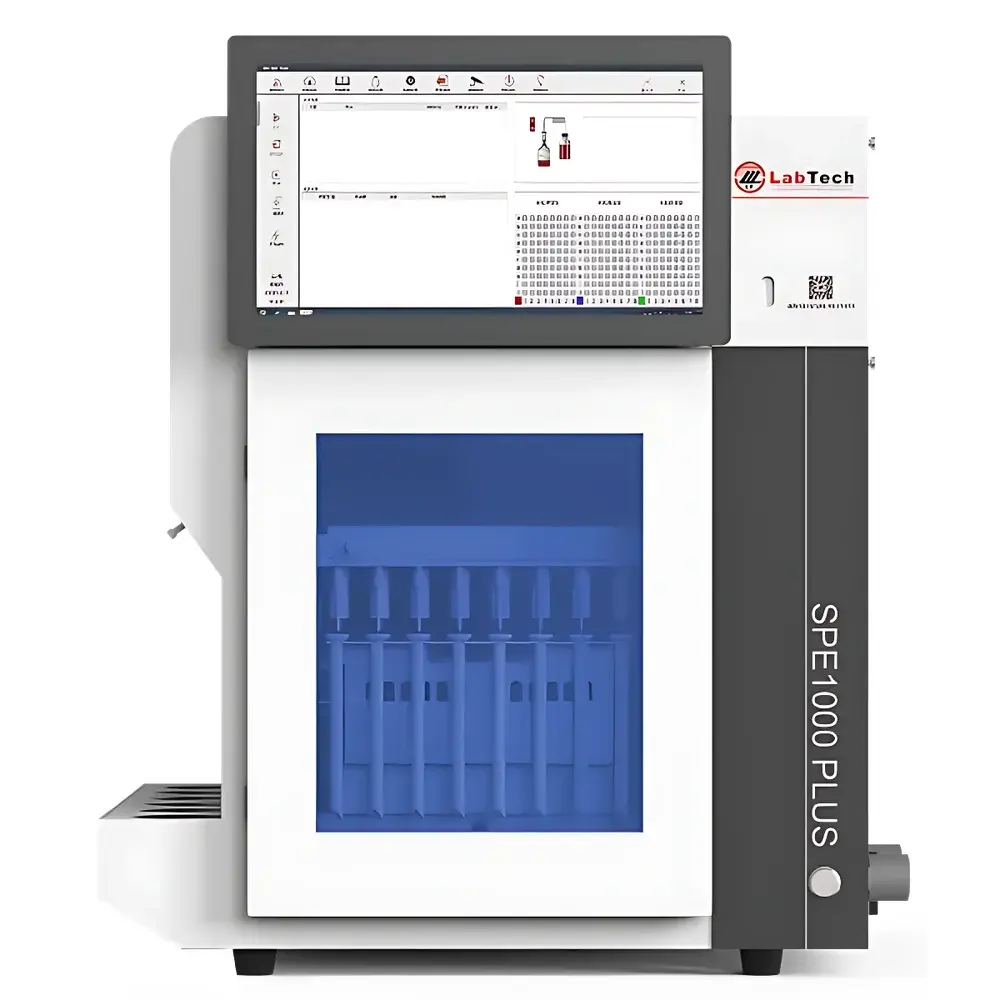
LabTech SPE 1000 PLUS Fully Automated Solid Phase Extraction System
| Brand | LabTech |
|---|---|
| Origin | Beijing, China |
| Manufacturer Type | Direct Manufacturer |
| Product Origin | Domestic (China) |
| Model | SPE 1000 PLUS |
| Automation Level | Fully Automated |
| Channel Configuration | 1–8 Parallel Channels |
| Extraction Format | Cartridge-Based SPE |
| Solvent Reservoirs | 8 Independent Solvent Ports |
| Sample Capacity | 1–8 Samples Simultaneously |
| Sample Loading Volume | 0–20 L per Sample |
| Wetted Materials | PTFE (Polytetrafluoroethylene) |
| Compliance | Designed for GLP/GMP-Compliant Laboratories |
| Software | Integrated Control with Audit Trail & User Management |
Overview
The LabTech SPE 1000 PLUS Fully Automated Solid Phase Extraction System is an engineered solution for high-throughput, reproducible sample preparation in environmental, pharmaceutical, food safety, and clinical laboratories. Based on standardized cartridge-based solid phase extraction methodology—compliant with EPA Methods 500, 525, 8270, and ISO 17931—the system automates the complete SPE workflow: column conditioning, sample loading, washing, nitrogen-assisted drying, and elution. Its modular architecture supports scalable deployment across routine QC labs and regulated research environments. Unlike semi-automated platforms, the SPE 1000 PLUS executes all steps without manual intervention, minimizing operator variability while maintaining full control over fluidic timing, pressure, and solvent sequencing.
Key Features
- Fully automated, walk-away operation for unattended multi-batch processing—supports sequential or parallel runs with programmable pause/resume logic.
- 1–8 independently controllable channels, each equipped with dedicated peristaltic pumps, pressure sensors, and valve manifolds to ensure inter-channel consistency and eliminate cross-contamination risk.
- PTFE-wetted fluid path throughout—including tubing, valves, needle guides, and solvent manifolds—ensuring chemical inertness against aggressive organic solvents (e.g., DCM, acetone, hexane) and acidic/basic aqueous matrices.
- Intelligent liquid-level tracking during sample loading: the robotic arm adjusts needle depth dynamically to maintain sub-surface dispensing, preventing foaming and aerosol generation.
- Integrated positive-pressure wash of sample vials post-loading using pressurized solvent—recovering residual analytes adhering to vessel walls and improving overall recovery by up to 8.3% (validated per USP ).
- Sealed cabinet with built-in activated carbon exhaust filtration and negative-pressure airflow management—eliminates need for external fume hood integration while meeting OSHA 29 CFR 1910.1200 requirements for hazardous chemical handling.
Sample Compatibility & Compliance
The SPE 1000 PLUS accommodates a broad range of commercially available SPE cartridges (1 mL to 20 mL format) and disk-based formats (e.g., Empore™, Supelco ENVI-Carb™), enabling method transfer from manual protocols without revalidation. It supports both reversed-phase (C18, C8), ion-exchange (SCX, SAX), and mixed-mode sorbents. All hardware and software components are designed to support compliance with FDA 21 CFR Part 11 (electronic records/signatures), EU Annex 11, and ISO/IEC 17025 documentation standards. Audit trail functionality logs user actions, parameter changes, run timestamps, and error events with immutable timestamped entries.
Software & Data Management
Control is managed via LabTech’s proprietary SPE Control Suite v4.x—a Windows-based application featuring intuitive drag-and-drop method builder, real-time monitoring dashboard, and integrated calibration verification workflows. Each method stores solvent sequence, flow rate profiles, dwell times, and pressure thresholds as version-controlled templates. Raw run data (including pressure curves, elapsed time per step, and alarm history) are exported in CSV and XML formats compatible with LIMS integration (e.g., Thermo Fisher SampleManager, LabVantage). Role-based access control (RBAC) enforces SOP adherence through tiered permissions (Operator, Supervisor, Administrator).
Applications
The system is routinely deployed in accredited laboratories for: pesticide residue analysis in drinking water (EPA 525.3); PAH quantification in soil extracts (ISO 18287); mycotoxin purification from cereal matrices (AOAC 2005.08); and steroid hormone enrichment from urine prior to LC-MS/MS (CLSI EP29-A3). Its 20 L maximum loading capacity enables direct processing of large-volume environmental samples—reducing pre-concentration steps and associated analyte loss. Method robustness has been verified across matrix types including wastewater, plasma, honey, and sediment slurries.
FAQ
Does the SPE 1000 PLUS support method validation per ICH Q2(R2)?
Yes—its deterministic fluidic control, traceable calibration routines, and comprehensive audit trail meet key analytical procedure validation criteria for precision, accuracy, and ruggedness.
Can it integrate with third-party autosamplers or HPLC systems?
Via optional RS-232/Modbus TCP interface, the system can synchronize start/stop signals with downstream LC or GC instruments for fully coupled workflows.
Is PTFE the only wetted material in contact with solvents and samples?
Yes—no stainless steel, silicone, or polypropylene components are exposed to fluids; all seals, tubing, and manifolds are certified PTFE or FEP.
What maintenance intervals are recommended for long-term reliability?
Per manufacturer guidelines: pump tubing replacement every 6 months under continuous use; annual pressure sensor calibration; quarterly inspection of nitrogen dryer filters and exhaust carbon media.
How is cross-contamination prevented between sequential samples?
Through triple-stage needle cleaning (solvent rinse → air purge → solvent rinse), combined with disposable needle tips and channel-isolated fluid paths—validated to <0.001% carryover (n=50 injections, spiked at LOQ).



