
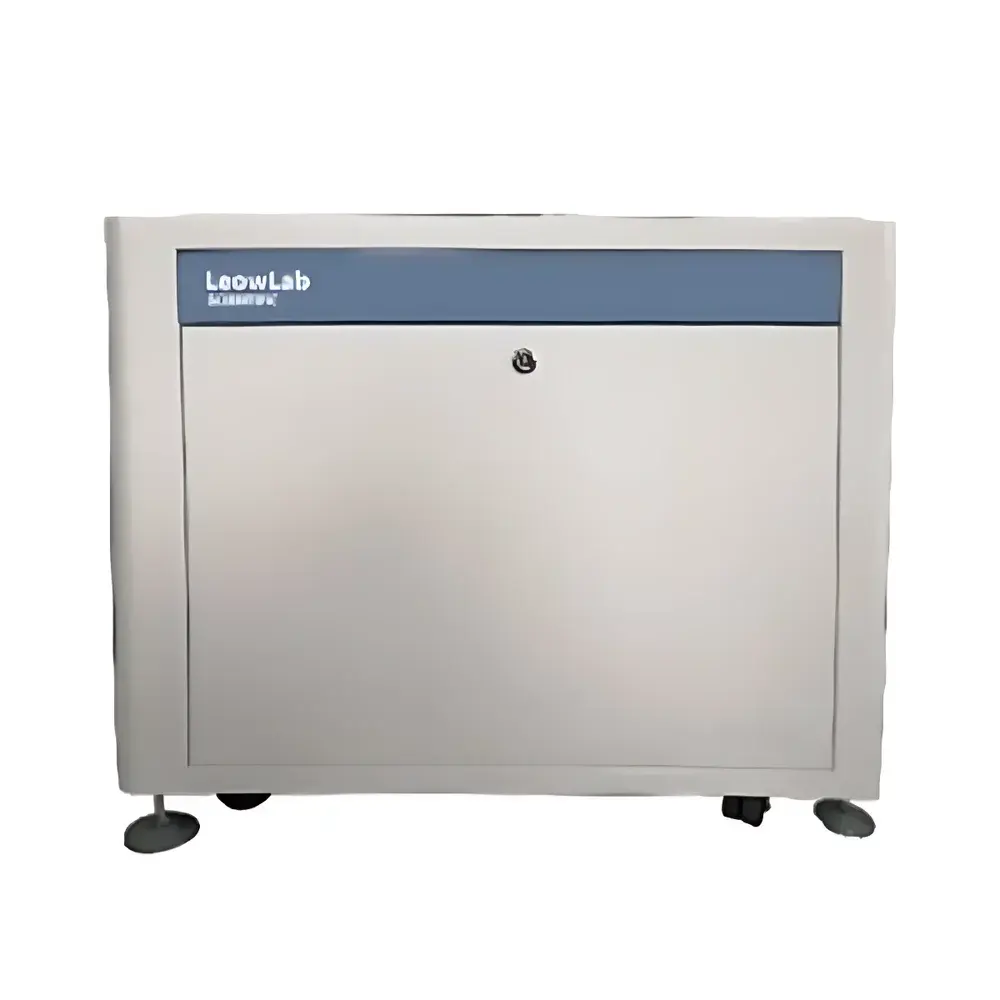
LeowLab LMS Bench Mass Spectrometry Workstation
| Brand | LeowLab |
|---|---|
| Origin | Guangdong, China |
| Manufacturer Type | Authorized Distributor |
| Country of Origin | China |
| Model | LMS Bench |
| Construction | Fully Steel Frame |
| Configuration | Single-Sided Workbench |
Overview
The LeowLab LMS Bench Mass Spectrometry Workstation is an engineered laboratory furniture solution specifically designed to support the operational, ergonomic, and environmental requirements of benchtop mass spectrometry systems. Unlike generic laboratory workbenches, the LMS Bench integrates mechanical infrastructure—such as vibration-isolated mounting surfaces, acoustic enclosures, and service-access architecture—directly into its structural design. It operates on a modular platform philosophy, enabling seamless integration of mass spectrometers (e.g., QTOF, triple quadrupole, and ion trap systems), associated vacuum pumps, and auxiliary gas supply units. The workstation complies with standard laboratory spatial planning guidelines per ISO 15195 and aligns with facility requirements outlined in ASTM E2877 for analytical instrument installation environments. Its fully steel construction ensures long-term dimensional stability under continuous load, minimizing micro-vibrational coupling that may affect mass accuracy and signal reproducibility.
Key Features
- Acoustically optimized mechanical pump enclosure delivering ≥10 dB noise reduction at 1 kHz, verified per ISO 3744 methodology—critical for maintaining low-background operation in high-sensitivity MS workflows.
- Pull-out oil service tray with precision-aligned guides and drip containment lip, facilitating rapid, spill-free pump oil replacement without disassembly or tooling.
- Integrated castor system with dual-locking heavy-duty polyurethane wheels (100 mm diameter, 150 kg load capacity per wheel), enabling repositioning within ISO Class 7 cleanroom-compliant lab spaces without compromising floor integrity.
- Modular utility routing channels (dedicated conduits for power, vacuum lines, gas tubing, and data cables) routed beneath the work surface to maintain electromagnetic compatibility and reduce cable clutter.
- Standardized mounting interface (M6 threaded inserts spaced at 100 mm intervals across the top plate) compatible with major OEM mass spectrometer footprints, including Thermo Fisher, Waters, Agilent, and Shimadzu platforms.
Sample Compatibility & Compliance
The LMS Bench does not perform analytical measurements and therefore has no sample compatibility constraints. However, its design supports compliance-critical workflows involving regulated analyses. The steel frame meets EN 14727:2014 structural load requirements for laboratory furniture (tested at 300 kg static load over 1 m²). All painted surfaces conform to ISO 12944-2 C3 corrosion category specifications for indoor laboratory environments. Optional gas generator integration modules are CE-marked and designed to deliver nitrogen, hydrogen, or zero-air streams meeting ISO 8573-1:2010 Class 1 purity standards—suitable for USP <1058> and FDA 21 CFR Part 11–aligned instrument qualification protocols.
Software & Data Management
As a passive infrastructure platform, the LMS Bench contains no embedded firmware, controllers, or software. However, its mechanical and spatial design directly supports digital laboratory initiatives: standardized cable management enables reliable connection to LIMS-integrated power monitoring systems; integrated RFID tag mounts (optional) allow asset tracking within CMMS platforms; and its fixed-height configuration (standard 850 mm ±2 mm) ensures repeatable ergonomics across multi-user environments—supporting audit-ready documentation per GLP Annex 11 and GMP Annex 11 requirements for instrument environment control.
Applications
- Installation base for LC-MS/MS, GC-MS, and MALDI-TOF systems requiring stable, low-noise, and service-accessible platforms.
- Mobile deployment in core facilities where instruments are shared across research groups and require rapid reconfiguration.
- Regulated QC laboratories performing pharmaceutical residual solvent analysis (ICH Q2(R2)), pesticide residue screening (AOAC 2012.01), or clinical toxicology testing (CLIA-certified workflows).
- Method transfer environments where identical mechanical boundary conditions must be replicated across multiple sites to ensure inter-laboratory data comparability.
- Educational labs deploying teaching-grade mass spectrometers where safety, service access, and modularity are pedagogical priorities.
FAQ
Does the LMS Bench include vibration isolation pads or active damping?
No—the workstation relies on passive mass-damping via its 32 kg/m² steel frame and rigid anchoring interface. For applications requiring sub-5 µm/s RMS vibration attenuation, external optical table coupling or pneumatic isolators are recommended.
Can the LMS Bench accommodate dual mechanical pumps?
Yes—custom configurations with dual-pump bays are available upon request, subject to structural reinforcement and acoustic lining upgrades.
Is electrical grounding integrated into the frame?
Yes—the entire steel structure is bonded to a dedicated 6 AWG copper grounding bus bar, compliant with IEC 61000-6-4 and ANSI/ESD S20.20 requirements for electrostatic discharge protection.
What is the lead time for optional gas generator integration?
Standard integration requires 4–6 weeks from order confirmation, including factory pre-installation, leak testing, and pressure decay validation per ISO 15848-1.
Are CAD drawings and installation manuals available?
Yes—DWG, STEP, and PDF documentation packages are provided free of charge with every unit, including load distribution schematics and utility routing diagrams.



