
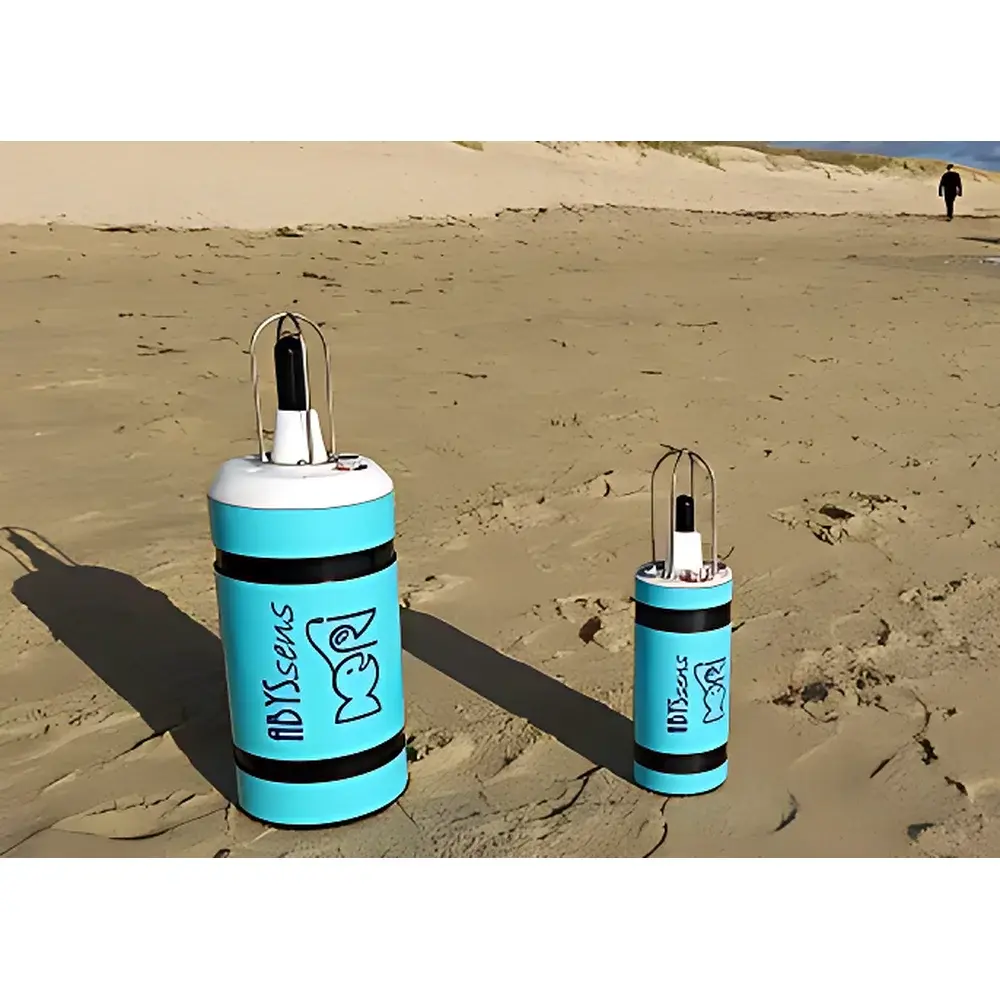
ABYSSens SENS Autonomous Underwater Noise Recorder
| Brand | ABYSSens |
|---|---|
| Origin | France |
| Model | SENS |
| Instrument Type | Autonomous Hydrophone Recorder |
| Frequency Range | 2 Hz to 30 kHz (optional up to 250 kHz) |
| Sampling Rate | 400 kS/s |
| Operating Depth | 300 m (pressure-rated) |
| Dynamic Range | 24-bit |
| Sensitivity | −185 dB re 1 µPa |
| Data Format | WAV |
| Memory Capacity | Up to 4 TB |
| Battery Life | 17 days continuous (optional 70 days) |
| Housing Diameter | 90 mm |
| Length | 277 mm |
| Air Weight | 1.9 kg |
| Waterproof Enclosure | Yes |
| High-Pass Filtering | Supported |
| Communication Interface | Wi-Fi |
| Measurement Duration | Up to 30 days |
| Nominal Self-Noise | Not specified (typical for calibrated hydrophones < 20 µPa RMS in quiet conditions) |
| Compliance | Designed for ISO 18405:2017 (Underwater Acoustics — Terminology), IEC 60651/60804 (Sound Level Meters), and ASTM E1869–21 (Standard Guide for Underwater Acoustic Monitoring) |
Overview
The ABYSSens SENS Autonomous Underwater Noise Recorder is a high-fidelity, self-contained hydrophone system engineered for long-term passive acoustic monitoring in marine environments. It operates on the principle of piezoelectric transduction—converting pressure fluctuations in water into proportional electrical signals—with calibrated sensitivity referenced to 1 µPa. Unlike surface-tethered systems, the SENS recorder integrates sensor, digitizer, non-volatile storage, power management, and wireless telemetry within a single pressure-resistant housing, eliminating dependency on shipboard infrastructure or real-time cabling. Its 2 Hz–30 kHz bandwidth (extendable to 250 kHz upon configuration) supports characterization of low-frequency geophysical noise (e.g., seismic tremors, shipping cavitation), mid-band biological vocalizations (e.g., cetacean clicks and whistles), and high-frequency transient events (e.g., snapping shrimp). The device is designed for deployment in open-ocean, coastal, and estuarine settings where sustained, unattended operation under variable hydrostatic pressure (up to 300 m depth) is required.
Key Features
- Hermetically sealed titanium-alloy housing rated to 300 m depth, compliant with ISO 85042 (underwater equipment environmental testing)
- 24-bit analog-to-digital conversion at 400 kS/s, enabling time-domain fidelity essential for pulse analysis and spectral decomposition
- Configurable high-pass filtering to suppress low-frequency flow noise without compromising biological signal integrity
- Onboard Wi-Fi interface for post-retrieval data offload and firmware updates—no physical connector required
- Expandable internal storage supporting up to 4 TB of uncompressed WAV files, ensuring archival-grade data integrity
- Rechargeable lithium-thionyl chloride battery pack delivering 17 days of continuous recording (70-day option available for low-duty-cycle deployments)
- Calibration traceable to national metrology institutes (NMI), with factory-supplied sensitivity certificate per IEC 60651 Annex B
Sample Compatibility & Compliance
The SENS recorder is compatible with standard oceanographic mooring systems, seabed landers, and autonomous underwater vehicle (AUV) integration kits. Its cylindrical form factor (277 mm × 90 mm) minimizes flow-induced vibration artifacts. All materials comply with ISO 10258 (corrosion resistance of underwater instrumentation) and RoHS 2011/65/EU. The instrument meets functional requirements outlined in ISO 18405:2017 for underwater acoustic terminology and measurement uncertainty estimation. While not certified for regulatory compliance under IMO Resolution A.1152(32) (Guidelines for underwater radiated noise measurement), its performance characteristics align with best practices for scientific baseline studies supporting Environmental Impact Assessments (EIAs) and Marine Spatial Planning (MSP) frameworks.
Software & Data Management
Data retrieval is supported via ABYSSens’ proprietary desktop application, HydroView Pro, which provides time-synchronized spectrogram visualization, band-limited energy integration (e.g., third-octave, 1/12-octave), and automated detection of tonal features using matched-filter algorithms. Export formats include MATLAB (.mat), CSV (for statistical analysis), and standardized NetCDF-4 compliant files adhering to the CF Metadata Conventions v1.8. The software enforces audit-trail logging per GLP principles and supports metadata tagging per ISO 19115-3 for geospatial context. No cloud upload is performed by default; all processing occurs locally to preserve data sovereignty—a requirement for many governmental and academic marine observatories.
Applications
- Baseline ambient noise mapping for offshore wind farm environmental licensing
- Passive acoustic monitoring (PAM) of cetacean presence, distribution, and behavioral response to anthropogenic stimuli
- Quantification of vessel radiated noise signatures across speed and load conditions
- Laboratory-based calibration validation of reference hydrophones and transducer arrays
- Long-term monitoring of hydrothermal vent acoustics and submarine landslide precursors
- Acoustic habitat assessment in protected marine areas (MPAs) under EU Marine Strategy Framework Directive (MSFD) reporting obligations
FAQ
Is the SENS recorder suitable for real-time telemetry?
No—it is strictly autonomous. Data retrieval occurs post-recovery via Wi-Fi; no satellite or acoustic modem interface is integrated.
Can the sampling rate be adjusted in situ?
No. Sampling parameters are configured pre-deployment via USB-C interface; runtime reconfiguration is not supported to ensure timing stability.
Does the unit include factory calibration documentation?
Yes—each unit ships with a NIST-traceable calibration certificate valid for 12 months, including frequency response curve and self-noise floor measurement.
What is the recommended maintenance interval?
Hydrostatic pressure testing and O-ring replacement are advised every 24 months or after 10 deployments exceeding 150 m depth.
Is the WAV format compatible with PAMGuard and Raven Pro?
Yes—uncompressed linear PCM WAV files at 400 kS/s are natively supported; metadata injection (e.g., GPS time sync, depth, temperature) requires manual import via HydroView Pro export templates.
Related Products







