
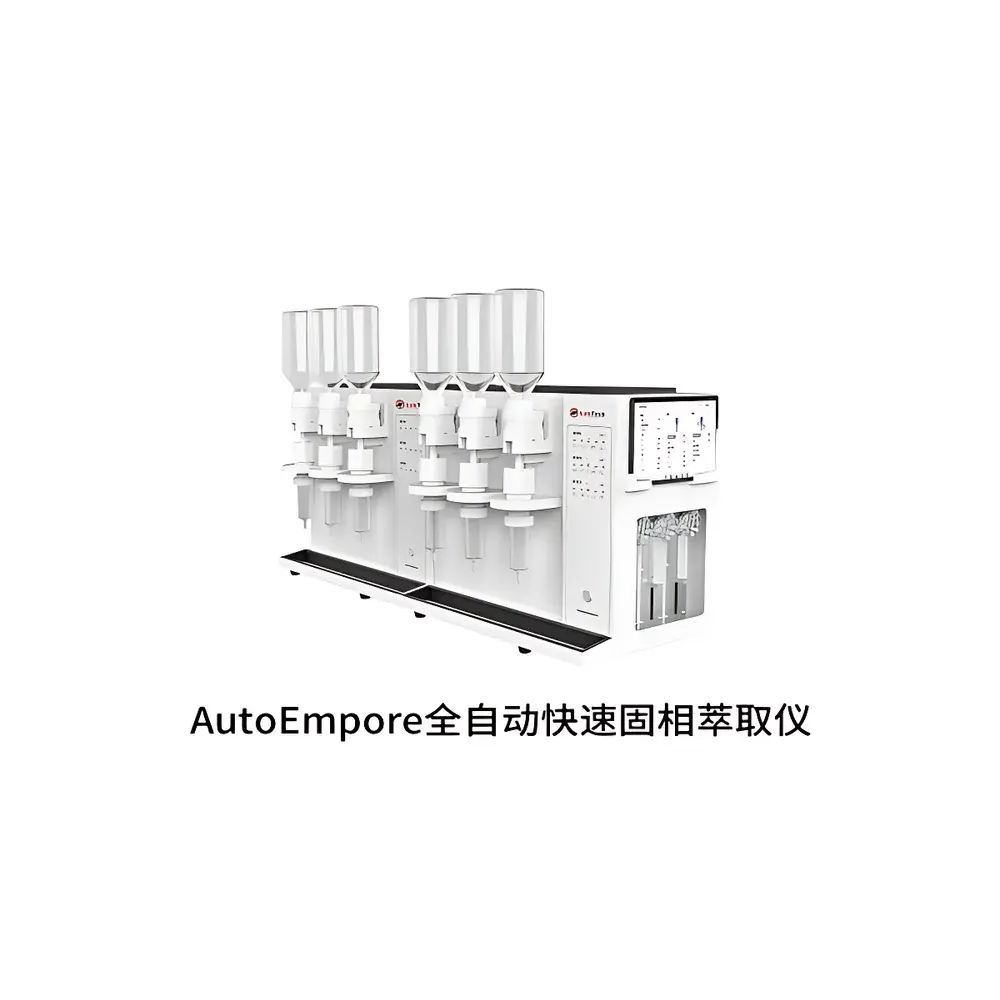
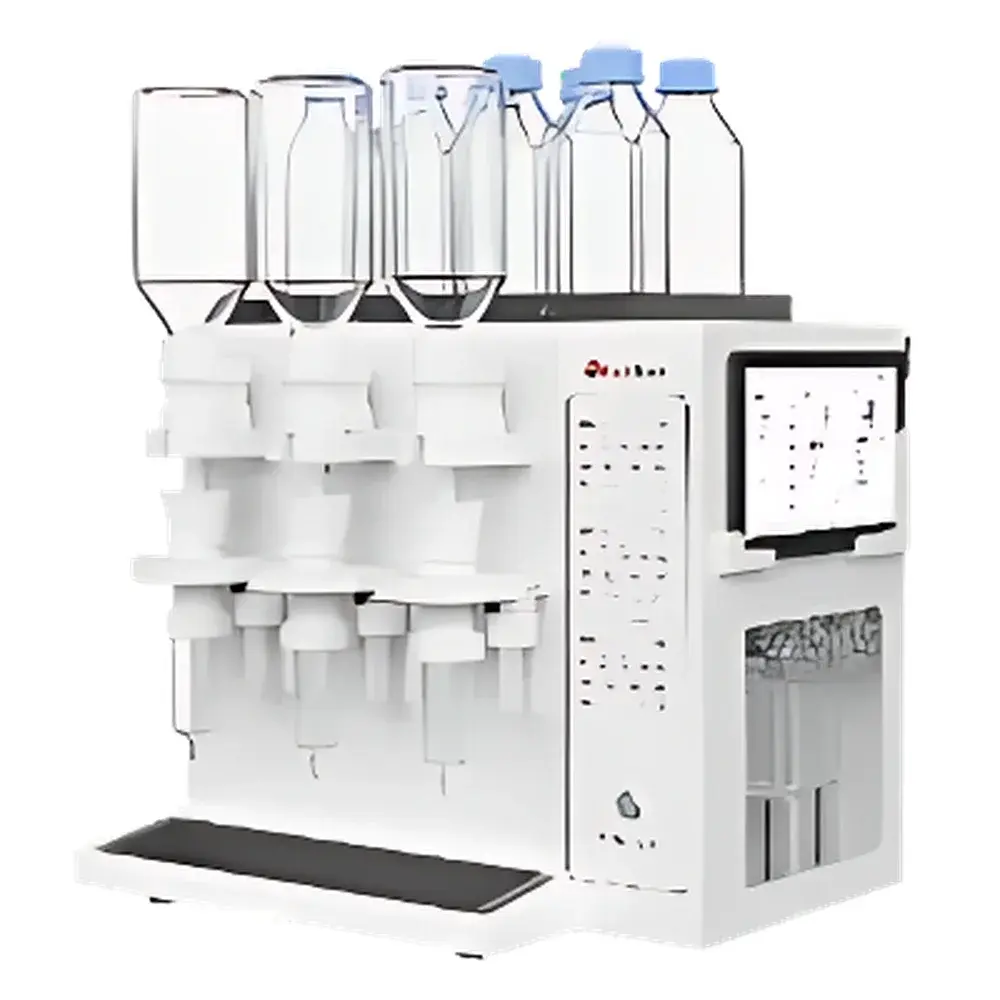
LabTech AutoEmpore Automated Fast Solid Phase Extraction System
| Brand | LabTech |
|---|---|
| Origin | Beijing, China |
| Manufacturer Type | Manufacturer |
| Product Category | Domestic |
| Model | AutoEmpore |
| Channel Configuration | Multi-channel |
| Extraction Technology | Membrane-based SPE |
| Sample Throughput | Up to 3 × 1 L water samples in ≤10 min (enrichment only) |
| Flow Rate | Up to 120 mL/min |
| Supported Formats | 25 mm & 47 mm SPE membranes |
| Integrated Features | On-line filtration, on-line water removal, independent dual-pump per channel, membrane-cartridge hybrid compatibility |
| Software Control | Mobile/tablet-based APP with method library, audit trail, and remote monitoring capability |
| Regulatory Alignment | Designed for GLP-compliant workflows |
| Background Performance | Ultra-low PFAS and phthalate background via shortened fluidic path and inert wetted materials |
| Membrane Source | In-house manufactured Empore™-compatible extraction membranes |
Overview
The LabTech AutoEmpore Automated Fast Solid Phase Extraction System is an engineered solution for high-throughput, reproducible sample preparation in environmental, public health, forensic, and regulatory laboratories. It implements membrane-based solid phase extraction (SPE) — a flow-through format leveraging porous polymeric or silica-based membranes with high surface-area-to-volume ratios — enabling rapid analyte retention and elution under precisely controlled hydraulic conditions. Unlike conventional packed-bed column SPE, the AutoEmpore system utilizes flat-disc membranes that minimize backpressure, allow higher linear flow velocities (up to 120 mL/min), and eliminate pre-filtration requirements for raw surface water, wastewater, and drinking water matrices. Its architecture is optimized for large-volume (up to 1 L per run) aqueous sample processing, particularly targeting trace-level organic contaminants including per- and polyfluoroalkyl substances (PFAS), phthalates, pesticides, pharmaceuticals, and emerging contaminants.
Key Features
- Multi-channel parallel processing: Independent operation of up to three channels, each equipped with a dedicated dual-pump system for precise, method-specific control of loading, washing, and elution flow rates — eliminating cross-method interference.
- Membrane-column hybrid compatibility: Supports both 25 mm and 47 mm diameter extraction membranes as well as standard 1 mL, 3 mL, 6 mL, and 12 mL SPE cartridges — facilitating method transfer and validation across legacy and next-generation protocols.
- Integrated on-line filtration and water removal: Built-in hydrophobic membrane-based phase separation eliminates manual filtration steps and enables direct injection of turbid or particulate-laden water samples; on-line water removal during elution ensures anhydrous solvent collection for downstream GC or LC analysis.
- Ultra-low background performance: Shortened fluidic path, fluoropolymer-free wetted components, and proprietary low-leaching Empore™-compatible membranes collectively reduce inherent PFAS and phthalate contamination — critical for sub-ppt quantification in environmental monitoring.
- Mobile-first software interface: Tablet- and smartphone-compatible application provides real-time status monitoring, method scheduling, parameter logging, and electronic signature support — aligned with ALCOA+ principles for data integrity.
Sample Compatibility & Compliance
The AutoEmpore system is validated for use with diverse aqueous matrices including potable water, river and lake surface water, municipal wastewater effluent, industrial discharge, and leachate. It complies with methodological frameworks referenced in EPA Methods 537.1, 1633 (draft), ISO 21675:2019, and ASTM D7979–21 for PFAS analysis, and supports adaptation to USP , ISO/IEC 17025:2017, and GLP/GMP documentation requirements. Optional 21 CFR Part 11–compliant configuration includes user access controls, electronic audit trails, and immutable method/data archiving — suitable for regulated environments such as state environmental labs and CDC-certified facilities.
Software & Data Management
The embedded control software records all operational parameters — including flow rate profiles, valve actuation timestamps, pressure transients, and method execution logs — into a timestamped, encrypted database. Each run generates a machine-readable .csv report containing metadata (operator ID, sample ID, method version, calibration status) and process metrics. The mobile application supports offline method deployment, firmware updates over-the-air, and secure cloud synchronization (with on-premise server option). Audit trails are retained for ≥15 years and exportable in PDF/A-2 or XML formats for regulatory submission.
Applications
- High-volume PFAS monitoring in source water and distribution systems
- Routine surveillance of endocrine-disrupting compounds (EDCs) and pharmaceutical residues in wastewater treatment plants
- Forensic toxicology screening of illicit drugs and metabolites in surface runoff and sewage epidemiology studies
- Radiochemical analysis of radionuclides (e.g., 90Sr, 241Am) using chelating membranes
- Multi-residue analysis of organometallic species (e.g., methylmercury, butyltin) in compliance with ISO 17294-2
FAQ
Can the AutoEmpore process unfiltered surface water directly?
Yes — its integrated on-line filtration module allows direct injection of raw surface water, groundwater, and wastewater without pre-filtration.
Is method validation support available for regulatory submissions?
LabTech provides IQ/OQ documentation templates, system suitability test protocols, and application notes aligned with EPA and ISO method requirements.
What maintenance is required for long-term reliability?
Routine maintenance includes quarterly pump calibration verification, biannual valve seal inspection, and annual replacement of consumable wetted-path components — all tracked automatically in the software maintenance log.
Does the system support custom membrane development?
Yes — the open-fluidics architecture and standardized membrane holder design enable integration of third-party or customer-synthesized extraction membranes upon qualification.
How is data security ensured during remote operation?
All wireless communication uses TLS 1.2+ encryption; local data storage employs AES-256 encryption; role-based access control enforces granular permissions for operators, supervisors, and auditors.



