
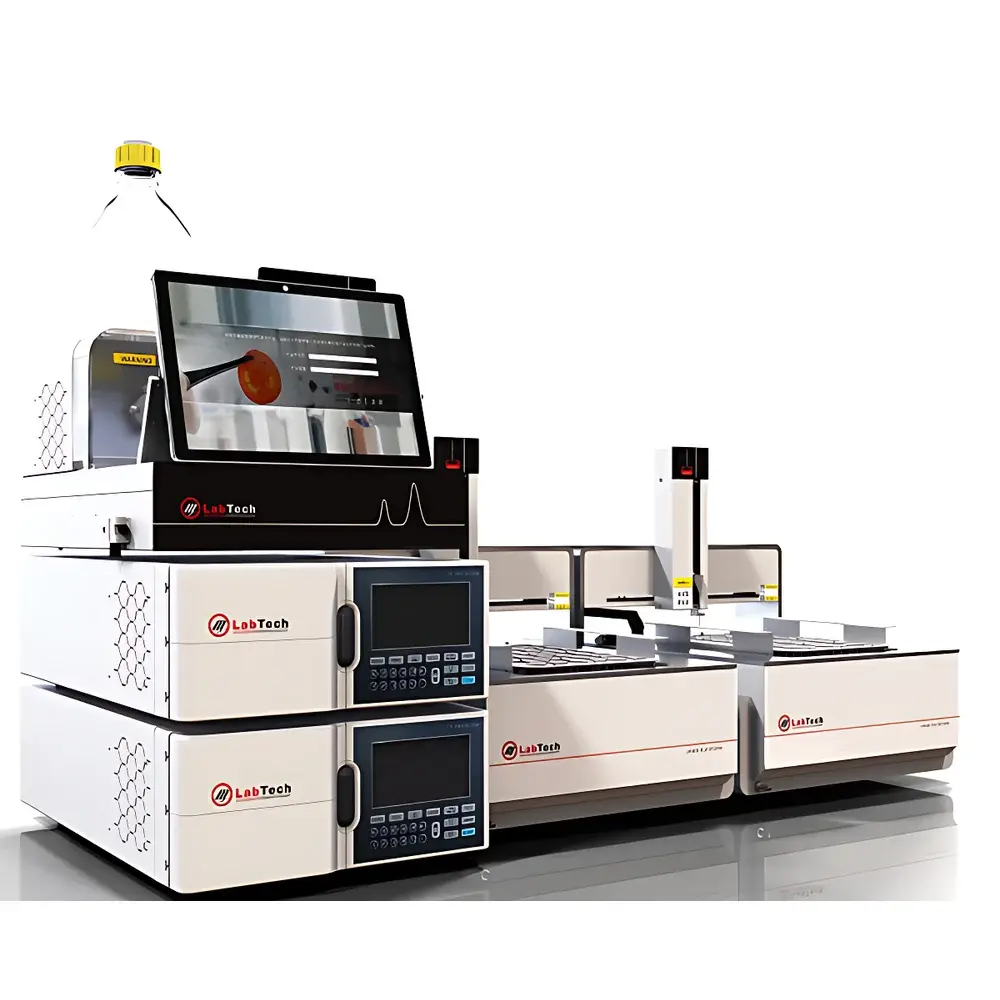
GPC 1000 Automated Gel Permeation Chromatography (GPC) System
| Brand | LabTech |
|---|---|
| Origin | Beijing, China |
| Manufacturer Type | Original Equipment Manufacturer (OEM) |
| Country of Origin | China |
| Model | GPC 1000 |
| Quotation | Upon Request |
| Flow Rate | Not Applicable (Fixed-Volume Fraction Collection Mode) |
| Maximum Pressure | Not Specified |
| Flow Stability | Not Specified |
| Auto-Sampler Volume Range | Up to 10 mL per injection |
| Auto-Sampler Capacity | Configurable via modular rack system |
Overview
The LabTech GPC 1000 Automated Gel Permeation Chromatography System is an integrated, benchtop purification platform engineered for high-reproducibility molecular-weight-based fractionation of complex biological and environmental matrices. Unlike conventional HPLC-based systems, the GPC 1000 operates on the principle of size-exclusion chromatography (SEC), wherein analytes are separated in solution according to their hydrodynamic volume as they pass through a porous gel matrix—typically cross-linked polystyrene-divinylbenzene (PS-DVB) or silica-based media. This physical separation mechanism enables selective removal of macromolecular interferences (e.g., lipids, proteins, humic substances, polymers) and low-molecular-weight contaminants (e.g., plasticizers, pesticides, residual solvents), thereby significantly enhancing analytical fidelity in downstream GC-MS, LC-MS/MS, or ICP-MS workflows. Designed for unattended operation, the system executes full sequence automation—including sample loading, column elution, real-time UV monitoring, fraction triggering, and target-component collection—without manual intervention across multi-sample batches.
Key Features
- Stainless-steel pre-packed GPC columns: Factory-equilibrated with validated pore-size distribution (e.g., 10⁴–10⁶ Da exclusion range); eliminates column packing variability and reduces method development time.
- True “complete-loop” sample introduction: Ensures 100% transfer of volumes ≤10 mL into the column, minimizing adsorptive loss and improving recovery reproducibility for trace analytes.
- Dual-piston precision solvent delivery: Incorporates passive damping technology to suppress pulsation and maintain stable baseline pressure during gradient or isocratic elution—critical for consistent retention time alignment across runs.
- Variable-wavelength UV detector (190–400 nm): Enables real-time spectral assessment of eluent composition; supports method optimization via absorbance profiling at λmax for target analytes or co-eluting interferents.
- Independent 3-axis robotic platform: Separates sample aspiration and fraction collection mechanics to prevent cross-contamination; features septum-piercing needle design to minimize solvent evaporation during extended runs.
- Integrated pressure monitoring with programmable safety thresholds: Triggers audible/visual alerts and automatic pump shutdown upon exceeding user-defined pressure limits—protecting column integrity and ensuring GLP-compliant operational continuity.
Sample Compatibility & Compliance
The GPC 1000 accommodates a broad spectrum of sample types including soil extracts, sediment homogenates, food homogenates (e.g., fish tissue, vegetable oils), clinical plasma digests, and polymer dissolution matrices. It supports common GPC-compatible solvents such as tetrahydrofuran (THF), chloroform, and dichloromethane—compatible with ASTM D5296, ISO 11922, and USP guidelines for SEC validation. The system architecture adheres to fundamental principles of Good Laboratory Practice (GLP) and supports audit-ready data handling when paired with compliant LIMS or electronic lab notebook (ELN) integration. While not inherently 21 CFR Part 11-certified out-of-the-box, its software interface permits configuration of user access controls, electronic signatures, and immutable audit trails—facilitating qualification under regulated environments.
Software & Data Management
Controlled via LabTech’s proprietary GPC Control Suite (v3.x), the system provides intuitive method building with customizable fraction collection logic (time-based, peak-triggered, or UV-threshold gated). All acquisition parameters—including UV wavelength, collection window, needle wash cycles, and pressure setpoints—are stored as encrypted method files with timestamped version history. Raw chromatograms and fraction logs export in vendor-neutral formats (CSV, ASCII) for third-party processing. The software supports batch scheduling, remote status monitoring via Ethernet/Wi-Fi, and optional integration with LabWare LIMS or Thermo Fisher SampleManager for enterprise-scale workflow orchestration.
Applications
- Environmental analysis: Cleanup of EPA Method 1694, 8270D, and 8082 extracts prior to GC-MS quantification of pharmaceuticals, flame retardants, and PCB congeners.
- Food safety testing: Removal of triglycerides and sterols from olive oil, milk fat, or meat extracts to improve detection sensitivity for mycotoxins and pesticide residues per EU SANTE/11312/2021 requirements.
- Agrochemical R&D: Isolation of active ingredient degradation products from plant tissue matrices for structural elucidation by high-resolution mass spectrometry.
- Polymer characterization: Fractionation of synthetic polymer blends for molecular weight distribution (MWD) analysis using calibrated PS standards—complementing ASTM D3593 and ISO 16014 protocols.
FAQ
What column chemistries are supported by the GPC 1000?
The system is optimized for stainless-steel, pre-packed columns containing cross-linked PS-DVB gels (e.g., Bio-Beads SX-3, PLgel Mixed-D) with pore sizes ranging from 10³ to 10⁷ Da. Custom column configurations may be qualified upon request.
Can the GPC 1000 interface with existing laboratory informatics systems?
Yes—via OPC UA or TCP/IP protocols, the instrument supports bidirectional communication with major LIMS and ELN platforms. Full API documentation is available under NDA for custom integration projects.
Is method validation support provided?
LabTech offers application notes, system suitability test (SST) templates, and IQ/OQ documentation packages aligned with ISO/IEC 17025 and FDA guidance for chromatographic purification systems.
What maintenance intervals are recommended for routine operation?
Column lifetime is typically ≥500 injections under standard THF elution; pump seals require replacement every 12 months or 2,000 operating hours; UV lamp calibration is advised quarterly using NIST-traceable standards.



