
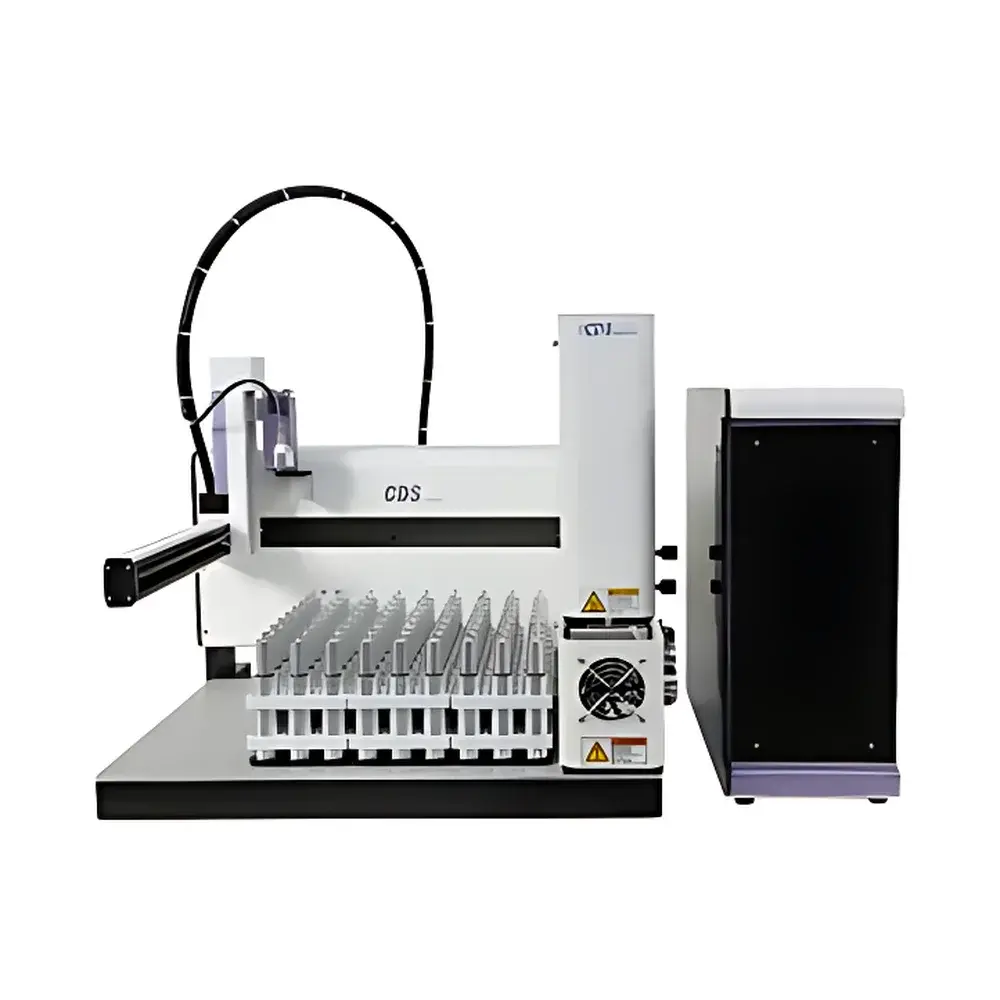
CDS 7550s Automated Thermal Desorber
| Brand | CDS Analytical |
|---|---|
| Origin | USA |
| Model | 7550s |
| Instrument Type | Dual-Stage Thermal Desorber |
| Sample Capacity | 72 positions |
| Cold Trap Temperature Range | –40 °C to +400 °C (Peltier-assisted pre-concentration) |
| Desorption Temperature Range | Ambient to 400 °C |
| Valve Operating Temperature | Up to 350 °C |
| Detection Compatibility | Universal interface for GC and GC-MS systems (all major brands) |
| Carrier Gas Control | Precision mass flow control with split capability |
| Sample Preservation Mode | Integrated cryo-trap bypass & fraction collection |
| Dry-Purge Function | Automated in-line dry-purge of traps and transfer lines |
| Tube Conditioning | On-board thermal conditioning of sorbent tubes (up to 400 °C) |
Overview
The CDS 7550s Automated Thermal Desorber is a dual-stage, fully programmable thermal desorption system engineered for high-fidelity volatile organic compound (VOC) and semi-volatile organic compound (SVOC) analysis in complex matrices. Based on over five decades of CDS Analytical’s instrument design heritage, the 7550s implements a robust two-step desorption architecture: primary thermal desorption from sorbent tubes followed by cryogenic focusing in a Peltier-cooled cold trap, then rapid flash desorption into the GC or GC-MS inlet. This sequential process ensures quantitative recovery of analytes from C2 hydrocarbons through high-boiling SVOCs (e.g., phthalates, polycyclic aromatic hydrocarbons), minimizing breakthrough and carryover. Its modular gas path—featuring inert, ultra-high-temperature valves (rated to 350 °C), heated transfer lines (up to 300 °C), and metal-sealed interfaces—eliminates adsorption artifacts and supports method ruggedness across environmental, industrial hygiene, food safety, and forensic applications.
Key Features
- 72-position autosampler with robotic arm handling, enabling unattended overnight and multi-day batch analysis
- Dual-zone temperature control: independent regulation of desorption oven (ambient–400 °C) and cryogenic cold trap (–40 °C to +400 °C), supporting both low-VOC and high-boiling SVOC workflows
- Patented metal-sealed sample chamber: eliminates consumable tube caps and O-rings, reducing maintenance and cross-contamination risk
- Integrated dry-purge module: automated inert-gas purging of traps and transfer lines prior to desorption—critical for moisture-rich samples (e.g., indoor air, breath, food headspace) and calibration standard preparation
- On-board sorbent tube conditioning: programmable thermal aging at up to 400 °C with controlled purge gas flow, eliminating need for external tube ovens
- Split-and-collect functionality: real-time分流 of desorbed vapor enables parallel analysis or archival storage of aliquots for re-injection or confirmatory testing
- Universal GC/GC-MS interface: standardized heated transfer line with pressure-tight Swagelok fittings; compatible with Agilent, Thermo Fisher, Shimadzu, PerkinElmer, and Bruker systems
Sample Compatibility & Compliance
The CDS 7550s accommodates industry-standard sorbent tubes—including Tenax®, Carbopack™, Carboxen®, and custom-packed multi-bed configurations—via adjustable tube holders and auto-sensing diameter detection. It supports EPA Methods TO-17 (determination of VOCs in ambient air), TO-15 (canister-based VOC analysis with thermal desorption), ASTM D6196 (VOC content in consumer products), and ISO 16000-6 (indoor air VOC monitoring). The system meets GLP and GMP data integrity requirements through hardware-enforced audit trails, user-access controls, and electronic signatures compliant with FDA 21 CFR Part 11 when operated with validated LIMS or chromatography data systems (CDS). All wetted surfaces are electropolished stainless steel or fused silica-lined, ensuring trace-level performance without memory effects.
Software & Data Management
Controlled via CDS’s proprietary WinDesorb™ software (Windows OS), the 7550s provides intuitive method development, sequence scheduling, and real-time diagnostics—including valve timing verification, temperature ramp profiling, and carrier gas flow validation. Method templates align with regulatory protocols (e.g., EPA TO-17 default parameters), and all acquisition parameters are timestamped and stored with raw desorption thermograms. Export options include CSV, XML, and AIA formats for seamless integration with third-party CDS platforms. Audit trail logs record operator actions, parameter changes, and system events with immutable timestamps—essential for laboratory accreditation (ISO/IEC 17025) and regulatory inspections.
Applications
The CDS 7550s delivers reproducible quantitation across diverse use cases: ambient and indoor air monitoring (formaldehyde, benzene, xylene isomers); emissions testing from automotive interiors, packaging films, and children’s toys; residual solvent analysis in pharmaceutical excipients per ICH Q3C; flavor and fragrance profiling in beverages and cosmetics; forensic toxicology screening for accelerants and illicit volatiles; and occupational exposure assessment in manufacturing settings. Its high-temperature valve and trap stability enable reliable analysis of challenging SVOCs such as brominated flame retardants (PBDEs), organophosphate esters (OPEs), and polychlorinated biphenyls (PCBs) without degradation or adsorption loss.
FAQ
Does the 7550s support single-stage and dual-stage desorption methods?
Yes—it operates in both single-stage (direct desorption to GC) and dual-stage (trap-focused) modes, configurable per sample group within a single sequence.
Can it be used with non-CDS sorbent tubes?
Yes—the system accepts standard 1/4″ OD stainless steel or glass tubes from multiple vendors; tube geometry and bed depth are user-defined in method parameters.
Is method validation support available?
CDS provides IQ/OQ documentation packages, system suitability test protocols, and application notes aligned with EPA, ASTM, and ISO standards.
What maintenance intervals are recommended?
Valve actuation cycles and trap performance are logged automatically; routine checks include leak verification, trap efficiency testing (using certified standards), and desorption oven calibration every 6 months under GLP conditions.
How is data integrity ensured during long unattended runs?
All method parameters, run logs, and diagnostic outputs are written to redundant storage locations with SHA-256 checksums; unexpected power loss triggers graceful shutdown and resume-on-reboot capability.




