
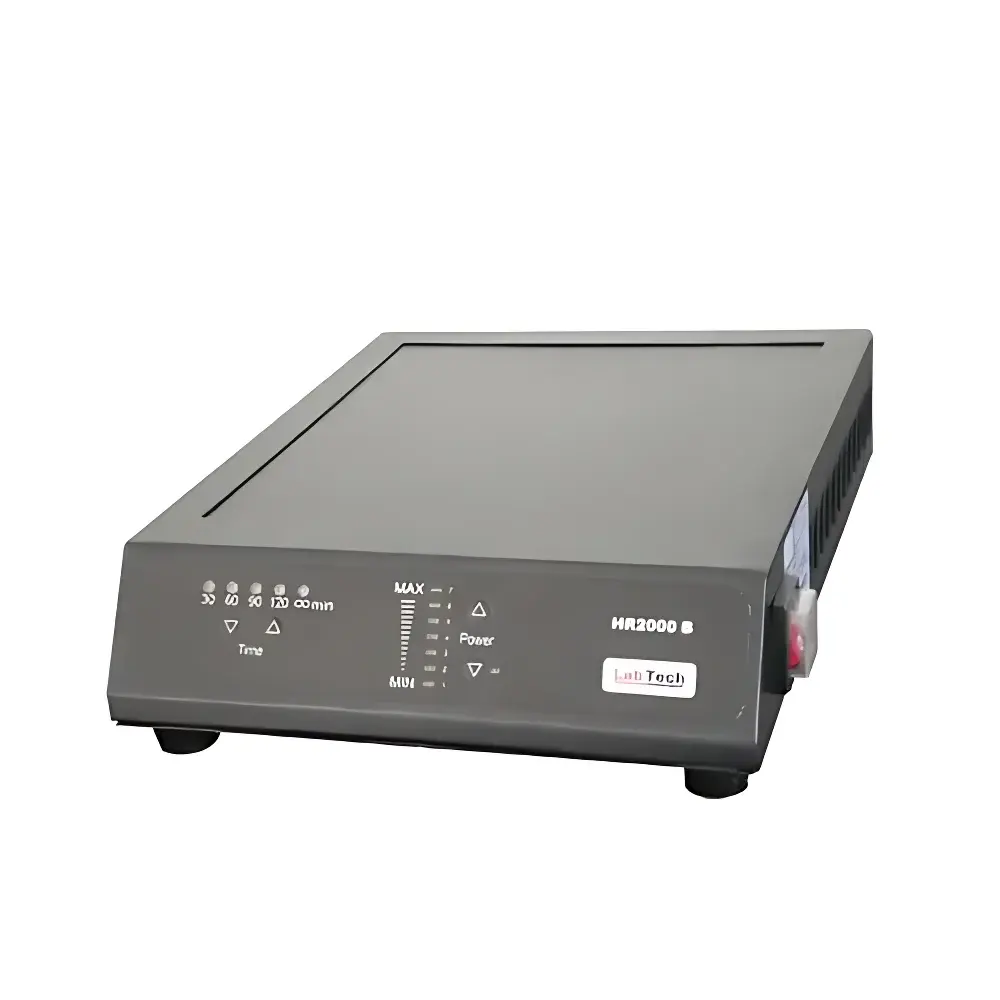
HR2000 Series Infrared Radiative Heating System
| Brand | LabTech |
|---|---|
| Origin | Beijing, China |
| Manufacturer Type | Direct Manufacturer |
| Country of Origin | China |
| Model | HR2000 Series |
| Pricing | Available Upon Request |
Overview
The HR2000 Series Infrared Radiative Heating System is an engineered solution for controlled, rapid, and uniform thermal treatment of laboratory samples during preparation and digestion workflows. Unlike conventional conductive or convective heating platforms, the HR2000 employs near-infrared (NIR) radiation—wavelengths spanning approximately 780 nm to 2500 nm—as its primary energy transfer mechanism. This photonic heating principle enables direct photon absorption by sample matrices (e.g., organic solvents, aqueous digests, polymer blends), minimizing thermal lag and interfacial resistance. The system operates on a hybrid heat transfer model: dominant radiative coupling supplemented by secondary conduction through contact with the heated ceramic-coated aluminum plate. This architecture delivers accelerated ramp rates (typically >10 °C/s in open-vessel configurations), improved spatial temperature homogeneity (<±2.5 °C across 12-position sample zones), and reduced total energy consumption per cycle compared to resistive hotplates or oil baths.
Key Features
- Near-infrared emitter array with spectral output optimized for high absorptivity in common lab solvents and biological matrices
- Adjustable irradiance intensity (0–100% full power) and programmable temperature setpoint range (room temperature to 300 °C)
- Digital PID temperature control with real-time feedback via integrated Pt100 sensor and closed-loop compensation
- Multi-step timer functionality (up to 99 hours, 59 minutes, with auto-shutdown and hold-to-temperature modes)
- Ceramic-enamel coated heating surface offering enhanced chemical resistance against acids (including HNO₃, HCl, HF up to 40% v/v), alkalis, and organic solvents
- Modular design supporting interchangeable sample carriers: standard 12-place digestion blocks (for 50 mL Teflon®-lined vessels), custom aluminum blocks for irregular geometries, and optional quartz tray inserts for UV-transparent applications
- Front-panel LCD interface with English-language menu navigation and password-protected parameter locking for GLP-compliant operation
Sample Compatibility & Compliance
The HR2000 Series is validated for use with a broad spectrum of sample types encountered in environmental, pharmaceutical, food safety, and geochemical laboratories—including soil extracts, tissue homogenates, wastewater sludge, plant digests, and polymer ash residues. Vessel compatibility includes PTFE, quartz, borosilicate glass, and high-purity graphite crucibles rated for ≤300 °C continuous exposure. The system conforms to IEC 61010-1:2010 safety requirements for electrical equipment used in laboratory environments and meets EMC directive 2014/30/EU. While not intrinsically certified for hazardous area use, optional grounding kits and fume hood integration accessories are available to support ISO/IEC 17025-accredited digestion protocols. All firmware versions maintain audit-trail logging of setpoints, run durations, and fault events—supporting traceability under FDA 21 CFR Part 11 when paired with LabTech’s optional LIMS-connect software module.
Software & Data Management
The HR2000 Series supports standalone operation via its embedded controller; however, optional PC-based software (LabTech DigControl v3.2) enables remote monitoring, multi-unit synchronization, and automated method execution. Data export is supported in CSV and XML formats, with timestamps aligned to UTC and metadata tagging for sample ID, operator, and method version. The software implements role-based access control (RBAC), electronic signature capture for critical parameter changes, and automatic generation of PDF reports compliant with ISO 17025 clause 7.8.2. Raw temperature logs are stored with 1-second resolution and can be imported into third-party statistical analysis tools (e.g., JMP, Minitab) for process capability assessment (Cp/Cpk) of digestion repeatability.
Applications
- Rapid open-vessel acid digestion of environmental solids prior to ICP-OES or ICP-MS analysis
- Controlled solvent evaporation in residue analysis workflows (e.g., pesticide multiresidue methods per EN 15662)
- Thermal pretreatment of catalysts and battery electrode materials prior to BET surface area measurement
- Pre-concentration of trace metals from large-volume water samples using chelating resin columns
- Accelerated drying of hygroscopic standards and reference materials without thermal degradation
- Pre-heating of reaction mixtures in kinetic studies where precise ramp-rate control is essential
FAQ
What is the maximum recommended operating temperature for Teflon-lined digestion vessels on the HR2000?
The system is rated for sustained operation at 280 °C with standard PFA/Teflon vessels; prolonged exposure above this threshold may accelerate fluoropolymer aging.
Can the HR2000 be integrated into an automated sample prep line?
Yes—RS-485 Modbus RTU and optional Ethernet/IP interfaces enable bidirectional communication with robotic liquid handlers and autosamplers.
Does the HR2000 require external cooling after shutdown?
No active cooling is required; the ceramic-coated surface dissipates residual heat passively within 15–20 minutes under ambient conditions.
Is calibration verification traceable to NIST standards?
LabTech provides optional annual calibration services with certificates traceable to NIST SRM 1967 (Standard Platinum Resistance Thermometer), including as-found/as-left data.
How does NIR heating differ from microwave-assisted digestion in terms of reproducibility?
NIR delivers volumetrically uniform energy deposition without standing-wave artifacts, resulting in lower inter-run CVs (<2.1%) for digestate clarity and metal recovery versus microwave systems in heterogeneous solid matrices.



