
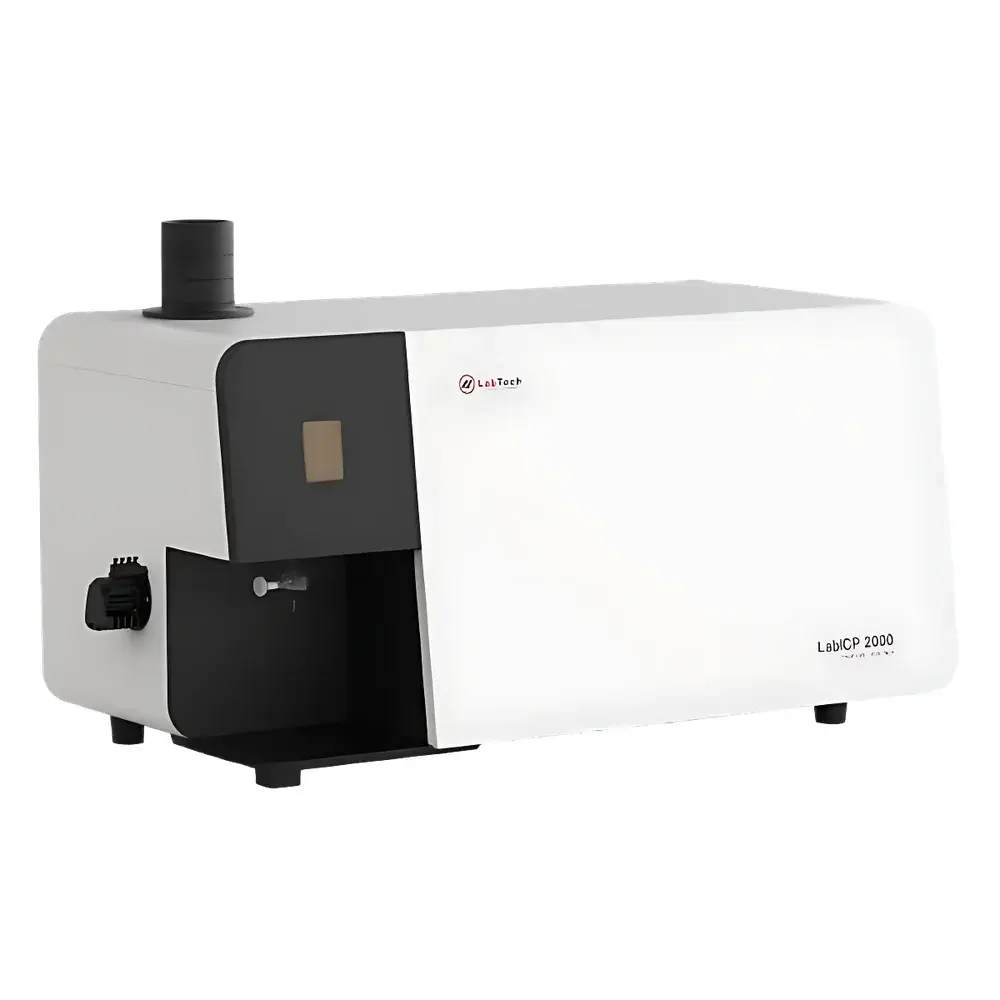
LabTech LabICP 2000 ICP-OES
| Brand | LabTech |
|---|---|
| Origin | Beijing, China |
| Manufacturer Type | Manufacturer |
| Regional Category | Domestic (China) |
| Model | LabICP 2000 ICP-OES |
| Instrument Type | Full-Spectrum Simultaneous ICP-OES |
| Optical Design | Prism + High-Resolution Echelle Grating Two-Dimensional Cross-Dispersed System |
| Detector | Megapixel Large-Area CCD |
| Plasma Orientation | Vertical Torch |
| Observation Modes | Radial, Axial, Dual-View, and Attenuated Variants |
| Gas Control | Mass Flow Controllers (MFCs) for All Gases |
| Software | HiICP Platform with Real-Time & Offline Analysis Capabilities |
| Cooling | Thermoelectrically Cooled CCD with MPS Thermal Isolation Structure |
| Purge | Positive-Pressure Sealed Spectrometer Chamber with Independent Front-Optics Purge |
| RF Generator | Solid-State Crystal-Controlled RF Source with Real-Time Power Monitoring |
Overview
The LabTech LabICP 2000 is a full-spectrum simultaneous inductively coupled plasma optical emission spectrometer (ICP-OES) engineered for high-throughput, multi-element analysis across diverse sample matrices. It operates on the fundamental principle of atomic emission spectroscopy: liquid or digested samples are nebulized into an argon-supported, ~10,000 K vertical plasma torch, where elements are atomized, excited, and emit characteristic wavelengths upon relaxation. These emissions are resolved by a two-dimensional dispersion system—comprising a prism and a high-resolution echelle grating—enabling simultaneous detection of the entire UV–visible spectral range (165–900 nm) without mechanical scanning. This architecture eliminates sequential wavelength scanning delays and ensures consistent integration times across all analytes, supporting robust semi-quantitative screening and precise quantitative determination of major, minor, and trace elements (ppb to % w/w) in a single run.
Key Features
- Two-dimensional cross-dispersed optical system combining prism pre-dispersion and echelle grating for high spectral resolution and minimal overlap between adjacent lines.
- Vertical plasma torch configuration optimized for stability with complex matrices, including high-salt, organic solvent-based, and acidic digestates.
- Dual-view observation capability (radial, axial, and configurable attenuated modes) enables dynamic linear range extension—radial for high-concentration elements (e.g., Ca, Mg, Na), axial for ultra-trace detection (e.g., As, Cd, Pb), and dual-view for automated concentration-range switching within one measurement sequence.
- Solid-state, crystal-controlled RF generator delivering stable power output (< ±0.1% short-term stability) with real-time digital monitoring; designed to maintain plasma robustness under variable matrix loads without manual re-tuning.
- Thermoelectrically cooled megapixel CCD detector mounted via Multi-Pillar Structure (MPS) thermal isolation, minimizing heat transfer from the spectrometer chamber and reducing dark current—critical for achieving low instrumental detection limits (IDLs) in deep-UV regions.
- Positive-pressure sealed spectrometer chamber with independent front-optics purge path reduces argon consumption by up to 40% compared to conventional purged systems and accelerates stabilization time after startup.
Sample Compatibility & Compliance
The LabICP 2000 accommodates aqueous solutions, acid digests (HNO₃, HCl, HF), organic extracts (e.g., MIBK, xylene), and diluted biological fluids following standard EPA, ISO, and ASTM digestion protocols (e.g., EPA Method 200.7, ISO 11885, ASTM D5191). Its modular peristaltic pump, concentric glass nebulizer, and cyclonic spray chamber support direct analysis of low-viscosity samples; optional accessories include micro-flow nebulizers, desolvation systems, and laser ablation interfaces for solid sampling. The instrument meets essential regulatory design criteria for GLP and GMP environments: hardware-level audit trails in HiICP software, user-accessible calibration logs, electronic signature support, and compliance-ready reporting templates aligned with FDA 21 CFR Part 11 requirements for data integrity.
Software & Data Management
HiICP is a Windows-based analytical platform supporting both real-time acquisition and offline reprocessing. It provides intuitive workflow navigation for method development—including wavelength selection, background correction strategies (multi-point or polynomial), internal standardization, and matrix-matched or standard addition calibration. Quantitative results are traceable through hierarchical project folders containing raw spectra, processed integrals, QC metrics (RSD, recovery %, LOD/LOQ), and audit logs with timestamps and operator IDs. Export options include CSV, PDF, and XML formats compatible with LIMS integration. Batch processing, automated report generation, and customizable pass/fail criteria for QC samples further enhance laboratory efficiency.
Applications
The LabICP 2000 serves routine and research laboratories in environmental monitoring (soil leachates, wastewater, drinking water per ISO 17294-2), geochemical exploration (rock digests, ore concentrates), metallurgical QA/QC (alloy composition, slag analysis), pharmaceutical excipient testing (USP / elemental impurities), and food safety (heavy metals in cereals, infant formula, seafood). Its dual-view flexibility and robust plasma enable reliable analysis of challenging samples such as seawater (Na, K, Mg at high mg/L levels), hydrocarbon-rich petrochemical effluents, and high-TDS industrial brines—without dilution or matrix separation.
FAQ
What plasma observation modes does the LabICP 2000 support?
Radial, axial, dual-view, and their attenuated variants—configurable per element or group to optimize sensitivity and dynamic range.
Is the RF generator air-cooled or water-cooled?
It is air-cooled, utilizing a solid-state design with integrated thermal management for continuous operation without external chillers.
Does the system comply with FDA 21 CFR Part 11 requirements?
Yes—HiICP supports electronic signatures, audit trails, and role-based access control, enabling compliance in regulated pharmaceutical and clinical labs.
Can the instrument analyze solids directly?
Not natively; however, it is compatible with third-party laser ablation systems for direct solid sampling when interfaced via standardized ICP-OES communication protocols.
What is the typical warm-up time before stable operation?
Less than 15 minutes for plasma ignition and spectral stabilization, thanks to the sealed, positively pressurized optical chamber and rapid gas flow initialization.





