
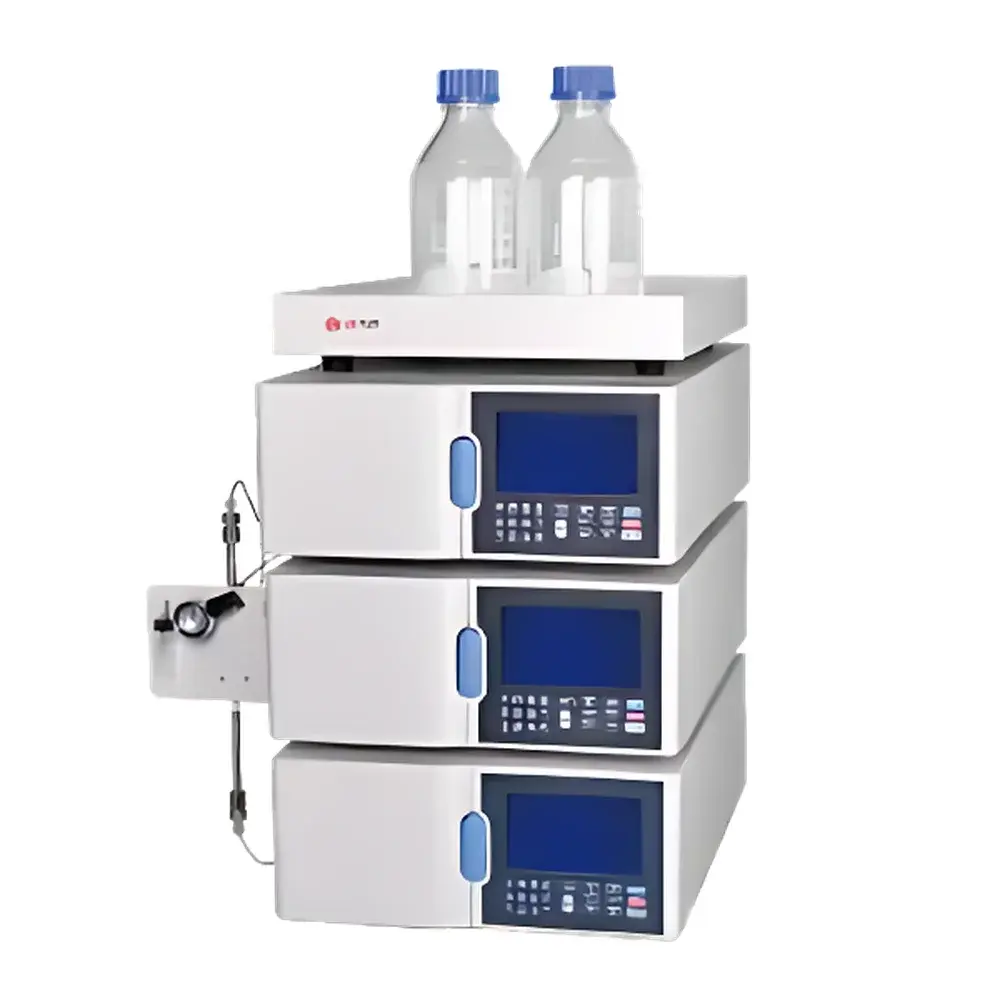
LabTech LC600 Binary High-Pressure Gradient Liquid Chromatography System
| Brand | LabTech |
|---|---|
| Origin | Beijing, China |
| Manufacturer Type | Original Equipment Manufacturer (OEM) |
| Instrument Type | Conventional High-Performance Liquid Chromatograph (HPLC) |
| Model | LC600 Binary High-Pressure Gradient HPLC System |
| Compliance | Designed for GLP/GMP-aligned laboratories |
| Software | PC-controlled with audit trail capability (21 CFR Part 11 compliant configuration available) |
Overview
The LabTech LC600 Binary High-Pressure Gradient Liquid Chromatography System is a robust, laboratory-grade HPLC platform engineered for reproducible separation, identification, and quantification of complex organic and inorganic mixtures. Built upon classical reversed-phase, normal-phase, and ion-exchange chromatographic principles, the LC600 employs high-pressure gradient elution—precisely mixing two mobile phase solvents at pressures up to 40 MPa (400 bar)—to achieve enhanced resolution and peak capacity across diverse sample matrices. Its architecture integrates a dual-piston series pump with cam-driven actuation, suspended piston guidance, and digital pulse dampening to minimize flow pulsation (<0.1% RSD), ensuring baseline stability critical for trace-level UV detection and method transfer consistency. The system is purpose-built for routine QC/QA workflows in regulated environments including pharmaceutical stability testing, raw material assay, food contaminant screening, and feed additive profiling.
Key Features
- Dual-plunger, cam-driven binary solvent delivery system with digital active pulse damping—achieving flow accuracy ±0.2% and precision <0.075% RSD at 1.0 mL/min
- Stepper motor micro-stepping control enabling smooth, low-vibration operation across flow rates from 0.001 to 9.999 mL/min
- High-integrity sapphire-coated pistons and chemically resistant PEEK/fluoroelastomer seals for extended service life under aggressive mobile phases (e.g., 0.1% TFA, 100% acetonitrile, pH 1.5–12)
- Integrated online pump wash module with programmable flush cycles—automatically purging residual buffer salts from piston seals to prevent crystallization-induced wear
- UV-Vis detector featuring a holographic flat-field grating, sine-bar wavelength drive mechanism, and quartz-coated optical path—delivering spectral reliability and long-term photometric stability
- Wavelength programming capability with up to 8 time-segmented steps per run, allowing dynamic optimization of detection sensitivity across multi-component elution profiles
- Automated fraction collector with XY-axis motion control, supporting six collection triggers: time-based, peak apex, threshold voltage, slope, UV absorbance window, and external TTL signal
Sample Compatibility & Compliance
The LC600 accommodates standard 3.9–4.6 mm ID analytical columns (up to 250 mm length) and is compatible with sub-2 µm particle-packed columns when operated within pressure limits. It supports common HPLC stationary phases—including C18, C8, phenyl-hexyl, HILIC, and mixed-mode resins—and tolerates mobile phases containing volatile buffers (ammonium formate/acetate), ion-pair reagents, and low-UV-cutoff solvents (e.g., THF, DCM). The system meets mechanical and electrical safety requirements per IEC 61010-1 and is configurable for compliance with ISO/IEC 17025, USP , ASTM D7217, and FDA 21 CFR Part 11 when deployed with validated software and electronic signature modules. Audit trail logging, user access controls, and method versioning are supported via optional LabTech ChromaControl™ software.
Software & Data Management
ChromaControl™ (v3.2+) provides full instrument control, sequence management, real-time chromatogram visualization, peak integration (with tangent skim, valley-to-valley, and exponential curve fitting), and report generation per GLP templates. Raw data files adhere to ANDI/NetCDF format for third-party processing (e.g., Empower, Chromeleon, OpenChrom). The software includes electronic signature enforcement, role-based permissions (Administrator, Analyst, Reviewer), and immutable audit trails recording all method edits, injection events, calibration actions, and report exports. Data integrity safeguards include automatic backup to network drives and SHA-256 hash verification for archived runs.
Applications
- Pharmaceutical: Assay of active pharmaceutical ingredients (APIs), related substances testing per ICH Q2(R2), dissolution profile analysis, and cleaning validation swab extract quantitation
- Food & Beverage: Detection of mycotoxins (aflatoxin B1, ochratoxin A), pesticide residues (organophosphates, neonicotinoids), preservatives (sorbates, benzoates), and nutritional markers (vitamins, amino acids)
- Agrochemical & Feed: Quantification of veterinary drug residues (tetracyclines, sulfonamides), coccidiostats, and mycotoxin co-contaminants in animal feed matrices
- Chemical Manufacturing: Impurity profiling of fine chemical intermediates, polymer additive analysis, and catalyst leaching studies
- Academic & Method Development Labs: Platform for gradient optimization, column selectivity screening, and coupling with preparative HPLC systems via synchronized fraction collection
FAQ
What is the maximum operating pressure of the LC600 binary pump?
The system is rated for continuous operation up to 40 MPa (400 bar), with pressure sensing and automatic shutdown at 42 MPa for hardware protection.
Does the UV-Vis detector support diode array functionality?
No—the LC600 UV-Vis detector is a single-wavelength or programmable fixed-wavelength unit; it does not incorporate a photodiode array (PDA) or spectral acquisition capability.
Can the system be integrated into a LIMS environment?
Yes—via OPC UA or ASCII file export protocols, ChromaControl™ supports structured data output (CSV, XML) compatible with major LIMS platforms for automated result ingestion and workflow handoff.
Is gradient delay volume characterized and compensatable?
Yes—the system’s dwell volume is factory-measured (typically 1.2–1.5 mL depending on configuration) and can be entered into method parameters to align gradient timing during method transfer.
What maintenance intervals are recommended for pump seals and check valves?
Under typical aqueous/organic usage, piston seals require replacement every 6–12 months; inlet/outlet check valves are inspected quarterly and replaced annually or after 5000 injections, whichever occurs first.
Related Products




