
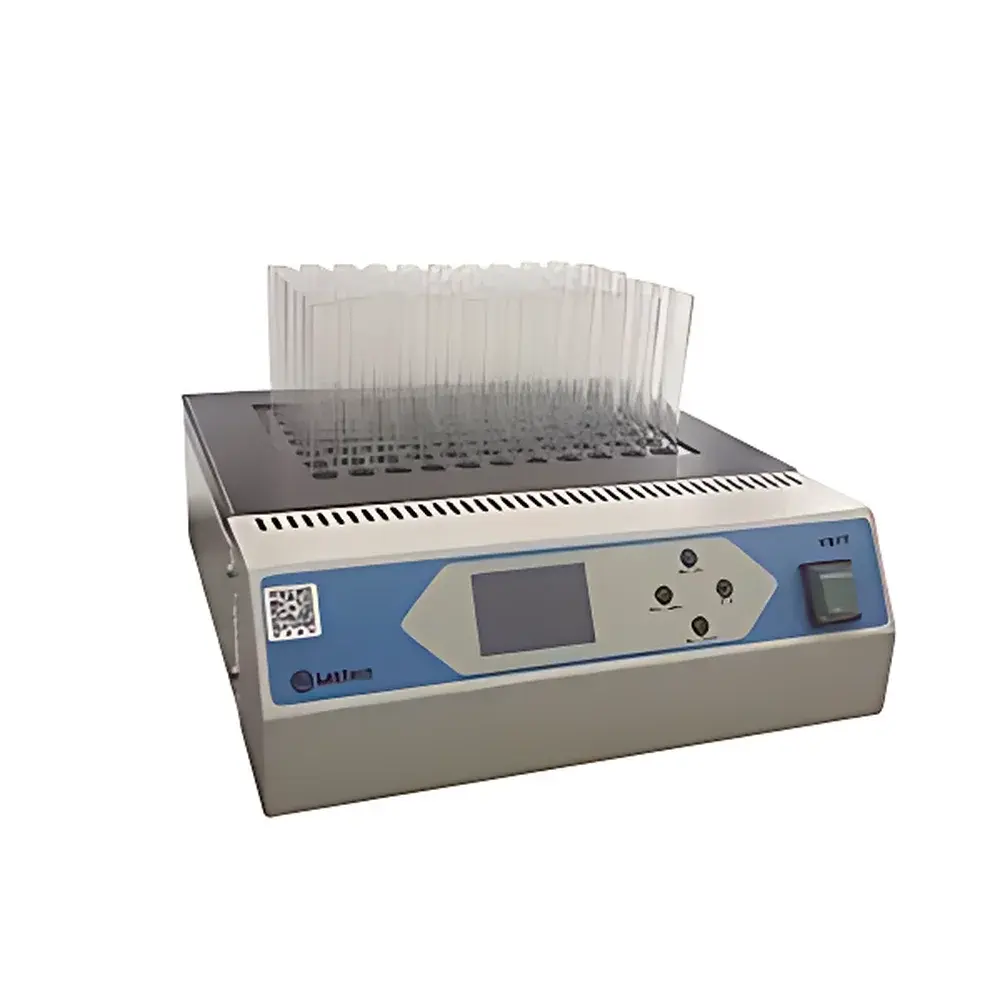
LabTech VB77 Urine Iodine Digestion System
| Brand | LabTech |
|---|---|
| Origin | Beijing, China |
| Manufacturer Type | Direct Manufacturer |
| Instrument Type | Electric Heating Digestion System |
| Automation Level | Semi-Automatic |
| Sample Capacity | 77 positions (16 mm test tubes) |
| Heating Method | Surround-Type Uniform Heating |
| Temperature Control | Intelligent PID Algorithm |
| Temperature Uniformity | ≤ ±1 °C between wells at 100 °C |
| Applicable Standards | Designed for WHO/US CDC-recommended urine iodine digestion protocols (alkaline persulfate digestion) |
| Tube Compatibility | 16 mm OD borosilicate or quartz digestion tubes |
Overview
The LabTech VB77 Urine Iodine Digestion System is an engineered solution specifically developed to meet the stringent sample preparation requirements of urinary iodine quantification in occupational health, public health surveillance, and clinical laboratories. It implements a controlled alkaline persulfate digestion protocol—aligned with WHO/US CDC and GB/T 13025.7–2012 methodologies—to oxidize organic iodine compounds into inorganic iodide prior to colorimetric or instrumental analysis (e.g., arsenic cerium catalytic spectrophotometry or ICP-MS). Unlike generic hot blocks or microwave digesters, the VB77 integrates purpose-built thermal architecture optimized for low-volume (0.5–1.0 mL), high-throughput urine matrix digestion. Its core design centers on reproducible thermal delivery: a surround-type heating mantle envelops each digestion well, minimizing radial thermal gradients and eliminating cold spots common in top-heated or conduction-only systems.
Key Features
- 77-position digestion capacity using standardized 16 mm outer-diameter digestion tubes—enabling full batch processing of epidemiological survey samples without manual repositioning or staging.
- Intelligent PID temperature control with real-time feedback loop, delivering stable setpoint maintenance across the operational range (room temperature to 150 °C) with ≤ ±1 °C inter-well uniformity at 100 °C—a critical threshold for consistent persulfate decomposition kinetics.
- Semi-automatic operation mode: programmable time-temperature profiles (up to 999 minutes per step), automatic power cutoff upon cycle completion, and audible/visual end-of-cycle notification—reducing operator dependency while preserving method flexibility.
- Corrosion-resistant aluminum alloy heating block with ceramic-coated surface and integrated thermal insulation—designed for long-term exposure to alkaline persulfate reagents and repeated thermal cycling.
- Dedicated safety architecture: over-temperature protection, dry-run detection, and grounded chassis compliance with IEC 61010-1 for laboratory electrical safety.
Sample Compatibility & Compliance
The VB77 accommodates standard 16 mm OD borosilicate or quartz digestion tubes (e.g., Kimble Chase 9820-16 or equivalent), compatible with both open-vessel alkaline persulfate digestion and alternative COD digestion applications per ISO 6060 and EPA 410.4. It supports sample volumes from 0.5 mL to 2.0 mL and tolerates reagent concentrations up to 1% (w/v) potassium persulfate in 0.1 M NaOH. The system is validated for use in GLP-compliant environments: temperature logs are timestamped and exportable (via optional RS232/USB interface), supporting audit readiness under ISO/IEC 17025 and FDA 21 CFR Part 11 when paired with compliant data management software.
Software & Data Management
While the VB77 operates via front-panel keypad and LCD interface, optional LabTech DigControl™ PC software enables remote parameter setting, real-time temperature monitoring, and automated log export in CSV format. All temperature setpoints, ramp rates, hold times, and actual measured values per well (averaged across three internal thermocouple zones) are recorded with millisecond timestamp resolution. Audit trails include operator ID entry (via configurable login), method version tagging, and electronic signature support—facilitating traceability in regulated workflows including national iodine deficiency disorder (IDD) monitoring programs.
Applications
- Urinary iodine concentration determination in population-based nutrition surveys and occupational exposure assessments.
- Pre-analytical sample conditioning for downstream detection by UV-Vis spectrophotometry (Sandell–Kolthoff reaction), IC, or ICP-MS.
- Method-validated digestion of urine matrices containing creatinine, urea, and organic acids without charring or iodine volatilization loss.
- Secondary utility in environmental and wastewater labs for COD digestion per Standard Methods 5220 D.
- Research-scale method development for halogen-speciation workflows requiring precise thermal control below 120 °C.
FAQ
What digestion protocols is the VB77 validated for?
The VB77 is factory-validated for the alkaline persulfate digestion method specified in WHO/US CDC “Laboratory Manual for the Assessment of Iodine Deficiency Disorders” and Chinese national standard GB/T 13025.7–2012.
Can the VB77 be used for microwave-incompatible methods?
Yes—it is designed exclusively for conductive/surround-heating open-vessel digestion; no microwave cavity or pressurized vessels are involved.
Is temperature calibration traceable to NIST standards?
Each unit ships with a Certificate of Calibration referencing NIST-traceable reference thermometers (±0.3 °C accuracy); field recalibration kits and procedures are available upon request.
Does the system support LIMS integration?
Via optional DigControl™ software and RS232/USB, raw temperature logs and run metadata can be exported in structured CSV for ingestion into LIMS or ELN platforms.
What maintenance is required for sustained accuracy?
Annual verification of inter-well uniformity and setpoint deviation is recommended; cleaning of the heating block surface with ethanol and lint-free wipes after each use ensures thermal contact integrity.
Related Products



